Freezing winter sleet, torrential downpours, or extreme summer humidity frequently force pet parents to stay inside. Active working dogs and young companion breeds do not simply power down when the front door stays shut. Without an outlet for natural drives, high-drive shepherds and terriers pace across rugs, chew baseboards, and bark at small outside noises. Pet owners in online canine forums often ask how to tire out a dog indoors safely without destroying the living room. Standard outdoor fetch cannot be replicated indoors, making structured mental enrichment essential.
Letting your pet sprint at top speed across slippery floorboards creates immediate orthopedic risks. Quick turns on smooth hardwood or laminate flooring cause torn dewclaws, patellar slips, and severe cruciate ligament sprains. Uncontrolled indoor sprinting also raises neurological excitement. Your pet ends up panting with elevated heart rates while remaining mentally wired.
A more dependable plan combines controlled mechanical retrieval with quiet scent searching. Ten minutes of measured physical retrieval relieves physical restlessness. Following that with ten minutes of dedicated nosework taps into canine olfactory biology to steady heart rates and produce sound physical relaxation.
Canine Olfactory Biology: Why Scent Work Exhausts Dogs Faster Than Running
Look into canine sensory anatomy to see why sniffing drains energy faster than running. Domestic dogs have roughly 200 million to 300 million olfactory receptors in their nasal cavities. Humans possess only about 6 million. The olfactory bulb inside a canine brain takes up forty times more proportional volume than the human equivalent.
Sniffing demands heavy cognitive processing power. Each inhalation directs scent particles through internal bony turbinates that sift chemical compounds. Just above the hard palate sits the vomeronasal organ, which analyzes intricate pheromones and biological markers. Sorting through these dense scent layers requires genuine mental exertion and steady glucose consumption.
Olfactory stimulation directly influences the autonomic nervous system. Chasing a bouncing ball sparks the sympathetic system, spiking blood pressure and elevating stress hormones. Methodical scent work activates the parasympathetic branch. It lowers resting pulse rates, slows respiration, and prompts steady dopamine production. Ten minutes of focused sniffing tires an energetic dog more effectively than thirty minutes of indoor running.
The Neurological Mechanics of Parasympathetic Activation via Scent Tracking
Canine brain scans show direct neural circuits linking the olfactory cortex to the limbic system. Unlike auditory or visual cues that first travel through the thalamus, scent molecules travel straight into memory and emotional control centers. This direct neural pathway explains why scent games transform a dog’s emotional state so rapidly.
During the search phase, the dog’s brain produces dopamine as it anticipates finding food. When the dog locates and extracts each reward, dopamine levels stabilize while serotonin and endorphin release begins. This neurochemical transition replaces frantic hunting behavior with peaceful satisfaction. In contrast, repetitive ball throwing floods the bloodstream with adrenaline without providing mental closure. Dogs subjected to repetitive sprinting remain jumpy, while dogs given systematic sniffing tasks show drops in breathing rates within five minutes of finishing.
The Risks of High-Impact Indoor Play on Slick Floors
Indoor exercise requires attentive setup of your home environment. Typical residential floors present hazards for running canines. Polyurethane hardwood, glazed tile, and vinyl planks provide virtually no claw grip.
When a canine chases a rolling ball across smooth floors, braking forces concentrate on the front limbs. Front paws skid forward, placing severe torque on the carpal joints and stifle ligaments. Over time, regular sliding causes micro-tears in soft tissues, worsens hip dysplasia, and quickens early arthritis.
Running into heavy furniture presents another danger. A dog tracking an errant throw can hit door frames, baseboards, or glass coffee tables. Setting up low-velocity games on slip-resistant rugs shields canine joints and keeps indoor play safe.
Comparative Breakdown: Physical Sprints vs Olfactory Problem Solving
Comparing physical sprinting to mental foraging highlights why structured enrichment works best on bad weather days.
|:---|:---|:---|:---| | Evaluation Criteria | High-Velocity Hallway Sprints | Controlled Gravity Retrieval | Dense Fleece Snuffle Mat Foraging | | Joint Impact Level | High risk of ligament strains and slip injuries | Low impact with controlled linear movement | Zero impact with stationary posture | | Autonomic Nervous System | Sympathetic arousal with elevated adrenaline | Moderate sympathetic with impulse control | Parasympathetic activation with lowered pulse | | Post-Activity Settle Time | 45 to 90 minutes of residual agitation | 15 to 20 minutes of gradual calming | 5 to 10 minutes before deep recumbent rest | | Cognitive Fatigue Factor | Minimal mental processing involved | Moderate focus on release cues and return | Intense olfactory processing across 300 million cells |
Structured Physical Retrieval with the Orange Ball Return Station
Indoor fetch needs strict rules so dogs stay safe and focused. Launching rubber balls down long corridors produces erratic ricochets and sliding stops. A stationary fetch station keeps movement predictable.
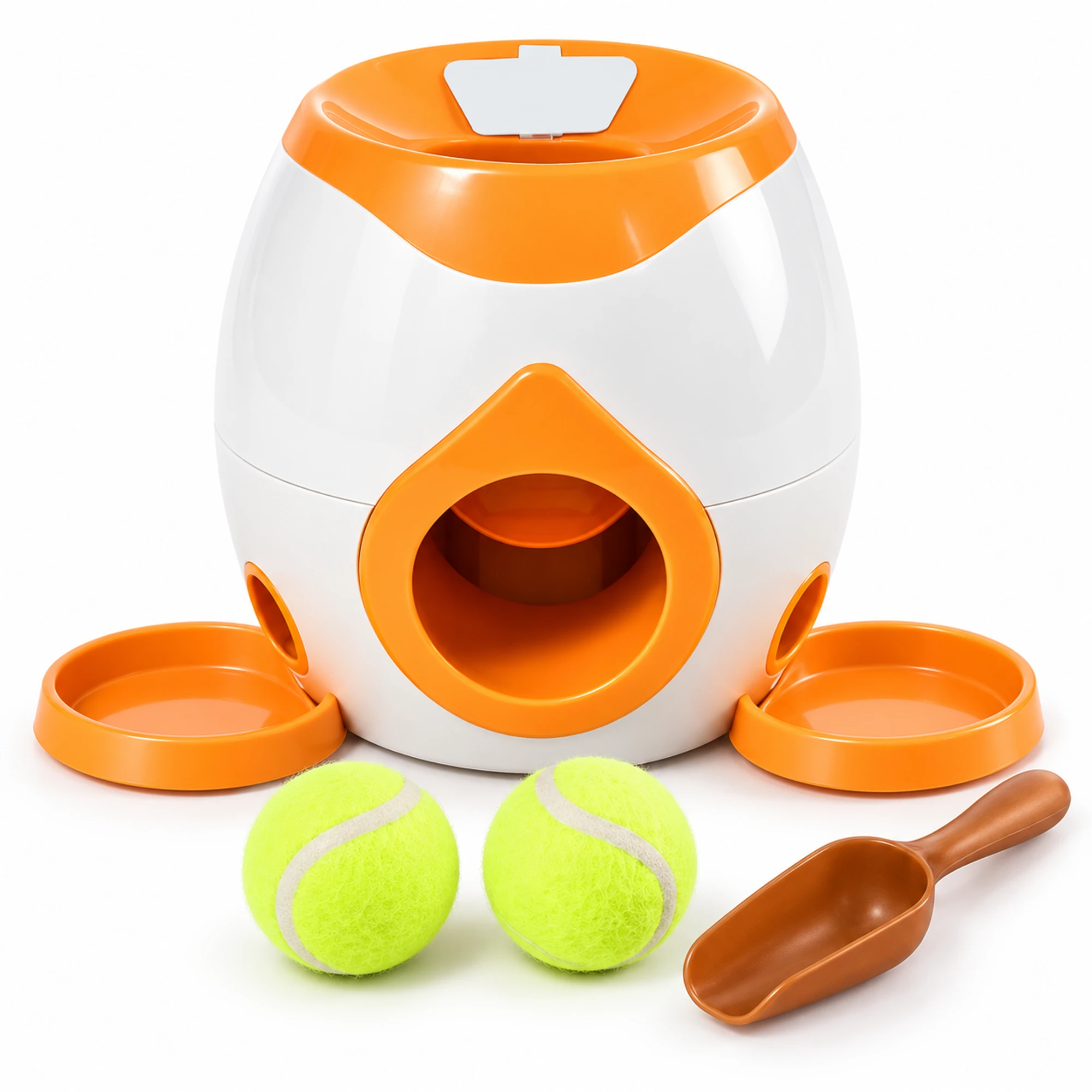
The Orange Ball Return and Reward Station uses pure gravity instead of electric motors to manage play. Owners place a standard tennis ball into the upper orange bowl. The ball rolls down through the front lower exit. Two side treat compartments hold dry biscuits. Because this station operates quietly without electric hums, sound-sensitive pets stay comfortable.
Follow these steps for a productive indoor session:
- Place the base unit at one end of a textured carpet or runner rug.
- Fill both side food bowls with small, crunchy training treats.
- Put your dog in a calm sit-stay six to eight feet away.
- Drop the tennis ball into the upper bowl and give your release cue like “fetch” or “take it”.
- The ball rolls out through the front opening. Your dog collects the ball and delivers it back to your hand.
- Reward the return with praise and a dry biscuit from a side dish.
This steady routine satisfies retrieval drive while building impulse control before each roll. Repeating the sequence for eight to ten minutes provides muscular conditioning without erratic collisions against walls.
Calming Olfactory Fatigue with the Ruffle Flower Snuffle Mat
Once controlled fetch relieves excess muscular tension, continuing with chase games can cause overstimulation. High-drive dogs settle best when transitioned into quiet scent searching.
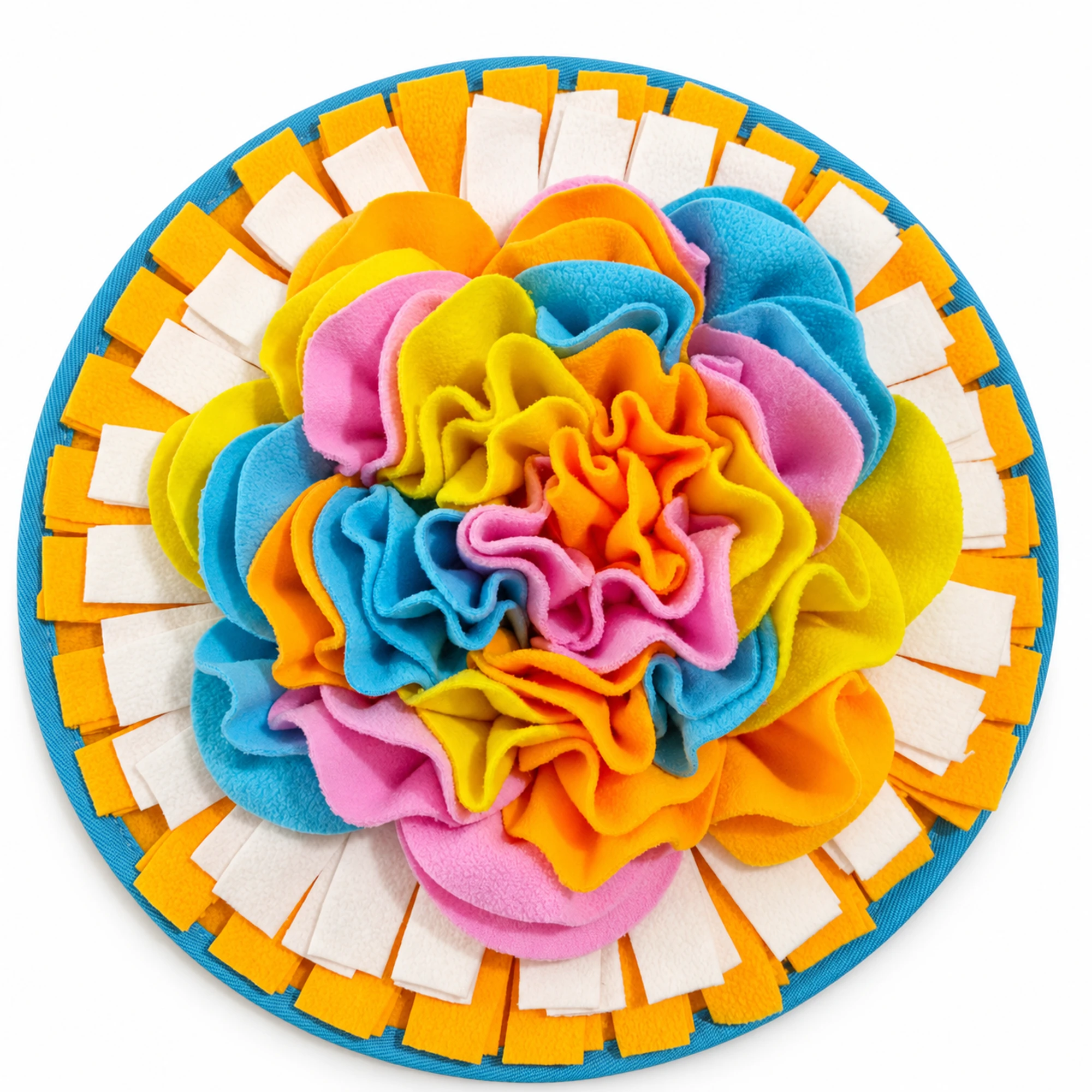
A round fleece snuffle mat incorporates layered fabric petals and circular fringe borders. Pet parents tuck dry kibble or small dehydrated treats between the fabric layers. To reach the food, the dog must drop its head, slow its movement, and sniff methodically.
Follow these steps for an effective foraging session:
- Lay the snuffle mat flat on the floor while keeping your dog in a sit.
- Open the fabric ruffles and place small pieces of dry food deep inside the inner folds and outer fringe.
- Release your dog with a gentle cue such as “search” or “find it”.
- Let your pet work through each fabric pocket at its own speed. Avoid pointing out treats or rushing the dog.
- When your dog finishes finding every piece of food, lift the mat and put it away out of reach.
Searching through dense fleece ruffles for eight to ten minutes delivers solid cognitive exertion. Dogs typically drink some water and lie down for a quiet nap after finishing their nosework session.
Breed-Specific Indoor Enrichment Adaptations
Different breeds show distinct play preferences, motor instincts, and fatigue limits. Tailoring indoor routines to canine breed heritage maximizes enrichment benefits while preventing behavioral frustration.
Herding dogs such as Border Collies, Australian Shepherds, and Shetland Sheepdogs value clear rules and impulse control. When using the Orange Ball Return Station, add a three-second down-stay before releasing the dog to grab the rolling ball. For scent work, tuck treats deep into the inner ruffles to challenge their analytical problem-solving skills.
Hound dogs such as Beagles, Basset Hounds, and Dachshunds possess deep scenting stamina. For these trailing specialists, cut physical fetch to five minutes and lengthen snuffle mat foraging to fifteen minutes. Break treats into tiny crumbs to encourage detailed scent tracking instead of quick visual spotting.
Terriers and sporting retrievers show intense prey drive and grabbing habits. Pair retrieval games with reliable drop commands to prevent possessive guarding. Watch snuffle mat sessions closely to stop energetic terriers from shaking the fabric mat like caught prey.
A Balanced 20-Minute Indoor Enrichment Routine
Pairing controlled physical retrieval with deep scent foraging forms an effective daily indoor program.
|:---|:---|:---|:---| | Phase | Duration | Activity | Physiological Outcome | | Phase 1: Controlled Motor Retrieval | 8 Minutes | Orange Ball Return Station | Burns muscular energy and reinforces impulse control on carpeted surfaces | | Phase 2: Calming Reset | 2 Minutes | Water Break and Sit-Stay | Lowers heart rate and resets focus before cognitive challenges | | Phase 3: Olfactory Foraging | 10 Minutes | Ruffle Flower Snuffle Mat | Engages olfactory processing and stimulates parasympathetic relaxation |
This three-stage routine takes twenty minutes, needs only a small corner of your living room, and calms restless dogs during stormy days.
Indoor Play Safety Protocols
Keep indoor enrichment sessions safe by using standard practical guidelines:
- Check the play space beforehand and move power cables, glassware, and unstable furniture out of reach.
- Always place non-slip rugs under the play zone to protect paws from smooth floor slips.
- Supervise all snuffle mat sessions directly. Fleece mats serve as foraging puzzles, not chew items.
- Use only dry, crunchy treats in fabric mats to keep the fleece clean and free of moisture buildup.
- Clean fleece mats periodically in warm water on a gentle cycle to remove saliva and dirt.
Common Questions About Exercising Dogs Indoors
Can indoor enrichment games replace daily outdoor walks permanently?
Indoor activities burn physical and mental energy during severe storms, but outdoor potty breaks and neighborhood sniffing remain important for overall health. Short elimination trips combined with twenty minutes of indoor enrichment keep dogs balanced during bad weather.
Why does sniffing tire an active dog faster than running?
Olfactory exploration requires substantial computational effort from the canine brain. Ten minutes of focused sniffing challenges neural pathways, reduces stress hormones, and promotes natural relaxation without stressing canine joints.
How do you prevent a dog from chewing the fleece snuffle mat?
Supervise every foraging session from start to finish. Once your dog finds all the treats, pick up the mat and store it inside a closed cupboard. If your dog begins gnawing or shaking the fabric edges, calmly redirect its attention and offer a suitable rubber chew toy instead.