If your hallway closet is a graveyard of abandoned cat toys, you are far from alone. Feline guardians often purchase neon balls expecting frantic sprints across the living room, only to watch their cat sniff the sphere once and wander away. Other times, a kitten goes wild over a simple felt ball for forty-eight hours before batting it under the refrigerator forever.
The truth is that cats never view ball toys as generic playthings. To an indoor feline, a rolling sphere represents fleeing quarry. Depending on whether your companion prefers stalking mice, swatting low-flying moths, or ambushing lizards, their ideal ball toy demands a specific weight, texture, acoustic profile, and movement pattern. Understanding what triggers your cat’s hunting drive helps you select playthings they will genuinely chase instead of wasting money on neglected plastic trinkets.
Why Cats Play with Balls: Understanding the Prey Drive
Cats never treat play as mindless recreation. Every swat, stalk, and sudden sprint expresses an ancient predatory hunting sequence: search, stalk, rush, pounce, capture, and bite. When a sphere rolls across hardwood, its momentum simulates an escaping creature attempting to flee.
However, different balls simulate different types of prey:
- Erratic movement simulates fleeing insects: Lightweight spheres that bounce or change direction mimic grasshoppers or beetles skittering along floorboards.
- Auditory feedback mimics hidden prey: Rattle or crinkle sounds simulate rodents rustling through dried grass or autumn leaves.
- Mouth-feel mimics capture success: Soft wool, felt, or pliable rubber gives satisfying tactile resistance when a cat sinks their claws and teeth into the prize.
When a cat ignores a toy, it usually means the ball fails to trigger that specific animal’s sensory threshold. A cat motivated primarily by rapid visual motion may ignore a stationary plush ball, while a noise-sensitive feline might retreat from a loud metallic bell or buzzing motor.
Comparing the Four Main Cat Ball Types
To choose the right option, it helps to break down the primary categories of cat ball toys available today.
1. Plush, Wool, and Felt Balls: For Silent Stalkers
Wool and felt balls remain beloved staples for cats that hunt silently. Crafted from compressed wool fibers, faux fur, or soft fleece, these lightweight spheres excel because a cat can easily scoop them up in their teeth and trot from room to room with their prize.
- Movement physics: Low roll distance on carpet, moderate glide on hardwood. They do not bounce high, which suits ground stalkers.
- Sound level: Completely silent during play.
- Best for: Cats that enjoy quiet nighttime play, carrying objects in their jaws, or batting toys into water dishes.
- Drawbacks: They accumulate dust, cat hair, and carpet lint quickly, and they frequently disappear under low-clearance furniture.
2. Hard Plastic Rattle and Bell Balls: For Audio-Motivated Hunters
Classic lattice spheres housing small beads or bells provide immediate audio feedback. When swatted across laminate or hardwood, they rattle sharply with every millimeter of travel.
- Movement physics: Fast and skittering on tile or laminate floors, but sluggish on thick area rugs.
- Sound level: Loud and continuous while rolling.
- Best for: Kittens and young cats with high curiosity who rely on acoustic cues to locate moving objects.
- Drawbacks: The persistent chiming can disrupt human sleep during late-night play sessions. Furthermore, timid or skittish cats often feel intimidated by the sharp metallic rattling.
3. High-Bounce Rubber and Foam Balls: For High-Energy Sprinters
High-density sponge balls and vulcanized rubber spheres offer intense kinetic rebound. Dropped from armchair height, they ricochet off baseboards and cabinet kickboards at unpredictable trajectories.
- Movement physics: High velocity and chaotic rebound angles that reward fast reflexes.
- Sound level: Muffled thuds on hard floors.
- Best for: Athletic cats, solo sprinters, and active breeds like Bengals, Abyssinians, and Siamese.
- Drawbacks: Fast rebounds can startle timid seniors, and soft foam balls can occasionally be chewed if your cat exhibits pica tendencies. Always verify material density before purchase.
4. Motorized and Self-Rolling Balls: For Independent Chasers
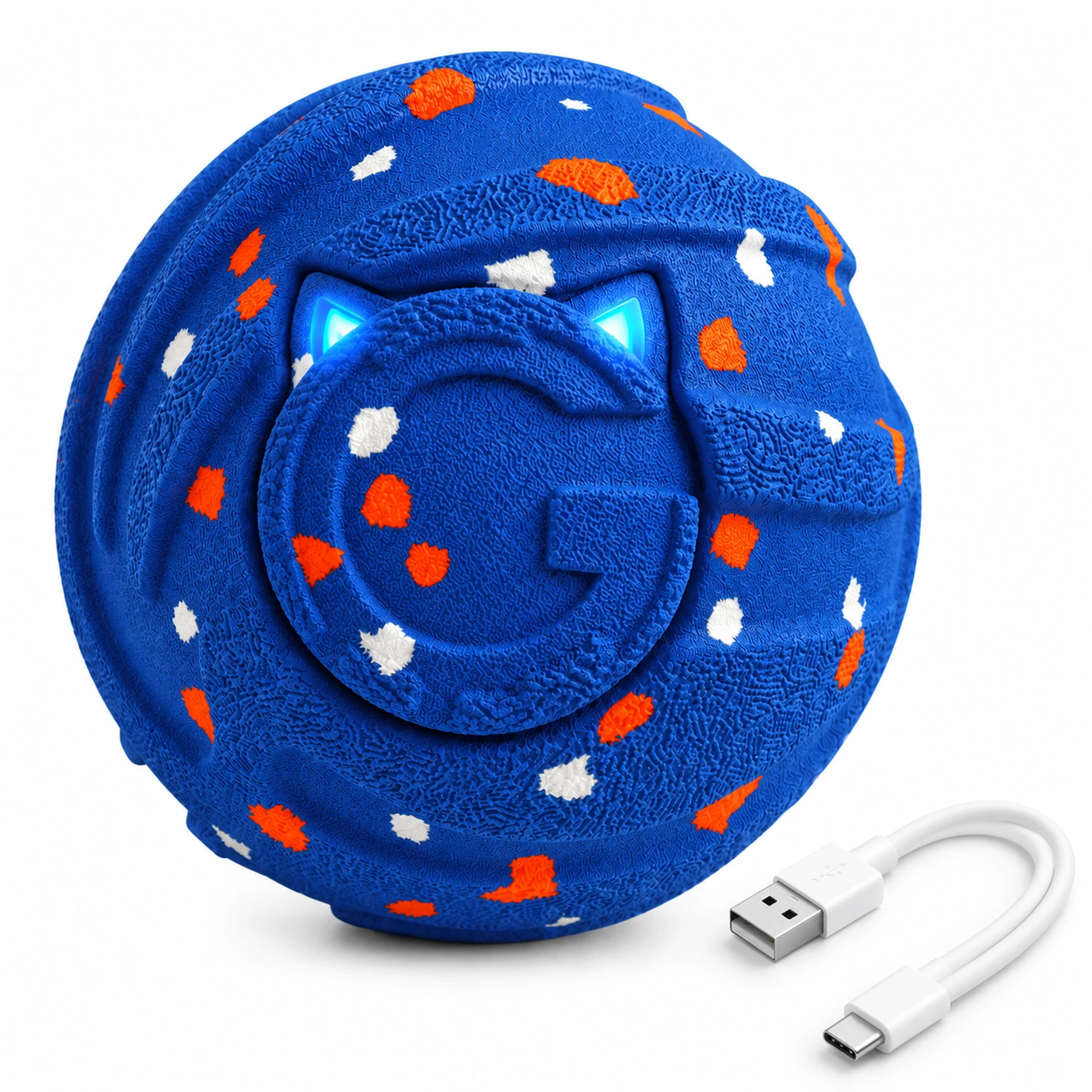
When pet parents are away at work, static toys quickly lose novelty because motionless prey rarely holds feline attention. An interactive cat ball solves this dilemma by using internal weighted motors and sensors to roll autonomously across smooth floors. Choosing a durable rolling cat toy ensures prolonged engagement without mechanical stalls. A motorized cat ball provides continuous, erratic stimulation during solo play sessions.
A prime example is the Deep Blue Cat Ear Textured Pet Ball. Its exterior casing is crafted from resilient ETPU foam rubber with orange and white flecks and curved channels across its surface. The textured ETPU shell gives paws and claws secure traction during mid-roll swats, while the internal motor creates unpredictable direction changes that prevent boredom.
- Movement physics: Autonomous, variable-speed rolling with obstacle avoidance.
- Sound level: Low mechanical hum.
- Best for: High-drive cats home alone during the workday, solo play sessions, and cats that demand interactive stimulation without needing an owner to throw toys constantly.
- Drawbacks: Motorized toys perform best on flat, smooth flooring such as hardwood, tile, or laminate, and may struggle on plush, high-pile carpeting.
Matching Ball Toys to Your Cat’s Personality
Every cat possesses a unique play personality. Here is how to match your cat’s behavioral profile to the ideal ball style:
| Cat Personality | Observed Behavior | Recommended Ball Type | Why It Works |
|---|---|---|---|
| The Ambusher | Hides behind table legs, stalks silently, prefers carrying toys to a safe stash | Wool or Felt Balls | Soft texture allows silent stalking and carrying in mouth |
| The Solo Sprinter | Races down hallways, ricochets off doorframes, thrives on speed | High-Bounce Rubber | Fast rebound angles satisfy intense chase stamina |
| The Curious Investigator | Tilts head at chirps, investigates rustling bags, visually tracks sounds | Rattle or Bell Balls | Audio feedback confirms prey location and direction |
| The Energetic Solo Player | Gets bored quickly when toys stop moving, demands continuous action | Motorized Self-Rolling Ball | Automatic motion sustains chase drive while owner is occupied |
| The Senior or Timid Cat | Reluctant to run, easily startled by loud noises or sudden moves | Lightweight Crinkle or Soft Foam | Gentle roll with minimal impact and zero intimidating noise |
Preventing Ball Loss and Safe Indoor Play
Even the most engaging cat ball toy is useless if it spends twenty-three hours a day trapped beneath your sofa. Feline owners regularly find dozen-ball caches during seasonal cleaning. Here are practical ways to maintain safe, uninterrupted indoor play:
- Install low-clearance blockers: Clear acrylic toy guards or foam under-couch blockers keep fast-moving spheres from rolling into dusty voids.
- Use enclosed tracks or cardboard arenas: Placing a rolling ball inside a shallow cardboard box or a wide plastic laundry basket creates a fun, contained arena where cats can swat without losing the toy across the room.
- Inspect toy integrity regularly: Discard any plastic balls with cracked seams or loose bells that could present a choking hazard. For textured rubber or motorized toys, wipe the exterior clean periodically to remove dust and hair buildup around moving joints.
- Practice toy rotation: Keep only two or three balls accessible at any time. Store the rest in a sealed container infused with dried catnip or silvervine. Swapping the selection every Sunday morning reignites instant hunting interest.
Frequently Asked Questions
Why does my cat ignore ball toys after five minutes?
Cats are evolutionarily wired to conserve energy for successful hunts. A static ball that comes to rest no longer behaves like living prey. To keep your cat engaged, introduce toys with unpredictable movement patterns, use interactive play sessions, or rotate toys weekly so the textures and scents remain novel.
Are motorized rolling balls safe for kittens and timid cats?
Yes, provided they are introduced with care. When introducing a motorized rolling ball to a hesitant cat, place it on a slow setting and allow your cat to observe from a safe perch or cat tree. Once they realize the object is harmless and fun to chase, their hunting instincts will take over naturally.