Key Takeaways
- Cats that appear indifferent to toys often experience sensory intimidation rather than a lack of hunting instinct.
- Moving toys directly toward a feline triggers defensive retreat instead of predatory pursuit because natural prey always flees.
- Covered hideaways like collapsible tunnels give timid cats psychological security to stalk without feeling exposed.
- Floor-level micro-movements with flexible feather wands awaken stalking reflexes far more effectively than frantic aerial flailing.
- Anchored suction toys allow nervous cats to initiate self-paced batting without feeling pressured by human physical presence.
- Concluding every interactive play session with a tangible capture and a protein treat satisfies the natural predatory feeding sequence.
Many cat guardians spend good money on bright balls, motorized mice, and feathered wands, only to watch their feline companion sniff the toy once and wander away. That calm indifference often convinces owners their pet is simply lazy, stubborn, or impossible to entertain with toys. Guardians searching for how to get a lazy cat to play often discover that true play disinterest is remarkably rare. In domestic felines, play is the direct behavioural expression of predatory hunting. When a cat refuses standard toys, the issue rarely lies in the animal itself. Instead, the problem almost always stems from human play mechanics that accidentally trigger caution, confusion, or sensory fatigue.
Re-engaging a reluctant cat requires understanding how domestic predators perceive their environment. A human towering over a five-kilo cat while aggressively shaking a plastic wand registers as an intimidating predator rather than an enticing hunting opportunity. Furthermore, natural prey never charges into a cat face; it creeps along baseboards, hides behind corners, and scrambles away. By adopting low-arousal play techniques, incorporating covered ambush tunnels, using flexible ground-skimming wands, and finishing each game with a rewarding meal, you can awaken the dormant hunter inside even the most hesitant feline.
Why Some Cats Refuse to Play: The Science of Predatory Arousal
When caring for a cat not interested in toys, ruling out underlying physical discomfort is the essential first step. A cat that stops playing abruptly or avoids jumping may suffer from dental inflammation, early arthritis in the spine or hips, or low-grade systemic illness. Because felines instinctively mask pain to avoid vulnerability, physical discomfort often manifests as quiet withdrawal rather than vocal complaints. If your veterinarian confirms your pet is in good health, their reluctance to engage with toys is entirely behavioural.
The most frequent human play mistake is overstimulation through excessive speed and spatial exposure. Humans naturally associate play with high-energy chasing and acrobatic leaps. For a bold, hyperactive kitten, erratic aerial swinging can be exciting. For a shy, sensitive, or senior adult cat, that same frantic movement produces sensory overload. When an object whips through the air with loud rushing noises, a cautious cat enters a defensive freeze state. Their pupils dilate, their muscles tense, and they choose retreat over pursuit.
Predatory arousal in cats develops in distinct stages: detect, stare, stalk, pounce, capture, and consume. Standard living room play often forces cats to jump straight from sleeping to pouncing, completely skipping the essential stare and stalk phases. When you observe your cat watching a toy motionless from across the room with twitching ears, they are not ignoring the item. They are engaged in the mental calculation phase of the hunt. Rushing that process or shoving the lure closer breaks their predatory concentration and terminates the game.
| Play Parameter | High-Arousal Flailing (Ineffective) | Low-Pressure Hunting (Effective) | Feline Behavioral Response |
|---|---|---|---|
| Movement Direction | Waved toward cat face | Crawled away into corners | Mimics authentic fleeing prey; triggers stalking |
| Spatial Positioning | Center of open living room | Baseboards, tunnels, rugs | Eliminates exposure anxiety and vulnerability |
| Lure Elevation | Swung high in the air | Skimmed along floorboards | Matches ground-dwelling rodents and insects |
| Sound Profile | Loud rattling and shouting | Subtle metallic bell chimes | Maintains auditory curiosity without fear |
| Session Duration | 20 to 30 continuous minutes | 5 to 10 focused minutes | Prevents mental fatigue and sensory burnout |
The Ambush Advantage: Creating Security with Play Tunnels
Wild feline hunters depend heavily on cover to stalk prey without giving away their location. In a typical modern home, wide living room rugs and polished hardwood floors offer zero concealment. For a nervous or rescue cat, stepping out into an open floor plan to chase a toy feels dangerously exposed. They worry about potential threats approaching from behind, which suppresses their hunting focus.
Providing structured cover instantly alters this dynamic by offering a secure perimeter base. According to JoyPetPlay merchant catalog listings, the Small Colour-Block Straight Cat Tunnel features a red entrance ring, yellow middle, and blue end ring with green edging, hanging entrance pink bell ball and red pompom, and a supplier-listed net weight of 93 g. This lightweight collapsible cat tunnel gives timid felines an enclosed observation post where their back and flanks remain shielded.
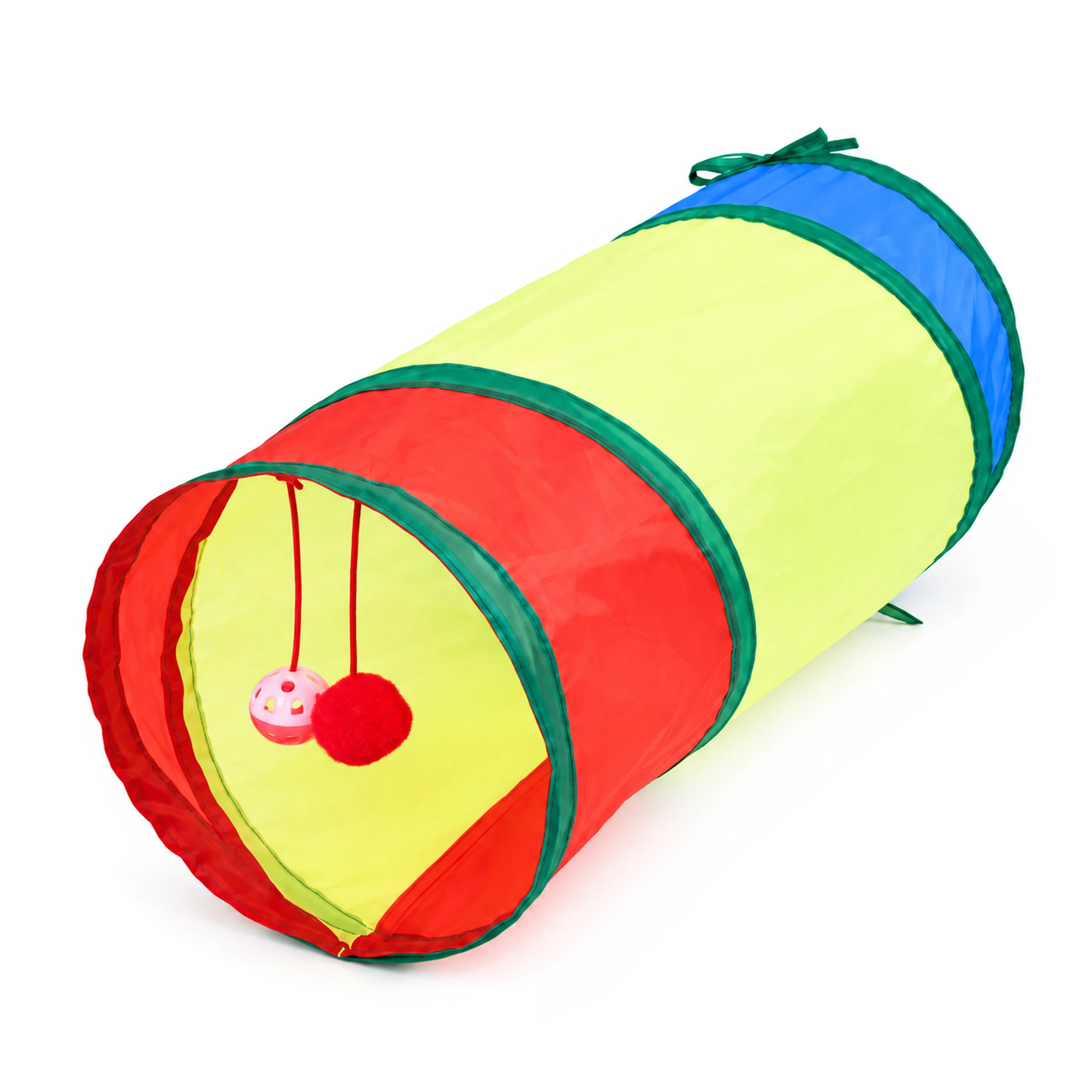
Inside the fabric tube, a cautious cat feels confident enough to watch external movements. The hanging pink bell ball and red pompom positioned right at the tunnel opening provide gentle tactile lures that cats can swat while remaining half-hidden. To utilize this tunnel during interactive sessions, position the tube along a familiar baseboard and drag an external lure past the entrance opening. The sudden flash of movement past the covered threshold encourages the cat to execute swift ambushes from safety, gradually building the confidence needed for wider exploration.
Floor-Level Micro-Movements: Realistic Feather Wand Techniques
Once your cat has a safe observation point, lure mechanics determine whether the stalking instinct turns into an active pounce. A quality cat feather teaser wand is an exceptionally versatile tool, yet many pet parents operate it like a fly swatter, whipping it back and forth in mid-air. Flying birds make up only a fraction of a cat natural diet; the vast majority of feline hunting targets are ground-dwelling rodents, lizards, and crawling beetles.
To awaken an indifferent cat, you must simulate terrestrial prey that is actively trying to hide. According to JoyPetPlay merchant catalog listings, the Natural Three Feather Spinner Cat Wand features a smooth wooden handle, flexible steel wire, and three natural feathers mounted around a radial spinner bead with a gentle bell. The thin spring-steel wire transmits minute hand tremors into delicate floor twitches that rigid plastic wands cannot replicate.
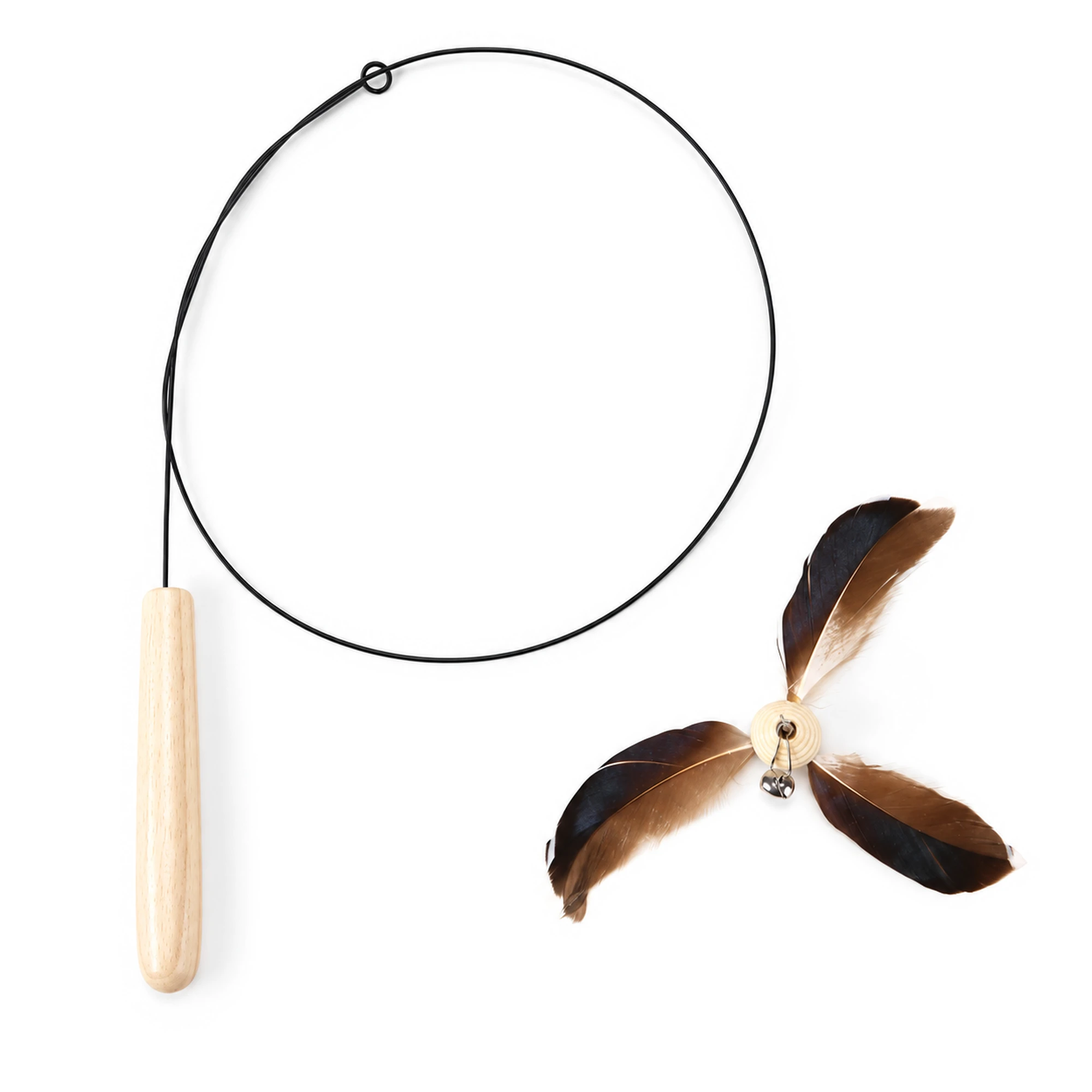
Instead of waving the plumage overhead, rest the feathers on the floor three meters away from your cat. Make the feathers twitch forward two centimeters, then freeze completely for ten seconds. Flick your wrist gently so the tiny metallic bell rings softly once, signalling an unseen animal rustling in dry leaves. Drag the radial feathers slowly behind a sofa cushion, beneath a low blanket, or around a doorframe so the lure partially disappears from view. Prey that disappears triggers an irresistible urge to peek and follow. At an agile 36 grams, the lightweight wooden handle allows effortless manipulation, letting you direct subtle creeping drills without tiring your arm.
Low-Pressure Solo Exploration: Suction-Mounted Toys
Some cats feel exceptionally sensitive to human posture. If an owner stands upright or sits too close, the cat may associate playtime with social pressure rather than independent curiosity. These felines often show interest in toys only when they believe nobody is watching. Providing self-regulated interactive stations allows anxious felines to test their hunting reflexes entirely on their own terms.
Stationary vertical toys bridge this gap by removing human physical proximity. According to JoyPetPlay merchant catalog listings, the Red Mushroom Retracting Feather Cat Toy features a 50g red mushroom suction cup housing, retracting white cord, and feather lure with a bell and clip. The durable suction cup mounts firmly to smooth surfaces like ceramic floor tiles, lower kitchen cabinets, or glass patio doors at your cat natural eye level.
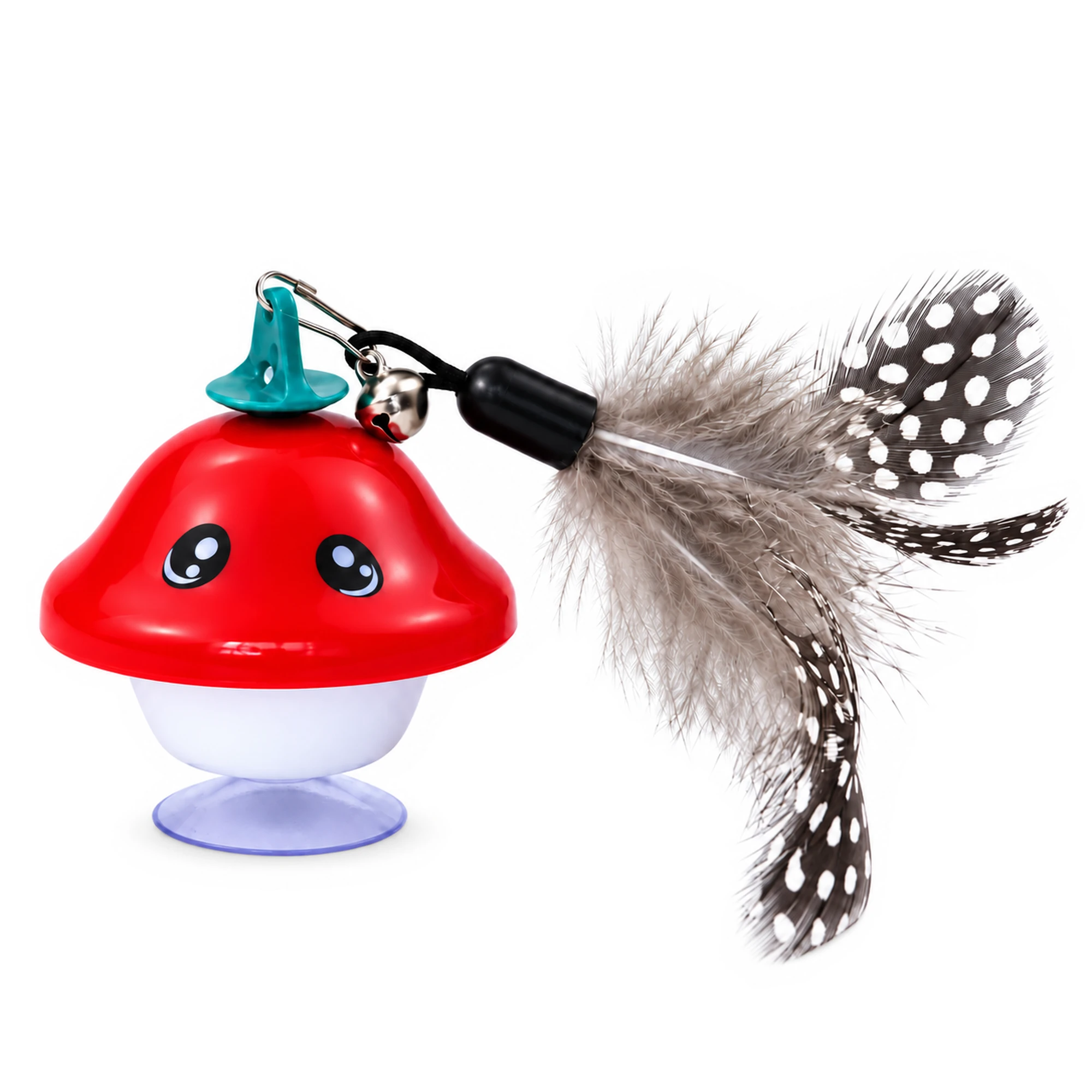
The elastic retracting cord generates gentle rebound action whenever a passing feline brushes or swats the spotted guinea fowl plumage. Because the lure rebounds automatically without requiring human operation, timid cats can approach, sniff, bat, and retreat without feeling trapped or scrutinized. Placing the suction mount near a sunny window or quiet hallway corner transforms an unused wall into an ambient predatory enrichment zone that encourages spontaneous swatting throughout quiet afternoon hours.
Completing the Predatory Loop: The Catch and Feed Routine
One of the easiest things to overlook during feline playtime is mental completion. In the wild, hunting is an energetically demanding activity with a singular biological purpose: obtaining food. When an indoor cat chases an evasive toy but never experiences a tangible physical capture, their predatory loop remains open. Over time, repeated unrewarded chasing produces frustration, causing cats to give up on toys altogether.
To build lasting play motivation, structure every interactive session around the complete predatory sequence:
- Short, Frequent Intervals: Limit interactive sessions to five or ten minutes. Short, focused sessions prevent physical fatigue and keep motivation high.
- Guaranteed Physical Capture: During the final minute of play, slow your wand movements down and allow your cat to pounce squarely on the feather lure. Let them grip the feathers with their front paws and deliver a satisfying bite.
- Immediate Protein Reward: The moment your cat captures the lure, offer a small dish of wet food or a high-protein treat. Consuming food signals to the feline nervous system that the hunt was successful.
- Groom and Sleep: After eating, your cat will naturally begin grooming their face and paws before curling up for a deep, restorative nap. This post-hunt relaxation reinforces playtime as a rewarding, emotionally fulfilling experience.
For additional insight into why indoor cats develop toy fatigue and how to rotate enrichment items effectively, explore our comprehensive analysis on why cats ignore toys as well as our guide on cat toys for kittens vs adult cats.
Frequently Asked Questions
How can I tell if my cat is bored or truly dislikes toys?
Cats that seem to dislike toys almost always suffer from environmental boredom and improper lure mechanics rather than a lack of play drive. When toys remain scattered permanently across living room carpets, they lose their visual and olfactory novelty, blending into ordinary furniture. You can distinguish boredom from genuine disinterest by observing your cat reaction to subtle floor-level motion. If your cat pupils dilate when you creep a flexible feather wand behind a doorframe or rustle paper under a rug, their hunting instinct is fully intact. Storing toys out of sight inside closed cupboards and bringing out only one or two items for dedicated five-minute games quickly revives their engagement.
What if my shy cat runs away when I pull out a toy?
If your cat flees when you produce a toy, the item or your physical posture is triggering fear rather than curiosity. Towering over a timid cat while waving large objects makes them feel cornered and vulnerable. To overcome this fear, step back several meters and sit flat on the floor to lower your visual profile. Introduce an ambush hideaway like a lightweight straight cat tunnel placed near their favorite safe room. Allow your cat to enter the tunnel undisturbed, then gently twitch a feather lure outside the opposite entrance. Having protected fabric walls around their body gives anxious cats the security they need to observe moving targets without feeling exposed.
Can suction cup toys help a cat that fears human movement during play?
Suction cup toys are exceptionally effective for cats that feel intimidated by human proximity during active play. Mounting a retractable feather toy to a low glass door or polished baseboard removes human presence from the interaction entirely. A cautious cat can approach the station at their own pace, sniff the feathers, and experiment with gentle paw swipes without worrying about sudden human movements or loud voices. As the cat discovers that swatting the lure produces exciting rebound movements without scary surprises, their self-confidence grows, making them far more receptive to interactive wand games later on.