When a dog empties a bowl of kibble in under forty seconds, mealtime resembles a high-powered vacuum cleaner at work. Pet parents frequently watch their dogs bolt food without chewing, followed shortly by coughing, throat gagging, or undigested kibble regurgitated across the kitchen floor.
Bolting meals brings genuine gastrointestinal hazards. Gulping dry pellets forces canines to ingest substantial pockets of air, triggering painful stomach distension and digestive upset. Although many owners invest in rigid plastic maze bowls, determined dogs routinely outsmart those stationary ridges in just a few sittings.
To create lasting mealtime pacing, dogs need dynamic barriers that require deliberate coordination or active scent tracking. Understanding the mechanical differences between simple maze bowls, multi-compartment sliding puzzles, and fabric foraging bowls is the most reliable way to slow down a fast eater safely.
The Physical Risks of Rapid Eating: Why Gulping Kibble Is Dangerous
Eating speed directly influences canine gastrointestinal mechanics. When a dog bolts food, three distinct clinical problems frequently develop:
- Aerophagia and Severe Gas: As dogs scoop mouthfuls of kibble rapidly, they swallow substantial quantities of air (aerophagia). This trapped air expands inside the stomach, causing visible abdominal distension, painful cramping, and excessive flatulence.
- Post-Meal Regurgitation: Unlike vomiting, which involves active abdominal contractions and bile, regurgitation is a passive ejection of undigested, unchewed food coated in saliva. When the esophagus becomes overloaded with dry kibble moving too fast, the body reflexively expels the meal within minutes of eating.
- Choking and Gastric Dilatation-Volvulus (GDV): Unchewed kibble lodges easily in the trachea when dogs gasp for air between swallows. In deep-chested breeds (such as German Shepherds, Great Danes, Standard Poodles, and Labrador Retrievers), rapid air intake and heavy food loads dramatically increase the risk of gastric dilatation-volvulus (bloat), an acute medical emergency where the stomach distends and twists on its axis.
Slowing eating speed gives the stomach time to signal satiety to the brain, prevents dangerous air accumulation, and allows saliva and gastric enzymes to begin normal digestion.
Why Static Maze Bowls Fail Against Fast Eaters
Plastic slow-feeder bowls with molded ridges, spirals, or honeycomb patterns are usually the first tool dog owners purchase. While these bowls provide temporary resistance for mild eaters, determined fast eaters routinely defeat them through several predictable behaviors:
| Gulping Technique | How the Dog Defeats Static Bowls | Resulting Mealtime |
|---|---|---|
| The Bulldozer | Pushes flat snout hard against ridges, compressing kibble into corners | 45 to 60 seconds |
| The Tongue Scoop | Uses tongue like a high-speed ladle, sweeping food along open channels | 60 to 90 seconds |
| The Flipper | Uses teeth or paws to grab bowl rim and flips entire unit upside down | 15 seconds |
| Cognitive Habituation | Memorizes static maze layout after 3 to 5 meals | Drops back under 1 minute |
Real-world dog owners regularly document this limitation. On community training forums like Reddit r/DogAdvice, owners report that dogs often figure out honeycomb maze bowls in just a few sessions, bringing eating times right back down to a single minute and continuing to gag.
Because static bowls lack moving components, they present an unchanging spatial puzzle. Once a dog figures out the angle of maximum tongue leverage, the barrier ceases to function as mental enrichment and becomes a minor physical speed bump.
Mechanical Solutions: Multi-Compartment Slide and Lift Feeders
To sustain slow eating over months rather than days, a feeding device must incorporate movable physical barriers that separate meals into small, isolated portions.
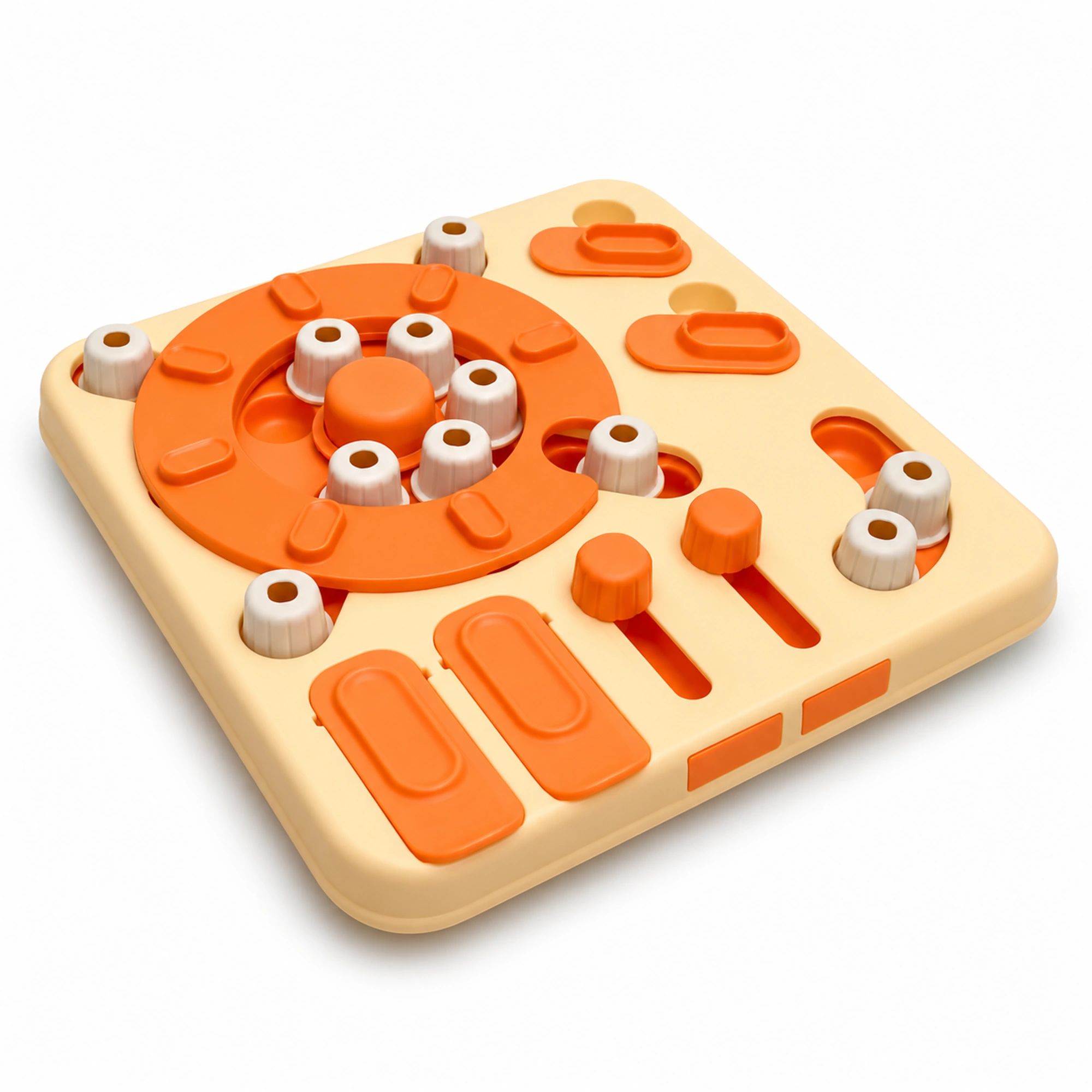
Mechanical puzzles like the Orange Turn, Slide & Lift Treat Puzzle address the shortcomings of static bowls by using multiple independent moving parts across a single square puzzle board. Instead of accessing an open maze, the dog must operate distinct mechanisms sequentially:
- Central Rotating Ring: Requires the dog to rotate a flat circular disk with its nose or paw to align access slots with hidden food chambers beneath.
- Sliding Drawer Handles: Features eight sliding handles around the perimeter that the dog must pull or push outward to expose small kibble wells.
- Hinged Lift-Up Doors: Demands that the dog use its muzzle to flip covers upward, preventing continuous tongue scooping.
- Swivelling Oval Flaps: Requires horizontal pivoting motions to push covers aside.
Because each compartment holds only a modest cluster of dry kibble, the dog cannot inhale food continuously. After opening one pocket, the dog consumes a single mouthful, pauses, and must re-engage its cognitive focus to manipulate the next mechanical barrier.
Distributing half of a dog’s normal dry kibble ration across these varied compartments transforms a 45-second gulping frenzy into an 8 to 15-minute sequence of physical coordination and mental problem-solving.
Olfactory Slow Feeding: Soft Roll-Up Foraging Bowls
While mechanical slider puzzles use rigid plastic barriers, scent-based foraging uses a dog’s natural olfactory instinct to interrupt rapid eating momentum. Sniffing and nose-work trigger parasympathetic nervous system activity, lowering heart rate and promoting calm behavior during meals.
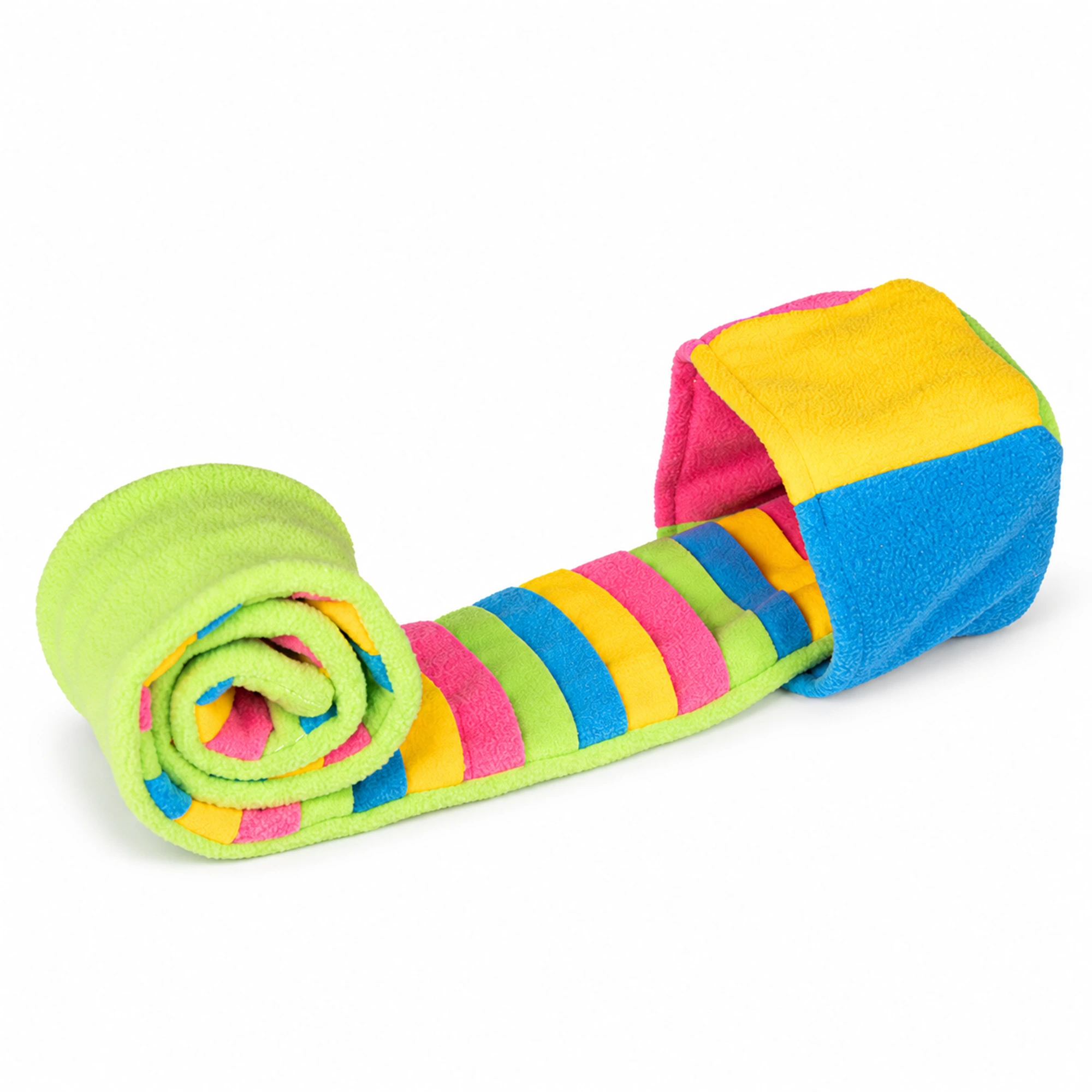
The Small Rainbow Roll-Up Foraging Bowl offers an effective olfactory solution for fast-eating small and medium dogs. Measuring 10 centimeters in rolled width and height, this feeder consists of a colorful fabric trail featuring sewn cloth bands housed within a soft fleece bowl (with a lime-green central roll and a blue, yellow, and pink bowl exterior).
Using a fabric roll-up bowl for daily meals involves three simple steps:
- Unroll the Cloth Trail: Lay the fabric strip flat on a clean surface.
- Load Kibble Between Bands: Distribute individual kibble pieces into the fabric bands along the length of the strip.
- Roll and Tuck: Roll the strip back up tightly and insert it into the soft fleece bowl base.
When presented with the bowl, the dog cannot open its mouth wide to gulp kibble. It must use its nose and paws to gently unroll the strip, working through individual fabric folds to extract single kibble pieces. This nose-work approach slows eating times to 10 to 20 minutes while eliminating the hard plastic impact on sensitive muzzles and teeth.
Matching the Puzzle to Your Dog’s Eating Style
Different fast eaters display different eating temperaments. Choosing the right puzzle design depends on how your dog approaches meals:
1. The Bulldozer (Strong, Physical Pushers)
Bulldozer dogs shove their snouts forcefully into bowls and rely on raw physical momentum. For these dogs, static bowls are completely useless because they simply push through the ridges.
- Recommended Setup: Heavy composite slider boards like the Orange Turn, Slide & Lift Treat Puzzle. Place the board on a non-slip silicone mat or inside a shallow tray so the dog cannot push it across the floor.
- Loading Strategy: Fill only the sliding drawers and hinged lids initially, keeping the central rotating ring unlocked until the dog learns to pause between compartments.
2. The Vacuum Gulping Dog (High-Drive, Low-Chewing Inhalers)
Vacuum eaters do not chew their food; they open their jaws wide and inhale dry kibble like a suction tube.
- Recommended Setup: Soft foraging systems like the Small Rainbow Roll-Up Foraging Bowl.
- Loading Strategy: Scatter kibble deeply into the internal fabric bands. Because kibble pieces are isolated within cloth folds, the dog can only retrieve one or two pieces at a time with its tongue, completely breaking the inhalation cycle.
3. The Frustrated Scratcher (High Energy, Impatient Eaters)
When faced with meal barriers, frustrated scratchers paw aggressively at toys, risking damage to plastic hinges or fabric seams.
- Recommended Setup: Start with partially opened puzzle compartments.
- Loading Strategy: Leave slider handles halfway open and the fleece trail partially unrolled. Sit beside your dog during the first three feeding sessions, using a calm verbal cue when they sniff gently, and guiding them away from biting the frame.
Step-by-Step Protocol: Transitioning Meals from Bowl to Puzzles
Abruptly switching a frantic eater from an open bowl to an advanced mechanical puzzle can provoke intense frustration, leading to paw slamming or toy chewing. Follow this gradual transition schedule:
- Days 1 to 2 (Split Meal Baseline): Feed half the meal in a standard slow feeder or scattered on a flat baking sheet, and place the other half in open, unlocked puzzle compartments. Allow your dog to see you place the food.
- Days 3 to 5 (Single Mechanism Challenge): Move two-thirds of the meal into the puzzle, engaging only one type of barrier (such as sliding handles or loosely rolled fleece).
- Days 6 and Beyond (Full Meal Enrichment): Place the entire meal across the multi-action puzzle or tightly rolled foraging bowl. Supervise every meal to ensure your dog focuses on solving barriers rather than chewing plastic edges or tearing fabric strips.
For dogs with varying problem-solving skills, explore our detailed guide on dog puzzle toy difficulty levels explained to scale mechanical complexity appropriately. If your dog shows initial hesitation with new feeding gear, read our troubleshooting advice on how to introduce a treat dispensing toy to build mealtime confidence without frustration.
Frequently Asked Questions
Can food puzzles completely replace my dog’s regular dinner bowl?
Yes. Many veterinary behaviorists recommend feeding dogs exclusively through food puzzles, snuffle mats, and scatter feeding. Working for food satisfies natural canine foraging instincts and prevents the boredom associated with eating entire meals from a static bowl in thirty seconds. Ensure you supervise meals to confirm your dog solves the puzzle calmly rather than chewing on plastic components.
What should I do if my dog tips over or chews on the puzzle toy?
Tipping and chewing indicate that the puzzle is either sliding across the floor or causing frustration. Place mechanical puzzle boards on a non-slip silicone mat or inside a secure tray to prevent tipping. If your dog begins chewing on plastic flaps or fabric bands, gently redirect them with a verbal cue, help them open the next compartment, and remove the puzzle immediately once all food has been consumed.
How often should I clean food puzzles used for daily meals?
Food puzzles used for dry kibble should be wiped down or washed weekly, while puzzles used with wet food, peanut butter, or bone broth require cleaning after every use. Plastic composite puzzles like the Orange Turn, Slide & Lift Treat Puzzle should be hand-washed in warm water with mild dish soap and air-dried thoroughly. Fabric foraging bowls like the Small Rainbow Roll-Up Foraging Bowl can be hand-washed or placed inside a mesh laundry bag on a gentle machine cycle, then air-dried to preserve fabric elasticity.