When pet parents first try interactive enrichment, the difficulty tiers printed on retail boxes frequently stir up confusion. A puzzle marketed as Level 2 may leave an eager retriever baffled, while a curious terrier dismantles a Level 3 feeder in seconds.
Demystifying canine puzzle ratings requires moving past commercial labels to analyze the specific physical mechanics needed to release kibble. Tier systems do not gauge raw canine intelligence. Rather, they quantify mechanical complexity: the number of distinct motions, prerequisite steps, and spatial manipulations a dog must orchestrate to reach an aromatic reward.
Matching a puzzle to your dog’s current problem-solving threshold prevents two common failures: learned helplessness (where a dog gives up and walks away) and destructive chewing (where frustration leads to biting the toy apart). This guide breaks down the industry standard difficulty scale from Level 1 through Level 4, explains how to evaluate your dog’s cognitive starting point, and provides practical scaffolding techniques to bridge skill gaps.
The Four-Tier Difficulty Framework Explained
The canine enrichment industry generally groups interactive toys into four progressive difficulty tiers. Each level introduces a distinct physical and mental challenge.
| Difficulty Tier | Core Mechanics | Dog Action Required | Primary Goal |
|---|---|---|---|
| Level 1: Beginner | Single-action motion, continuous gravity feed, open cavities | Nose nudge, paw swat, rolling | Build reward association and confidence |
| Level 2: Intermediate | Composite independent mechanisms (sliders, flaps, rotating disks) | Slide, lift, spin single components | Introduce fine motor control and spatial search |
| Level 3: Advanced | Sequential locks, prerequisite steps, multi-action dependencies | Move piece A to unlock piece B | Develop working memory and sequential planning |
| Level 4: Expert | Multi-tier nested mechanics, locking pegs, multi-directional tracks | Coordinate 3+ chained steps per compartment | Sustained cognitive stamina and precision handling |
Level 1: Single-Action Motion and Gravity Feed
Level 1 toys focus on teaching a dog that physical interaction produces food. These toys do not feature locking parts or sequential barriers. A single nudge, roll, or lift immediately releases kibble or exposes a treat well.
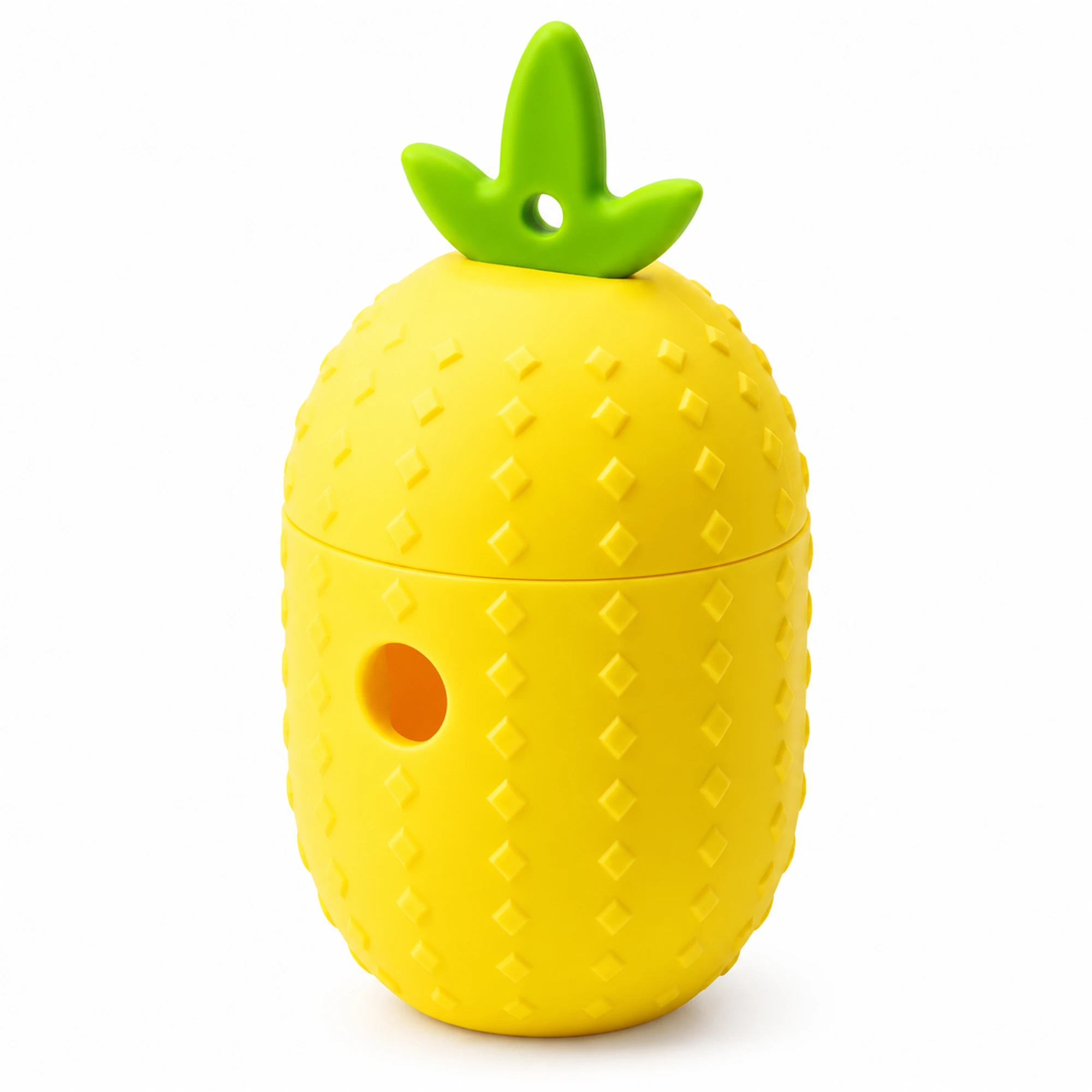
Typical Level 1 designs include rolling dispensers, wobble balls, and basic snuffle mats. For example, the Yellow Pineapple Roll & Treat Toy operates as a beginner rolling dispenser. Owners open the pineapple at its middle join to add treats, close it, and let their dog nudge and roll it to release food through the side opening. The bright yellow silicone body has raised diamond bumps and a green leafy crown that create an erratic roll, keeping novice dogs engaged without presenting mechanical frustration.
Level 1 is essential for puppies, rescue dogs with low confidence, senior dogs with cognitive decline, or dogs that have never worked for food before.
Level 2: Composite Independent Mechanisms
Level 2 introduces board-style puzzles where food is concealed under individual physical barriers. However, all barriers operate independently. Solving compartment A does not depend on solving compartment B.
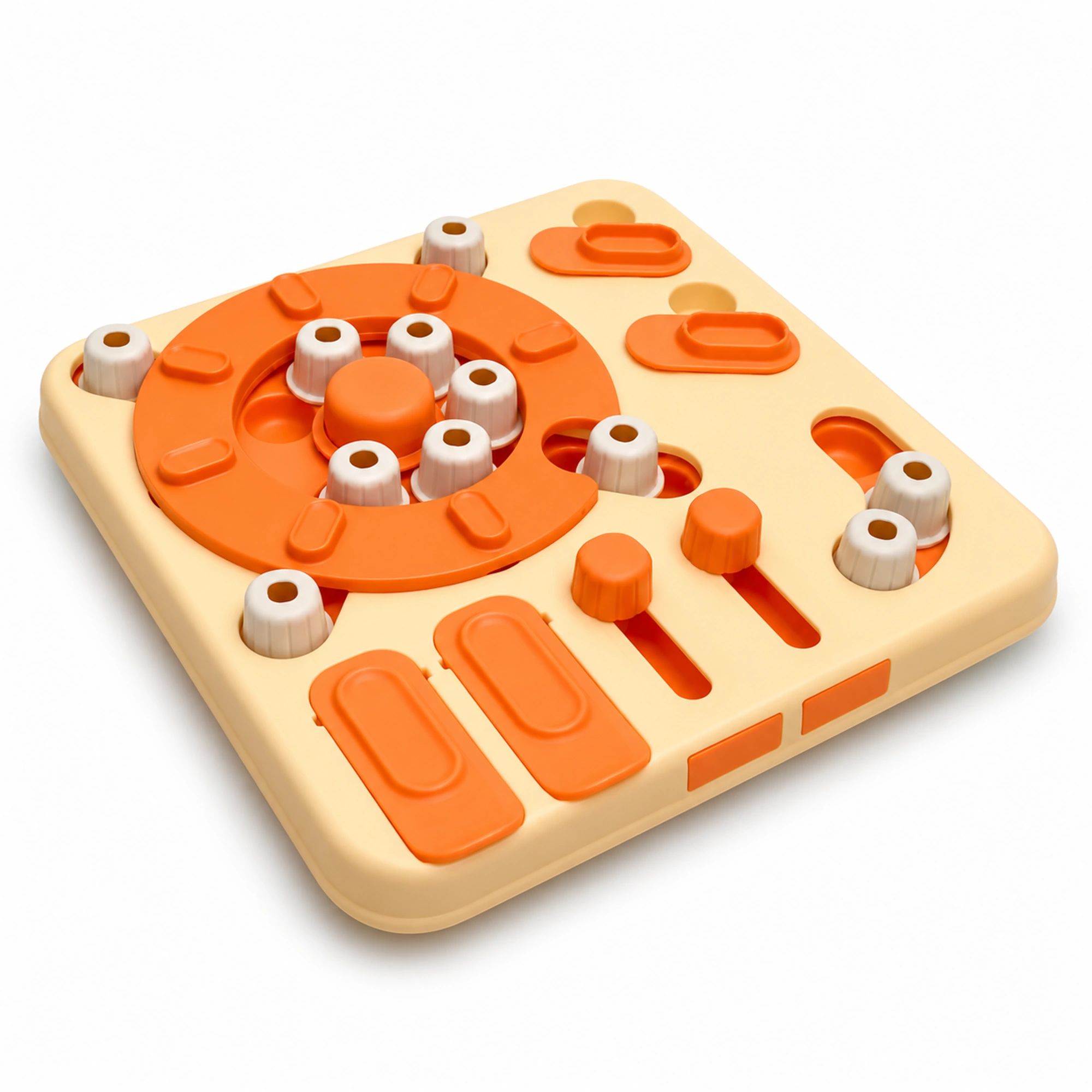
A dog playing with a Level 2 puzzle encounters multiple mechanical actions on the same board, such as sliding tiles, swivelling covers, and hinged lids. The Orange Turn, Slide & Lift Treat Puzzle demonstrates this composite structure. Dogs explore a rotating ring, sliding drawer handles, hinged lift-up covers, and swivelling oval covers on one square treat puzzle board. Owners hide small dry treats beneath various elements and let the dog test different motions during supervised play.
Because each mechanism operates independently, a dog that struggles with hinged covers can still achieve quick wins by sliding a drawer handle or nudging the central rotating ring. This multi-action variety builds broad motor problem-solving skills without overwhelming the dog.
Level 3: Sequential Prerequisite Locks
Level 3 marks a major cognitive shift: the introduction of sequential locks. On a Level 3 board, a compartment cannot be opened until a separate locking mechanism is moved out of the way.
Common Level 3 mechanisms include:
- Locking Pegs: Removable plastic bones or pegs that fit into tracks, blocking sliders from moving until the dog lifts the peg vertically.
- Rotating Ring Locks: An outer ring that must be turned to align a notch before an inner sliding compartment can travel along its track.
- Chained Drawers: Pull-drawers that remain pinned shut until a top slider is pushed forward.
Level 3 requires inhibitory control and delayed gratification. The dog smells the treat under slider B, but must resist clawing directly at slider B to first lift peg A.
Level 4: Multi-Tier Nested Puzzles
Level 4 puzzles represent the peak of commercial puzzle design. They combine sequential locks, nested rotating disks, and multi-directional sliding tracks across multiple physical layers.
In a Level 4 toy, unlocking a single treat cavity might require three or four distinct, consecutive maneuvers: spinning an upper tier to expose a release key, sliding a key into an alignment slot, lifting a lock, and finally sliding the treat tray open.
On community forums such as Reddit r/dogs, experienced owners frequently discuss puzzle limits. One owner observed that their Lhasa Apso breezed through Level 4 puzzles in under five minutes once the patterns were learned. This observation highlights a critical principle: difficulty ratings describe mechanical complexity, not permanent mental resistance. Once a dog decodes a physical sequence, muscle memory takes over and solving time drops dramatically.
Diagnosing Your Dog’s Cognitive Starting Point
Before purchasing a puzzle, assess how your dog naturally interacts with novel objects. Dogs rely on different problem-solving styles:
1. The Nose-First Explorer
- Behaviors: Uses the snout to sniff, nudge, flip, and push. Rarely uses paws.
- Natural Strengths: Rolling toys, snuffle mats, lifting cups, and swivelling lids.
- Weaknesses: Pull-drawers and sliding tiles that require paw traction.
- Recommended Entry: Level 1 rolling toys or Level 2 boards with raised rims that snouts can lever upward.
2. The Paw-First Tactician
- Behaviors: Scratches, swipes, pats, and bats objects with front paws.
- Natural Strengths: Sliding tiles, rotary wheels, and drawer pulls.
- Weaknesses: Deep cups or hinged flaps that require a gentle nose lift.
- Recommended Entry: Level 2 composite boards with sliding handles and spinning disks.
3. The Frustration-Biter
- Behaviors: Bites corners, attempts to carry the entire board, or tries to gnaw plastic lids off when food is not immediately accessible.
- Risk: Ingestion of plastic fragments, tooth damage, and learned destruction.
- Protocol: Do not jump to Level 2 or 3. Start at Level 1 with soft silicone dispensers to teach that calm manipulation, not crushing force, dispenses food.
Scaffolding Techniques: How to Teach Complex Mechanics
Dogs do not understand instruction manuals. If you introduce a Level 2 or Level 3 puzzle fully locked, most dogs will either abandon the task or attempt to chew through the plastic.
Scaffolding is the process of temporarily reducing difficulty so your dog experiences immediate success, then gradually restoring mechanical resistance.
Protocol 1: The Half-Open Slider
When introducing sliding covers or drawers on a board like the Orange Turn, Slide & Lift Treat Puzzle:
- Fill the treat compartment with a high-value treat.
- Leave the slider 75% open so the food is clearly visible and easily reached with a light nose touch.
- Once your dog nudges the slider to reach the food three times in a row, close it to 50% open.
- Progress to 25% open, where the dog must intentionally push the slider to widen the opening.
- Finally, close the slider completely.
Protocol 2: The Peg Removal Progression
When working with Level 3 sequential locks:
- Remove all locking pegs entirely. Let your dog solve the underlying sliding tiles as a standard Level 2 puzzle.
- Insert a single locking peg loosely, resting only halfway into its slot.
- Place a treat directly underneath the peg so lifting it yields an instant reward.
- Once your dog reliably lifts that single peg, push it down flush.
- Gradually add additional locking pegs across consecutive sessions.
Protocol 3: Scent-Marked Tracks
Dogs navigate primarily through olfaction. If a sliding tile sticks or a dog does not understand the track direction:
- Rub a piece of freeze-dried meat or cheese along the groove of the track.
- The scent trail encourages the dog’s nose to trace the exact line of travel required to push the slider.
Managing Session Duration and Mental Fatigue
Mental problem-solving consumes significant metabolic energy. During intense puzzle sessions, a dog’s brain processes olfactory cues, inhibits impulsive biting, and tests spatial hypotheses.
- Keep Sessions Under 10 Minutes: When a dog first tackles a new difficulty tier, limit sessions to 5 to 10 minutes.
- Watch for Fatigue Signals: Yawning, lip licking, turning away, sniffing the floor around the puzzle, or sudden frantic pawing are classic signs of cognitive exhaustion, not stubbornness.
- End on a Win: If your dog seems stuck on a complex Level 3 step, step in, open the slider halfway, allow them to grab the treat, and end the session on a positive note.
- Always Supervise: Interactive puzzles contain moving parts, hinges, and sliding covers. Never leave a dog unattended with a plastic puzzle board. Once the puzzle is empty, remove it from the floor immediately to preserve its value as a structured mental activity.
Frequently Asked Questions
How do I know if a puzzle toy is too difficult for my dog?
A puzzle is too difficult if your dog exhibits signs of acute frustration or learned helplessness. Frustration appears as biting the plastic frame, pawing aggressively at non-moving edges, whining, or attempting to flip the entire board. Learned helplessness appears as walking away, lying down with a flat posture, or ignoring the puzzle despite smelling high-value treats inside. If either occurs, de-escalate the mechanics immediately by removing lids or leaving sliders wide open.
Can a beginner dog jump directly to a Level 2 puzzle?
Yes, provided the Level 2 puzzle features composite independent elements rather than sequential locks. Puzzles like the Orange Turn, Slide & Lift Treat Puzzle offer multiple distinct manipulation points on a single board. If you leave several compartments partially open, a beginner dog can quickly learn by exploring easier sliders before attempting the rotating ring or hinged covers.
How often should I increase my dog’s puzzle level?
Progress to a higher difficulty level only when your dog solves every compartment of their current puzzle methodically and calmly in under two to three minutes across three consecutive sessions. If your dog still uses frantic scratching or brute force, remain at the current level with varied treat placements until movements become deliberate and precise.