Tug of war remains one of the most engaging games you can share with your canine companion. It burns physical energy, satisfies predatory gripping instincts, and builds mutual cooperation during indoor play sessions. Yet many pet parents worry that intense pulling might trigger aggression or encourage pushy habits.
When played with structured boundaries, tug does not cause behavior problems. Modern veterinary behaviorists recognize tug as a healthy cooperative activity that strengthens impulse control. Establishing clear dog tug toy rules keeps excitement manageable and protects human hands while keeping playtime safe for canine teeth and joints.
Understanding Canine Predatory Drive and Behavioral Science in Cooperative Play
Canine predatory motor patterns consist of an evolutionary sequence: search, stalk, chase, grab-bite, and kill-bite. Fetch exercises the chase phase, whereas tug satisfies the grab-bite drive. When dogs bite down on a rope or rubber strap and anchor their rear paws, their brains release dopamine and endorphins. This neurochemical release makes cooperative pulling both calming and mentally satisfying under thoughtful guidance.
Early canine literature from the twentieth century claimed that allowing a dog to win against a human encouraged pack dominance. Those early claims stemmed from artificial observations of unrelated wolves kept in cramped captive compounds. Modern ethologists and veterinary behaviorists have shown that companion dogs do not treat cooperative games as contests for social rank. During natural play bouts between canines, partners willingly alternate roles, trading victories to sustain mutual interest.
A dog that growls during vigorous tug is rarely displaying hostility. Play growls exhibit higher fundamental pitches, irregular rhythms, and brief pauses accompanied by bouncy play bows and loose hips. Agonistic growls remain low-pitched, steady, and paired with rigid musculature, fixed eyes, and pinned ears. Watching your dog’s complete posture rather than listening to vocalizations in isolation reveals their true emotional state.
Permitting your dog to win the toy frequently builds confidence and strengthens play motivation. When dogs win possession, their natural response in a cooperative relationship is to carry the prize back to your feet to restart the game. If a handler constantly wrenches the toy away and hoards it, the dog quickly learns that engagement brings loss, prompting them to play keep-away instead. Winning becomes an issue only if the dog guards the item defensively, snaps when approached, or refuses trades.
Foundational Safety Boundaries and Household Rules for Playing Tug with Dog
Orderly games depend on strict consistency across every household member. Dogs thrive when rules for playing tug with dog remain predictable across every session. The following principles form the backbone of safe play.
1. Instant Disengagement for Any Tooth Contact
The most critical safety boundary in canine play is zero tolerance for teeth touching human skin or clothing. Even during peak excitement, a dog must maintain sufficient bite control to target only the designated toy surface.
When a dog’s teeth accidentally brush your fingers, wrist, or sleeve, freeze immediately and speak a soft, neutral marker such as “oops.” Release your grip on the toy, stand straight up, fold your arms across your chest, and turn your gaze away for twenty to thirty seconds. Do not shout, scold, push the dog away, or wave your arms, because sudden motion and loud scolding escalate excitement. Complete stillness and withdrawal of attention act as an effective consequence: the dog discovers that tooth contact makes the entire game vanish. Once the dog offers a calm posture or sits quietly, present the toy again to restart play.
2. Predictable Initiation and Clean Release Cues
Never permit your dog to launch into play by leaping at a toy in your hand, grabbing your leash, or snatching equipment from shelves. Every tug interaction must start with an invitation initiated by the handler.
Require your dog to perform a polite stationary behavior first, such as a calm sit, down, or focused eye contact. Once the dog shows self-control, deliver a clear release word such as “take it” or “tug,” while presenting the toy horizontally at chest height.
Similarly, an ironclad release cue like “drop it” or “give” ensures you can pause the game smoothly at any moment. Train this cue through generous voluntary trades rather than physical prying. Present a high-value piece of freeze-dried meat or cooked chicken directly at your dog’s nose while holding the toy stationary against your thigh. The moment the dog opens their jaws to take the treat, deliver your verbal release cue, feed the treat, and immediately return the toy with your start cue. This trading loop teaches the dog that releasing the toy produces a tasty reward plus permission for more play, eliminating any urge to guard the item.
3. Lateral Planar Pulling Mechanics
Handlers must direct pulling forces horizontally in a gentle side-to-side sweeping motion. Never snap or jerk a tug toy upward, and avoid shaking it vertically.
A dog’s cervical spine and neck musculature absorb axial pulling and horizontal resistance with ease. Vertical whipping motions generate severe shear forces across the atlantoaxial joint and cervical vertebrae C1 through C7, raising the risk of disc herniation, muscle strains, and micro-fractures in puppy teeth. Always hold the toy low to the floor, allowing the dog to keep all four paws planted firmly on the ground with a flat, natural spinal posture. Following these dog tug of war rules prevents chronic orthopaedic injuries over time.
Biomechanical Comparison of Tug Play Equipment
Selecting appropriate gear protects both human joints and canine skeletal anatomy. Different tug designs absorb tension through distinct mechanical methods, creating varying levels of joint impact.
| Equipment Style | Resistance Type | Joint Impact on Handler | Recommended Dog Life Stage | Supervision Requirement |
|---|---|---|---|---|
| Handheld Braided Cotton Rope | Manual human counter-pull | Moderate to high on wrists and shoulders | Adult dogs with established release cues | Continuous active participation |
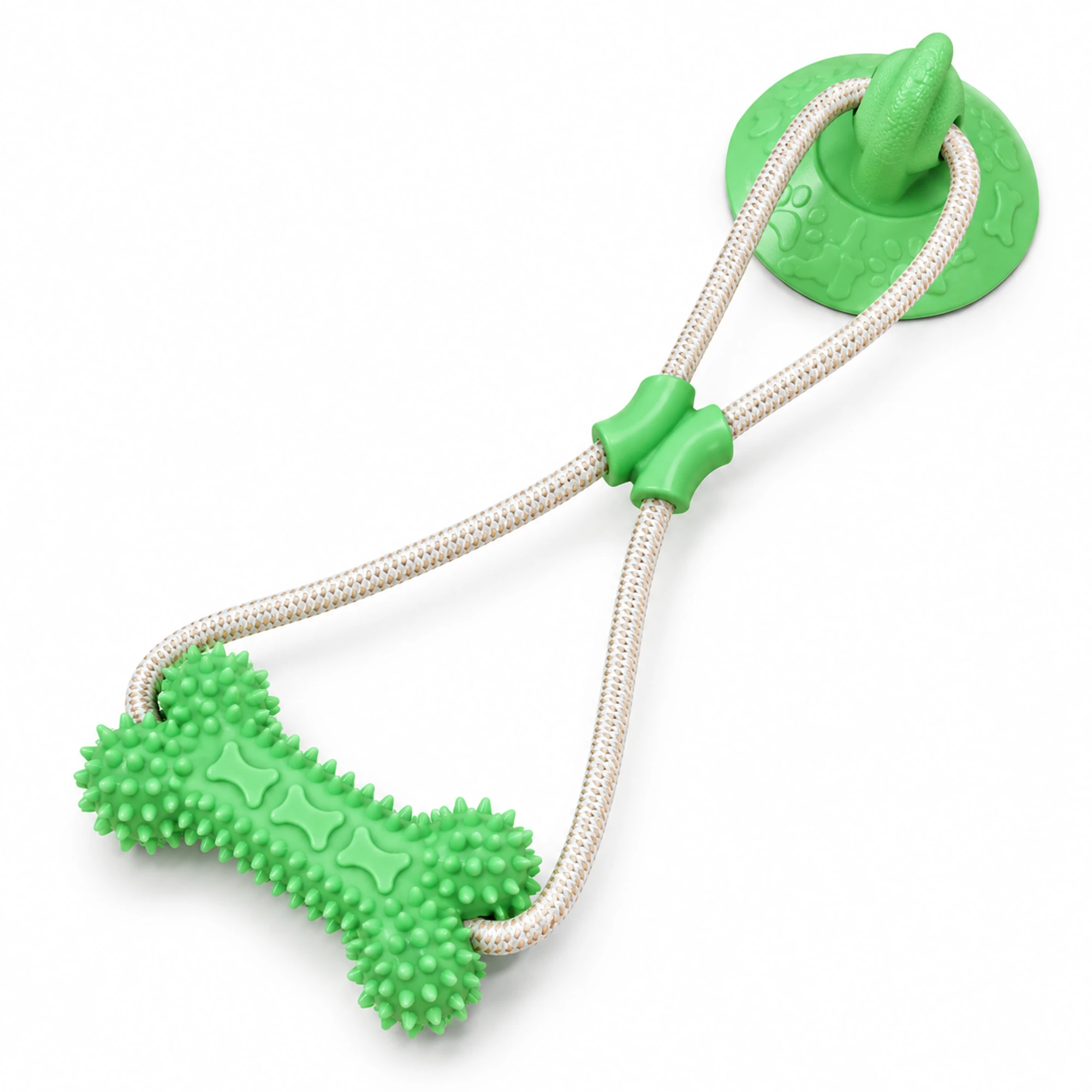
| Floor-Mounted Suction Rubber Bone | Stationary pneumatic suction | Zero strain on handler upper body | All life stages, especially active pullers | Continuous adult monitoring |
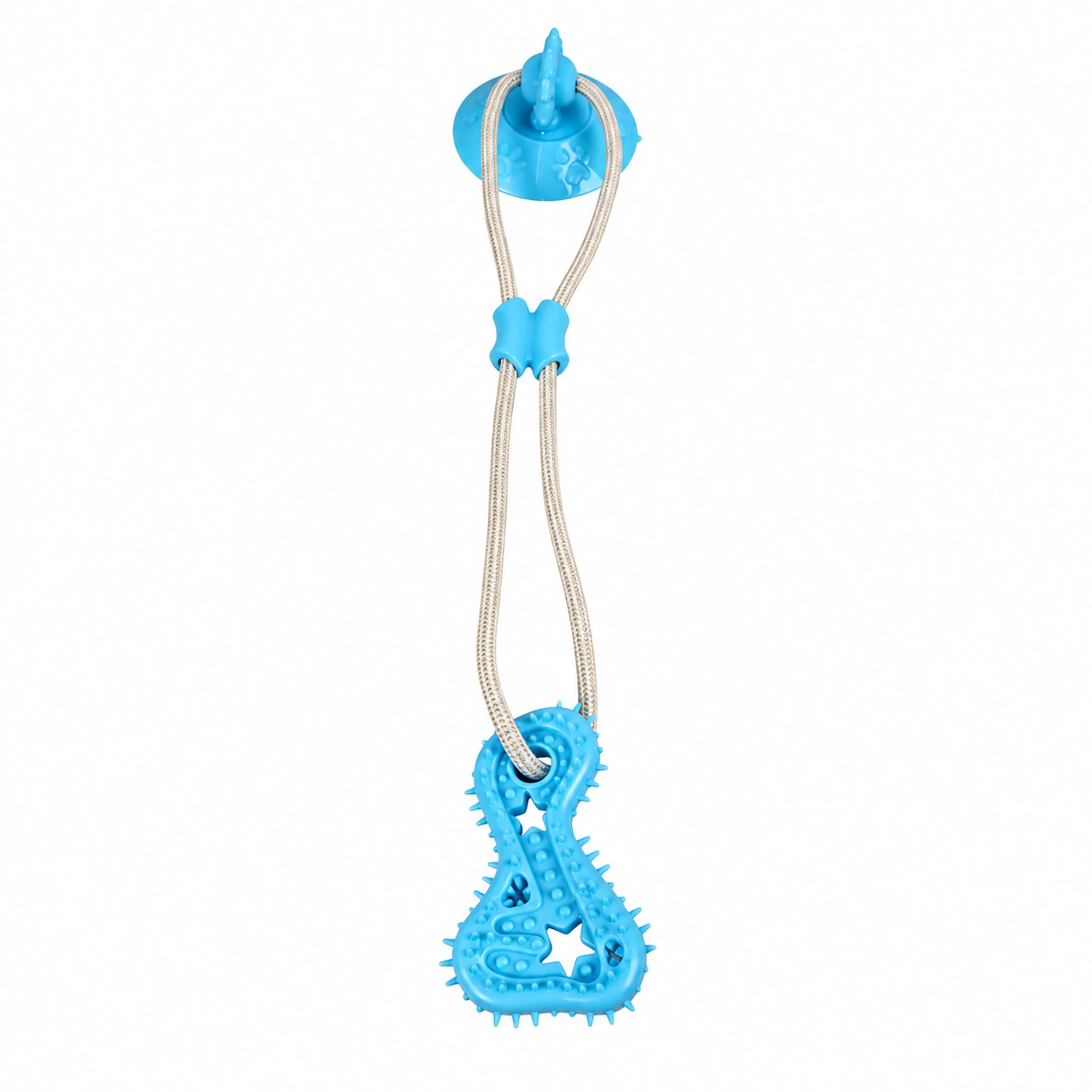
| Cyan Three-Ring Multi-Texture Tug | Stationary multi-point anchor | Zero strain on handler upper body | Puppies and teething adolescents | Active supervision during play |
| Overhead Spring Pole Rig | Dynamic elastic vertical suspension | Zero strain on handler | Mature working breeds over 18 months | Strict professional supervision |
| Soft Fabric Bungee Tug Handle | Elastic manual dampening | Low to moderate on handler joints | Senior dogs and sensitive handlers | Continuous active participation |
Floor-Anchored Tug Equipment: Safe Resistance for Power Pullers
For high-drive dogs, energetic adolescent puppies, or pet parents who experience wrist or shoulder strain during manual tugging, floor-anchored suction toys offer an outstanding indoor solution. These specialized devices rely on atmospheric pressure differentials to create secure floor adhesion, absorbing substantial pulling force while preserving ergonomic comfort. Knowing how to play tug safely becomes much simpler when the equipment supports natural mechanics.
Green Suction & Rope Bone Tug Game
The Green Suction & Rope Bone Tug Game is designed for dogs that favor classic chew bone textures and vigorous straight-line pulling. The system features a heavy-duty green suction base constructed from flexible, non-toxic thermoplastic elastomer. When pressed firmly against a non-porous floor, the concave base expels air and creates a strong pneumatic vacuum seal capable of withstanding tens of pounds of lateral pull.
Connected to this suction base is a tightly braided, wear-resistant synthetic rope fitted with a sliding adjustment collar. Owners can slide the green rope adjuster along the cord to lengthen or shorten the tether, matching the exact standing height of their dog. This height adjustment ensures that the dog pulls along a low, horizontal plane, maintaining neutral cervical alignment. The terminal end holds an ergonomically shaped chew bone covered in raised micro-ridges that stimulate gums and clean dental surfaces as the dog grips and tugs. When play ends, lifting the discreet release tab on the suction base edge releases the vacuum cleanly without marking or damaging floor surfaces.
Cyan Three-Ring Suction Tug Toy
For dogs that prefer varied mouth feels or multi-point grabbing surfaces, the Cyan Three-Ring Suction Tug Toy offers an adaptable alternative. This design couples a wide cyan suction base with a durable central tether linked to three interlocking spiked circular rings made of pliable dental rubber.
The tactile rings feature rounded nubbins that gently massage sensitive gingival tissues, making this model especially advantageous for teething puppies aged four to eight months who need constructive biting outlets. The three interconnected rings allow dogs to experiment with different grip angles, encouraging self-directed focus and sustained tactile exploration. Like its bone-ended counterpart, the cyan suction anchor adheres securely to glazed ceramic tile, polished marble, granite, smooth linoleum, and sealed polyurethane hardwood floors. Pet parents simply ensure the floor is free of dust, press the center of the cup downward with their heel or palm to seat the vacuum, calibrate the rope slider, and invite their dog to engage.
Systematic Five-Stage Training Protocol for Flawless Impulse Control
Transforming tug into a training exercise requires a methodical progression. By dividing sessions into discrete stages, you build dependable impulse control while keeping motivation high.
Stage 1: Surface Preparation and Equipment Calibration
Clean the intended floor area with a damp microfiber cloth to remove dust, dog hair, and grit. Tiny particles of debris compromise an airtight suction seal. Once dry, press the suction base down firmly at the center to expel all trapped air. Adjust the rope slider so the gripping bone or rings hover between four and eight inches above floor level, allowing your dog to pull without craning their neck upward.
Stage 2: Polite Initiation and Focused Engagement
Bring your dog into the room on a flat collar or harness. Ask for a quiet sit approximately three feet away from the anchored toy. Wait for your dog to shift their focus from the toy to your eyes. The instant eye contact occurs, mark with “yes” and give the release cue “take it,” gesturing toward the toy. This sequence teaches the dog that looking at the handler unlocks the fun.
Stage 3: Structured Pulling Bursts
Allow your dog to grip the toy and pull with full enthusiasm for twenty to thirty seconds. Encourage their effort with upbeat verbal praise. Watch their physical posture closely: keep their front feet and back feet grounded. If using a handheld toy in combination with anchored gear, move your hands gently from left to right along the horizontal plane.
Stage 4: Calm Release and Reset Intervals
Step in calmly, place your fingers lightly beside the toy or present a small aromatic treat right at the dog’s nostrils, and utter your cue “drop it.” As soon as the dog releases their grip, praise warmly and feed the treat. Ask for another brief sit and hold a ten-second pause. This pause teaches the dog to downshift from high sympathetic nervous system arousal back into calm focus on command.
Stage 5: Session Conclusion and Toy Rotation
After three to five cycles, or approximately ten to fifteen minutes of play, conclude the session before your dog reaches physical exhaustion. Say “all done,” unseat the suction base using the edge tab, and store the equipment inside a closed cupboard. Storing tug equipment out of sight maintains its perceived novelty and prevents unsupervised chewing that could fray ropes or damage suction components.
Material Durability, Dental Safety, and Equipment Selection Criteria
Selecting appropriate toys requires understanding how dental structures interact with synthetic polymers. A dog’s canine teeth and carnassial molars exert bite pressures ranging from two hundred to over seven hundred pounds per square inch depending on breed size. Toys manufactured from rigid plastics can cause enamel micro-fractures, while coarse, abrasive fibers like unrefined jute can wear down tooth cusps through repetitive friction.
High-grade thermoplastic rubber (TPR) and tightly woven high-tensile polyethylene ropes represent the gold standard for tug equipment. TPR offers optimal elasticity, flexing under intense jaw pressure without tearing or releasing harmful phthalates. The material yields slightly against tooth enamel, ensuring that shock waves from vigorous shaking disperse through the toy rather than transferring into the canine jaw joint and mandibular bones.
Inspect all tug toys before and after every play session. Look for frayed rope strands, loose rubber shards, or compromised suction edges. If any component exhibits tearing or thinning, discard or replace the affected section immediately to prevent accidental ingestion.
Troubleshooting Play Arousal and Resolving Overstimulation in Real Time
During active games, dogs occasionally become overstimulated, leading to frantic grabbing, jumping, or inability to hear verbal cues. Recognizing the signs of impending over-arousal allows you to intervene before safety boundaries dissolve.
If your dog displays dilated pupils, rapid panting with curled tongue edges, frantic body movements, or stiffening before grabbing, they have crossed their threshold for thoughtful impulse control. Immediately pause the game by releasing the toy and stepping behind a baby gate or turning completely still. Do not scold or grapple with the dog. Allow two to three minutes for cortisol and adrenaline levels to normalize. Scattering a handful of kibble or small treats across a snuffle mat or flat rug provides an excellent calming transition, as sniffing lowers heart rate and restores cognitive focus.
Practical FAQ: Expert Answers on Canine Tug Mechanics and Safety
Does playing tug of war make dogs aggressive?
Scientific behavioral studies show that structured tug play does not cause aggression. Tug channels natural canine predatory motor drives into cooperative play when managed with clear start and stop rules.
Should I always win the game of tug?
Letting your dog win the toy frequently builds confidence and strengthens play drive. In a cooperative bond, dogs happily return the toy to their handler to restart the game, making winning completely harmless.
What should I do if my dog’s teeth accidentally touch my hand during tug?
Immediately end the game. Say a calm neutral marker like “oops,” release the toy, and turn away with arms folded for thirty seconds. This consistent consequence teaches the dog that tooth contact on human skin terminates all play.
How do suction cup tug toys stick securely to floors?
Suction bases create an airtight pneumatic seal against clean, smooth, non-porous surfaces like polished glazed tiles, marble, or sealed hardwood. Cleaning the floor surface and pressing firmly down from the center expels air and ensures robust suction adhesion.
How long should a safe dog tug session last?
An ideal tug session lasts between ten and fifteen minutes. Dividing play into short twenty to thirty second bursts followed by calm release pauses prevents overstimulation and physical exhaustion.