Big canines possess distinct cranial geometry, remarkable jaw leverage, and immense chewing stamina. Choosing play equipment for an adult German Shepherd, Golden Retriever, Rottweiler, or Mastiff demands precise attention to physical dimensions rather than vague breed estimates printed on packaging. When pet parents research how to choose the right size dog toy for a large dog, the central objective rests on eliminating choking hazards while providing sufficient structural resistance against heavy bite pressure. A toy built for a medium terrier can slide past the rear molars of a giant breed, lodging inside the pharynx and creating an immediate airway emergency.
Understanding proper toy dimensions requires examining how canines grip, compress, and carry objects during active sessions. Large dogs generate substantial bite forces ranging between 250 and 500 pounds per square inch depending on their skull shape and jaw musculature. Toys that are too small fail to trigger adequate cognitive engagement and expose premolars to awkward focal pressure points. Conversely, toys that match cranial width and provide appropriate surface textures satisfy natural chewing instincts without endangering oral tissues or digestive tracts.
Anatomical Sizing Criteria: Skull Morphology and Airway Clearance
Canine skull anatomy heavily influences how toys fit inside the mouth. Dogs generally fall into three structural cranial categories that dictate appropriate toy diameter and length:
- Mesaticephalic Breeds: Labradors, Golden Retrievers, and German Shepherds possess proportional skull widths and medium-length muzzles. Their jaws deliver balanced crushing and shearing forces. Toys for these breeds must feature sufficient length to extend past both canine teeth simultaneously.
- Brachycephalic Large Breeds: Bullmastiffs, Boxers, and Cane Corsos exhibit wide, shortened palates with powerful masseter muscles. Their jaw leverage concentrates tremendous force along the premolars. Compact items can slip quickly toward the soft palate, making wide-diameter gear mandatory.
- Dolichocephalic Breeds: Doberman Pinschers and Greyhounds possess elongated, narrow rostrums. While their bite leverage at the anterior teeth is lower, their long oral cavity allows toys to roll backward toward the throat if the item lacks broad end stops.
Airway clearance depends on the two-inch diameter rule. Any spherical toy, retrieve dummy, or chew article must comfortably exceed the widest point of the dog’s dental arcade when the jaws open fully. If a canine can close its lips completely around an entire object with zero material visible outside the lip margins, that object presents an unacceptable choking hazard.
| Canine Weight Class | Muzzle Breadth at Molars | Minimum Toy Diameter | Minimum Bone Length | Recommended Tensile Material |
|---|---|---|---|---|
| 50 to 70 Pounds | 2.5 to 3.0 Inches | 3.25 Inches | 6.5 Inches | Vulcanized Natural Rubber / 12mm Cotton Rope |
| 71 to 90 Pounds | 3.0 to 3.5 Inches | 3.75 Inches | 7.5 Inches | High-Density Rubber / Multi-Ply Ballistic Fabric |
| 91 to 110 Pounds | 3.5 to 4.0 Inches | 4.25 Inches | 8.5 Inches | Reinforced Shore-A 65 Rubber / Dual-Stitched Nylon |
| Over 110 Pounds | 4.0 to 4.8 Inches | 4.75 Inches | 9.5 Inches | Dense Natural Rubber / Heavy-Duty Anchor Webbing |
The data table above illustrates why standard tennis balls measuring approximately 2.5 inches in diameter fail safety standards for canines over fifty pounds. A large dog catching a 2.5-inch ball at high velocity can inadvertently force the sphere into the posterior pharynx. Muscle spasms in the throat prevent the dog from expelling the ball, creating complete tracheal obstruction. Selecting retrieve objects measuring at least 3.5 to 4 inches eliminates this mechanical risk.
Material Dynamics: Tensile Resistance vs Dental Enamel Protection
Selecting the right dimensions is only half the battle. Toy composition must endure crushing jaw mechanics without fracturing canine dental enamel. Canine teeth are covered with an enamel layer that measures less than one millimeter in thickness, making them susceptible to slab fractures when biting unyielding surfaces.
Hard plastic bones, natural cattle hooves, and dense antler tines present significant dental risks for aggressive chewers. Veterinary dental registries note that the upper fourth premolar breaks frequently when dogs exert peak jaw force against rigid objects. When testing a toy for firmness, employ the fingernail indentation test. If you press your thumbnail firmly against the toy surface and it leaves a temporary visible mark, the material possesses enough flexibility to cushion tooth impacts.
Vulcanized natural rubber remains the premier standard for large dog toys. It exhibits high tear strength, flexural memory, and predictable compression characteristics. Natural rubber compresses slightly under molar pressure, absorbing kinetic energy and springing back into shape without producing sharp fragments. For fabric toys, reinforced multi-layer construction with cross-stitched ballistic webbing provides substantial durability during controlled enrichment exercises.
Soft Nosework and Cognitive Enrichment: Sizing Fabric Foraging Gear
Many owners believe that big dogs must only play with hard rubber or dense wood substitutes. However, cognitive enrichment through scent exploration provides profound mental relaxation for large breeds. High-drive working dogs often experience restlessness when their mental energy remains unspent. Scent games engage the olfactory bulb, lowering cortisol concentrations and providing constructive indoor focus.
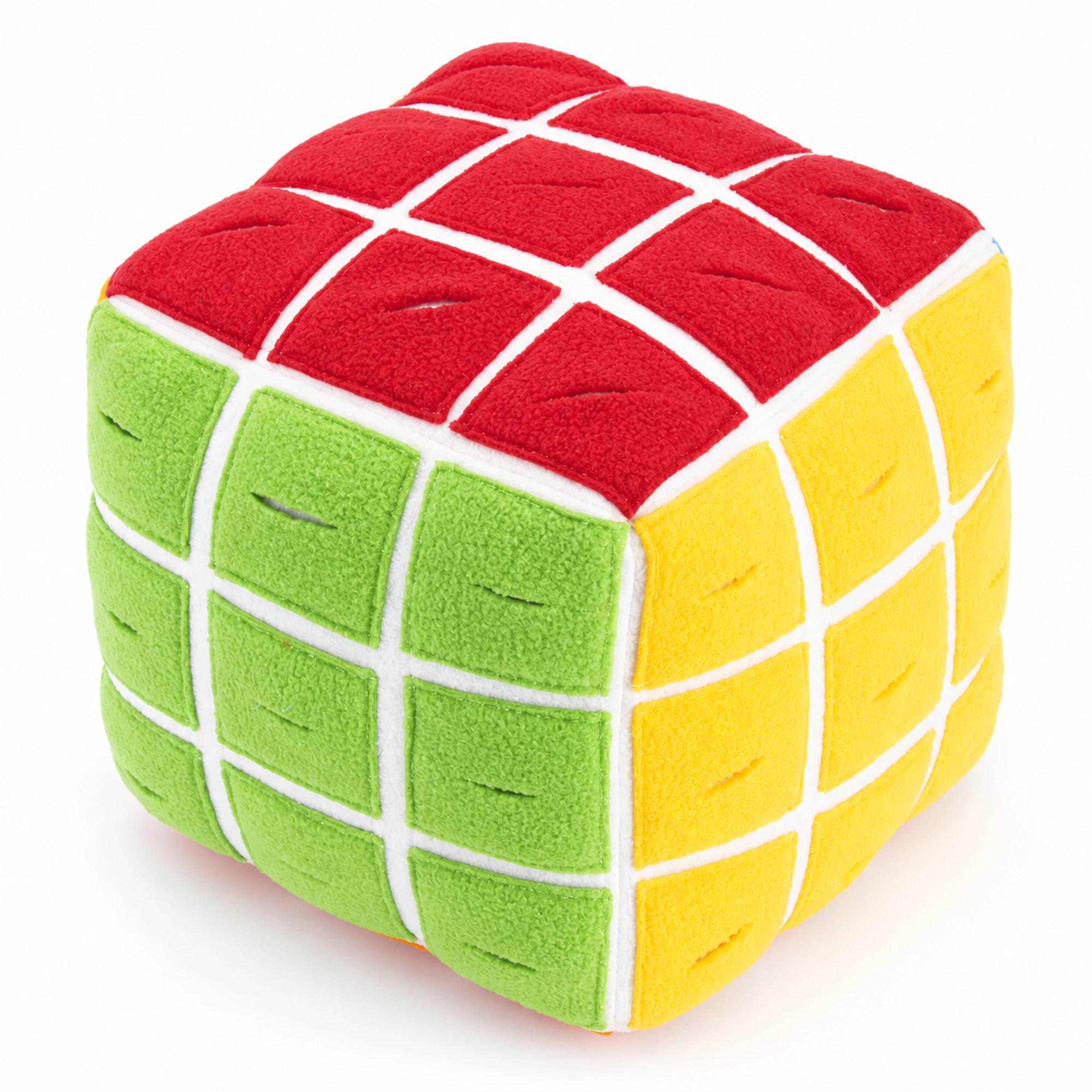
The Large Fabric Pocket Foraging Cube from the JoyPetPlay catalog demonstrates how fabric toys can safely accommodate large canines during supervised sessions. Measuring over seven inches across each dimension, this multi-sided soft puzzle cannot be swallowed or inhaled by a big dog. The toy features numerous folded fabric slits designed to conceal kibble and training treats.
Instead of gnawing through seams with raw bite pressure, dogs must manipulate the cube using their lips, tongue, and front paws to locate concealed food. The substantial cubic surface area forces large dogs to stabilize the toy with their forelimbs, slowing down treat consumption. Handlers can rotate the cube across different colored faces to extend search duration. Because the toy remains dedicated to scent detection rather than destructive chewing, it teaches large canines patient motor control while satisfying natural hunting drives.
Dynamic Manual Tug Mechanics: Safe Grip Leverage and Hand Clearance
Tug games offer exceptional physical conditioning and impulse control practice when managed with structured rules. For large canines, tug toys must provide substantial length so human hands remain safely outside the canine bite zone. Handlers must never grip a toy immediately adjacent to a 400 psi canine jaw.
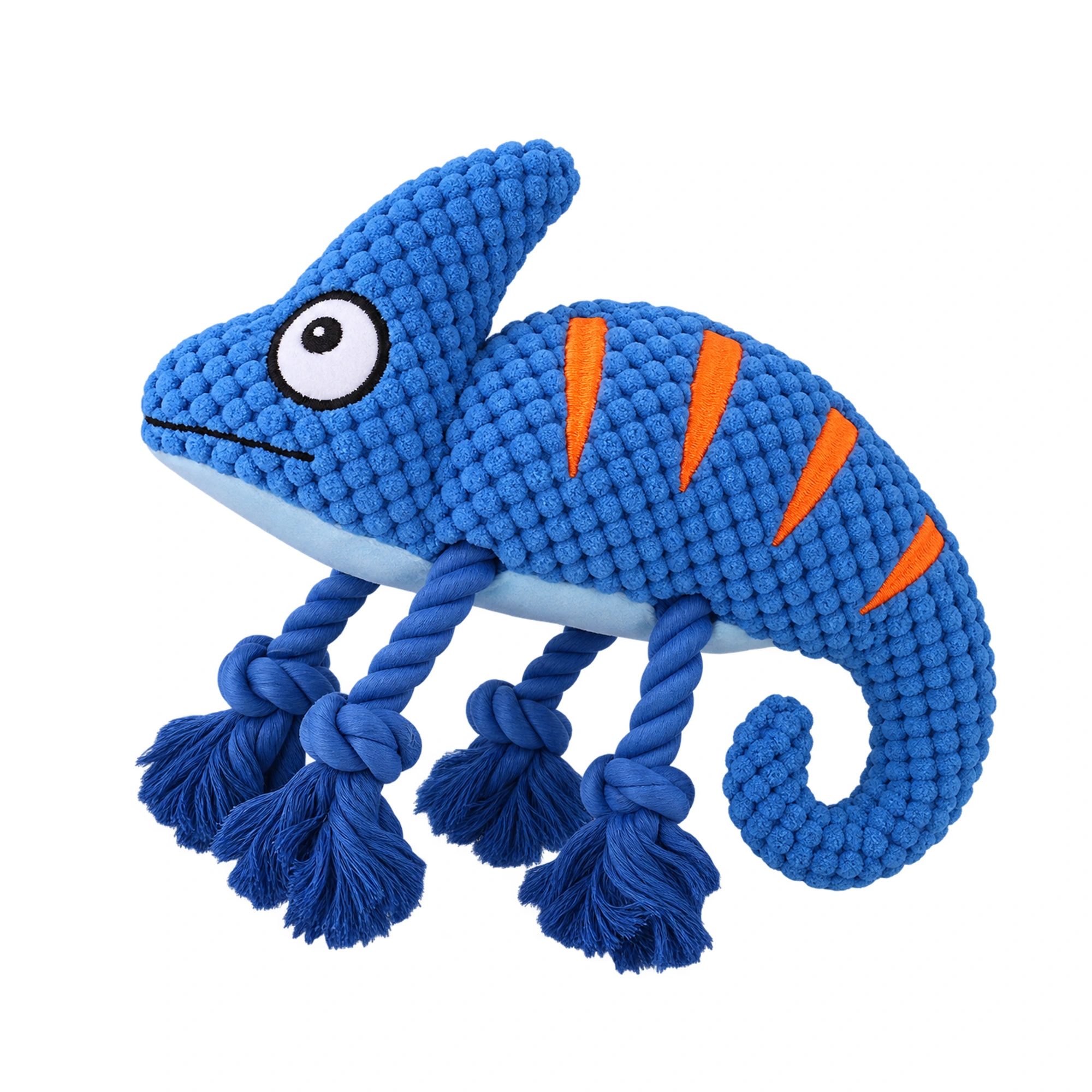
The Blue Pull-Through Chameleon Tug Toy from the JoyPetPlay catalog addresses this requirement directly. It incorporates four extended knotted cotton rope limbs that slide manually through a reinforced central body. The thick rope diameter provides adequate surface area for wide canine muzzles to gain a firm grip without slipping. Handlers can grasp the opposing rope knots at a safe distance, maintaining ergonomic posture during horizontal pulling motions.
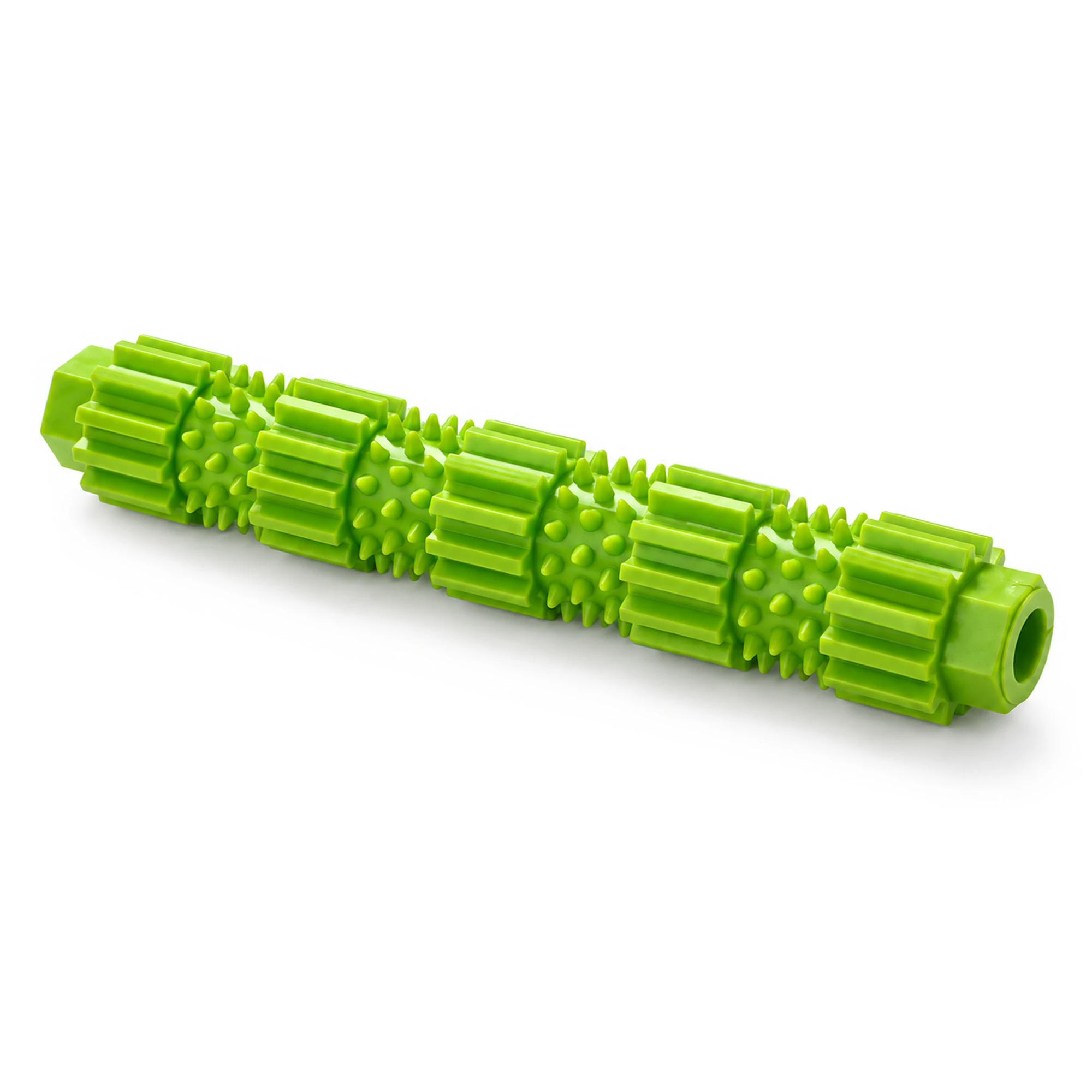
For stationary pulling indoors, the Green Suction Rope Bone Tug Game offers an alternative enrichment format. Anchored securely to smooth flooring via a broad suction base, it allows powerful dogs to work their shoulder and neck musculature against controlled tension without requiring handler counter-resistance. When sizing any tug apparatus, ensure the rope diameter matches jaw dimensions: cords under ten millimeters can cut into canine gums under high tension, whereas twelve to sixteen millimeter braided cotton distributes pulling force comfortably.
Canine Digestive Realities and Foreign Body Obstruction Hazards
When an oversized canine consumes an undersized toy, the digestive consequences can prove catastrophic. Foreign body ingestions represent one of the most frequent surgical emergencies in veterinary medicine. Small rubber squeakers, detachable plastic bells, and short foam balls can easily clear the pyloric sphincter of a large canine only to lodge firmly within the narrower lumens of the duodenum or jejunum.
Once trapped in the intestinal tract, a foreign object blocks fluid and nutrient transit while restricting local vascular supply. Ischemia develops within hours, followed by necrotic mucosal breakdown and possible peritonitis if intestinal perforation occurs. Larger toys that remain in the gastric cavity can cause chronic intermittent vomiting, gastric outflow obstruction, and severe mucosal ulceration.
To protect against these surgical outcomes, dog owners must eliminate all chew items that can be compacted to match gastrointestinal luminal diameters. For canines weighing sixty pounds or more, intestinal lumen width averages between twenty and twenty-five millimeters. Any toy component smaller than thirty-five millimeters poses an immediate internal obstruction risk if severed and swallowed.
Behavioral Energy Outlets and Sizing for Solitary Play
Large canines left unguided often turn to destructive chewing as an outlet for boredom, environmental stress, or separation distress. When dogs chew on household trim, sofa cushions, or drywall, they are seeking tactile resistance and oral feedback. Providing toys sized accurately for independent chewing redirects this pent-up energy into acceptable habits.
During solitary play, sizing guidelines must become significantly more conservative than during interactive sessions. Without a human handler present to monitor bite angle and chewing velocity, toys must feature dimensions that prevent any possibility of oral wedging. Hollow rubber toys designed to hold frozen peanut butter or blended wet food must possess dual ventilation holes. A single-hole design can generate an airtight suction seal against a dog’s tongue or palate, requiring veterinary sedation to release.
Protocol: Structured Four-Step Sizing and Safety Inspection Routine
To safeguard your large dog during daily play, establish a repeatable evaluation protocol before bringing any new toy into your household:
- Measure Muzzle Width: Use a flexible tailoring tape to record the distance across your dog’s upper jaw at the widest point behind the canine teeth. Ensure all spherical toys exceed this width by at least fifteen percent.
- Verify Weight Compatibility: Check manufacturer load ratings. A toy rated for dogs up to thirty pounds will tear rapidly under the fifty-pound leverage of an adolescent retriever or shepherd.
- Test Structural Seams: On fabric and plush items, pull firmly on all external ears, straps, and seams with twenty pounds of manual force. Any seam that stretches or pulls loose will separate within minutes of canine contact.
- Establish Retirement Benchmarks: Inspect rubber and rope toys after every play session. Retire rubber items showing deep surface cracks over two millimeters deep. For rope toys, trim frayed strands immediately to prevent ingestion of loose threads that cause linear foreign body obstructions.
Supervised play remains the bedrock of canine enrichment. Even the most durable large-scale toy should never be left with an unmonitored dog until you have observed multiple sessions of safe interaction. Matching toy scale to canine anatomy ensures a lifetime of rewarding, injury-free play.