Selecting the correct toy for a small dog requires balancing two distinct physical hazards: choking risks from undersized objects and jaw fatigue from oversized gear. Many commercial pet products in standard pet aisles cater to medium and large breeds. This leaves toy dogs with items that are either too heavy to carry or too wide to bite comfortably. Understanding how to measure your dog mouth span and matching toy mechanics to small paws ensures your companion stays safe, active, and mentally stimulated during indoor play.
Anatomical Considerations: Mouth Span, Jaw Leverage, and Cranial Shape
Small dogs are not miniature versions of large canines. Their skeletal structure, bite leverage, and dental spacing create unique interaction patterns with play objects. A ten-pound dog possesses significantly less masseter muscle volume than a fifty-pound dog. That difference limits the mechanical force their jaws can produce. Forcing a toy breed to open its jaws past a comfortable angle stresses the temporomandibular joint, causing rapid fatigue and frustration.
Cranial morphology also shapes toy selection:
- Brachycephalic Breeds: Pugs, French Bulldogs, Boston Terriers, and Shih Tzus have shortened facial bones and crowded teeth. Because their dental arcades are compressed, they struggle to grasp wide spheres or flat discs. They also experience airway compromise more easily, making lightweight objects with clear breathing room essential.
- Mesaticephalic and Dolichocephalic Breeds: Chihuahuas, Yorkshire Terriers, Italian Greyhounds, and Dachshunds possess elongated muzzles. While they reach into deeper toy openings, their narrow jaws lack the leverage to compress dense rubber walls.
- Retained Deciduous Teeth: Toy breeds frequently retain puppy baby teeth alongside adult canines. These crowded dental pockets catch on rough fabric fibers and narrow toy crevices. Smooth surfaces and soft foraging textures reduce that risk.
Observe your dog mouth opening when resting versus when yawning. A toy should never require your dog to open its mouth to the absolute maximum span simply to carry the object across a carpeted floor.
The Dual Dangers of Mismatched Toys: Choking Risks Versus Jaw Strain
The most dangerous mistake an owner can make is offering a toy that is too small. The Humane Society of the United States and veterinary emergency clinics warn that objects smaller than a dog throat opening present severe risks of tracheal obstruction and gastrointestinal blockage.
If a ball or rubber figure slips behind the rear carnassial teeth, normal swallowing reflexes draw the item down the pharynx during active play. For small dogs, a ball diameter under 6 centimeters (about 2.4 inches) is a frequent cause of airway accidents. A safe dog ball or chew item must always remain visibly wider than the back of the oral cavity so that accidental ingestion remains physically impossible.
On the other hand, oversized toys introduce subtle physical harm. When an owner provides a dense, heavyweight rubber bone designed for a retriever, a small dog cannot lift or squeeze the object. Attempting to bite dense materials can cause slab fractures on the premolars and carnassial teeth. Carrying excessive weight in the jaws causes cervical spine strain and muscle soreness in petite breeds. If a toy feels heavy when picked up with two fingers, it will tire a five-pound Chihuahua in minutes.
The Retail Dilemma: Why Small Dogs Ignore Standard Commercial Toys
Toy breed owners frequently share experiences on community forums like Reddit r/dogs about buying expensive toys only to watch their pets ignore them completely. The issue rarely stems from lack of interest in play. Instead, mainstream retail stores stock toys labeled for small dogs that remain impractical in real homes. Heavy vulcanized rubber, thick braided ropes, and stiff squeakers are scaled down in length but retain the wall thickness and rigidity of big dog gear.
Small dogs explore their world through agile paw taps, rapid nose nudges, and delicate chewing motions rather than crushing jaw power. When a squeaker requires twenty pounds of bite pressure to make a sound, a toy breed cannot trigger it. Frustrated by the lack of feedback, the dog walks away.
Successful interactive play for small breeds relies on toys that respond to low force:
- Rolling treat dispensers that glide smoothly across hardwood and low pile rugs.
- Soft fabric snuffle mats and roll up bowls that reward scent work rather than chewing force.
- Lightweight plastic or plush designs with multiple grab points for tiny teeth.
Sizing Criteria for Rolling Treat Dispensers
Rolling treat toys provide valuable cognitive exercise by combining movement with food rewards. However, the outer dimensions, wall weight, and treat exit ports must correspond to small dog biology.
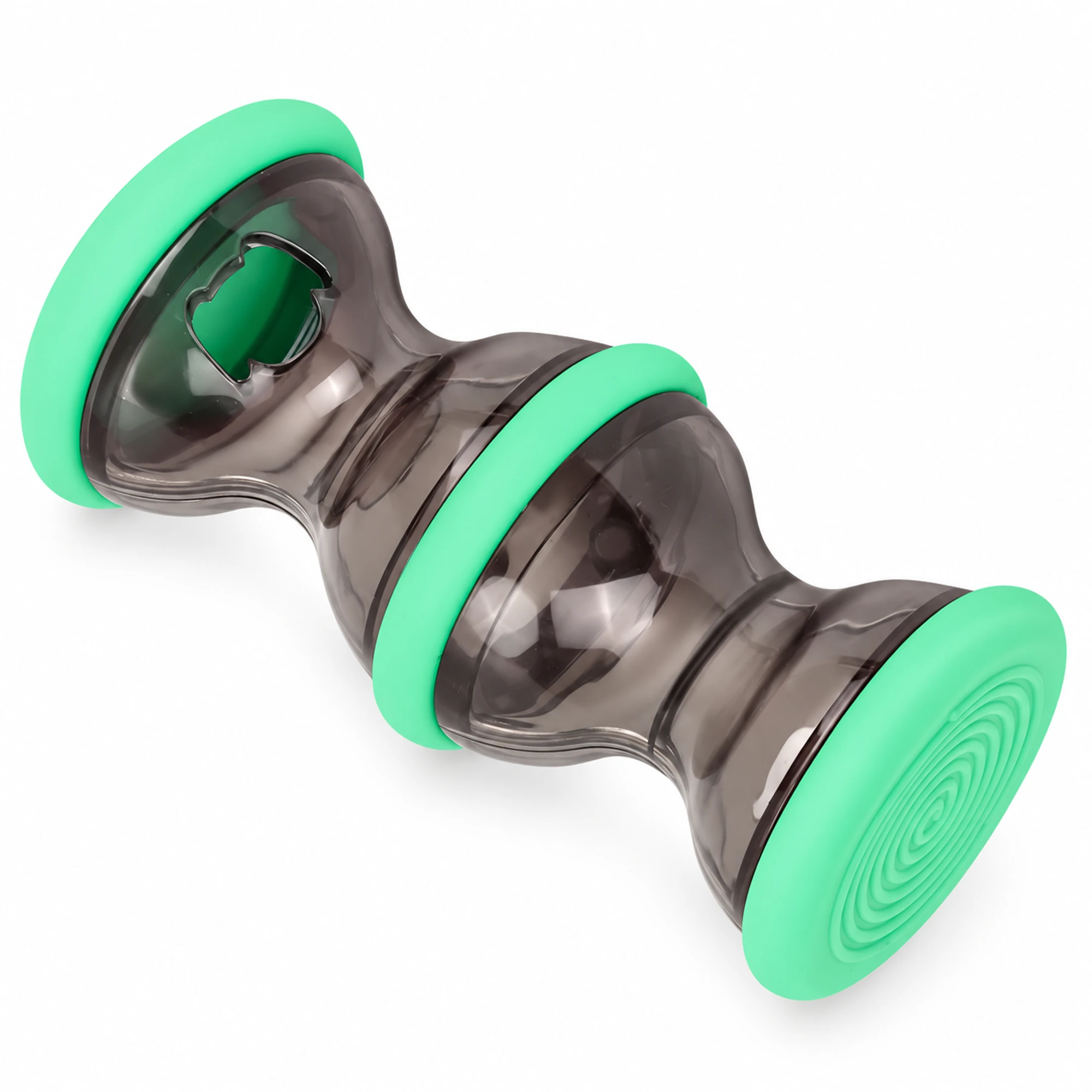
A practical example is the Mint Roll and Reward Small Dog Toys with Clear Dispenser ($11.30, catalog item mint-roll-reward-toy-small). This rolling cylinder features mint-colored end caps with concentric grip grooves and a clear central reservoir. The diameter is proportioned so that a small dog can nudge the unit with a nose boop or a front paw sweep without needing to bite the body. Dry kibble or tiny training treats drop through the dispensing holes as the cylinder rolls across the floor.
When selecting a rolling dispenser, verify these practical details:
- Rolling Resistance: The cylinder or sphere must glide with minimal friction. Heavy weighted bases designed to keep toys upright for large dogs are often too difficult for small dogs to tip.
- Port Diameter: The treat holes should allow standard small dog kibble (roughly 4 to 8 millimeters) to fall out with consistent nudges. If food becomes wedged, the dog loses motivation.
- Surface Texture: Grooved end caps provide traction for small paws and allow the dog to direct the roll without slipping.
Soft Foraging Bowls and Snuffle Mats: Scaled Scent Enrichment
Scent work offers natural mental relaxation that lowers cortisol levels in indoor dogs. While large snuffle mats measuring two to three feet square work well for big breeds, they swallow up living room floor space and scatter treats too widely for a tiny dog to navigate comfortably.
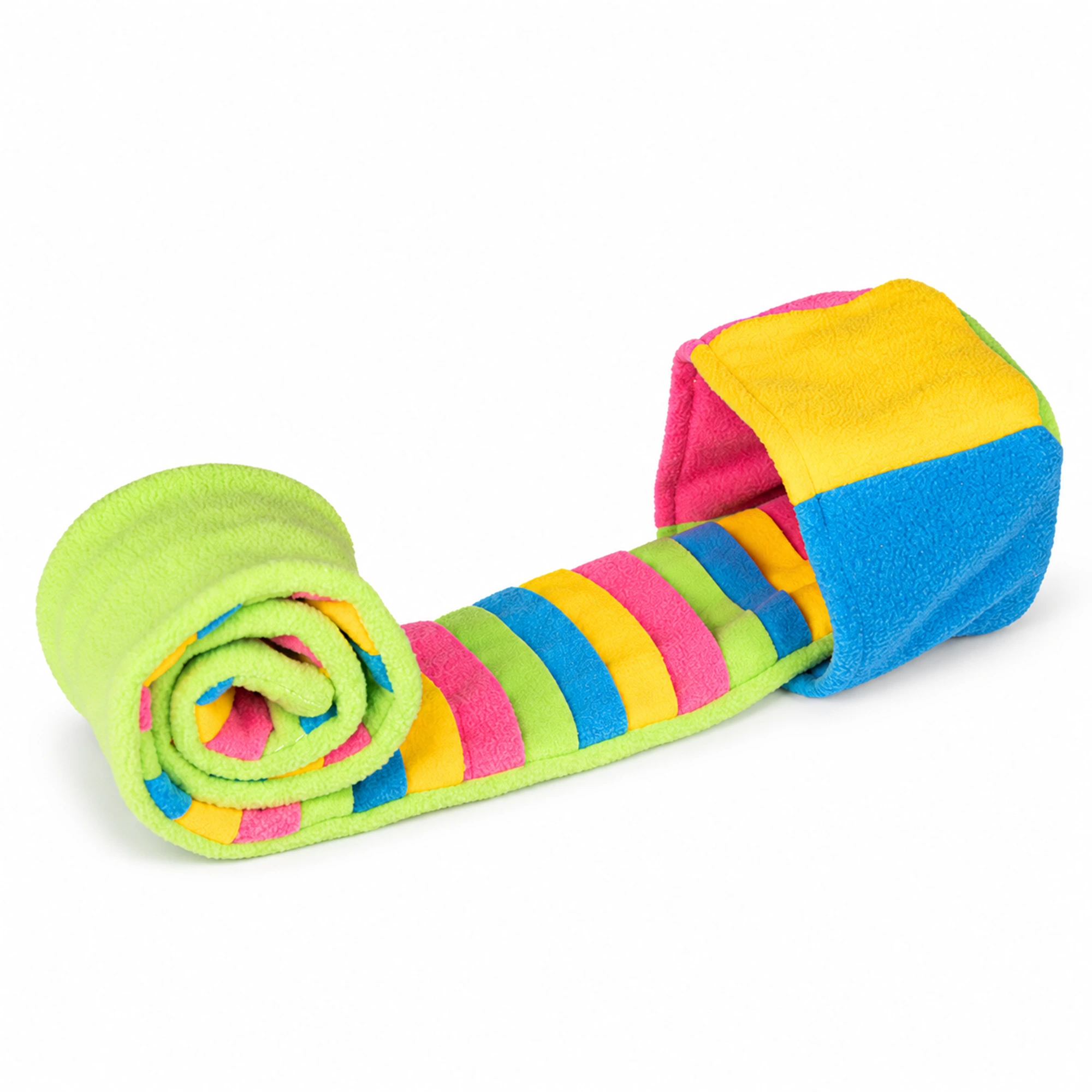
The Small Rainbow Roll-Up Snuffle Mat Foraging Bowl for Dogs ($16.00, catalog item small-rainbow-rollup-foraging-bowl) solves this footprint challenge. It features a compact fleece bowl containing a colorful roll up fabric trail fitted with multiple treat hiding bands. During supervised play, you pull out the trail, hide tiny treats inside the cloth folds, and roll it back into the bowl. A petite dog uses its muzzle and delicate paws to unroll the fabric strip segment by segment, discovering hidden rewards through methodical sniffing.
Soft fleece foraging tools offer significant benefits for small breeds:
- Delicate gums and senior teeth remain protected from abrasion.
- Compact dimensions allow the dog to reach every treat pocket without losing momentum.
- The fabric offers zero resistance to bite pressure, letting dogs with missing teeth participate fully in enrichment.
Small Dog Toy Sizing and Material Selection Matrix
Selecting the right product involves matching your dog weight category to recommended toy dimensions and materials. Use this reference guide before bringing new gear home:
| Weight Category | Example Breeds | Safe Ball Diameter | Recommended Materials | Primary Hazards to Avoid |
|---|---|---|---|---|
| Under 5 lbs (Micro Toy) | Teacup Chihuahua, Tiny Yorkie, Toy Russian | 5.5 cm to 6.5 cm | Thin wall rubber, soft fleece, lightweight hollow ABS | Heavy solid rubber, thick dense nylon, metal bells |
| 5 to 10 lbs (Toy Breed) | Pomeranian, Maltese, Miniature Pinscher | 6.0 cm to 7.0 cm | Pliable TPE, woven felt, grooved plastic cylinders | Stiff squeakers, oversized tennis balls, heavy rope knots |
| 10 to 15 lbs (Petite Small) | Shih Tzu, Miniature Schnauzer, Dachshund | 6.5 cm to 7.5 cm | Natural rubber, multi layer fleece, canvas rolls | Undersized bouncy balls, brittle thin plastics, unsewn eyes |
The Fingernail Test and Material Safety Guidelines
Dental fractures represent a major veterinary expense for dog owners. The American Veterinary Dental College recommends avoiding chew objects that are too hard to indent with a fingernail. Dense nylon bones, real animal hooves, and hard antler pieces do not yield under bite pressure. Because small dogs have thin enamel layers over their premolars, biting down on unyielding plastics frequently leads to slab fractures.
To test a toy at home, perform the fingernail indentation test:
- Press your thumbnail firmly into the surface of the toy.
- If the material gives slightly under thumb pressure, the material is generally safe for canine teeth.
- If the material resists completely and feels like hard stone or countertop composite, reserve that object solely for supervised fetching rather than chewing.
Inspect all seams, stitching, and end caps. Avoid toys with glued plastic eyes, decorative ribbons, or small internal noisemakers that can tear free under persistent chewing.
Safe Supervision Protocols and Toy Rotation Routines
No toy is completely indestructible, and even properly sized gear requires responsible supervision. Small dogs can be surprisingly determined dissectologists, using their sharp front incisors to nibble along seams until internal fibers become accessible.
Follow this five step supervision protocol for every new toy:
- Initial Fifteen Minute Observation: Supervise your dog continuously during the first session. Watch whether they attempt to swallow parts or wedge their jaw around narrow edges.
- Inspect After Play: Check the toy for puncture marks, loose threads, or cracked plastic. Discard any item showing structural failure.
- Calorie Deduction: Deduct all kibble and treats used in puzzle toys from your dog daily food intake. Small breeds gain weight rapidly when given unmonitored treats.
- Implement a Three Box Rotation: Divide your dog toy collection into three distinct baskets. Offer one basket for three days, then swap it for the next basket. Rotating toys renews curiosity without needing to buy new items constantly.
- Separate Play Zones in Multi Pet Homes: If you live with both large and small dogs, never leave small toys in shared areas. A toy that is perfectly safe for an eight-pound Bichon Frise is an immediate choking hazard for an eighty-pound Golden Retriever.
Frequently Asked Questions
What is the minimum safe ball size for a small dog?
The minimum safe ball diameter for most small dogs is approximately 6 centimeters (2.4 inches). The ball must be larger than the opening of the throat and wider than the gap between the rear molars. A ball that can be compressed and pulled into the pharynx poses an immediate choking emergency.
Why do small dogs prefer soft fleece foraging mats over hard rubber puzzles?
Small dogs have sensitive mouth structures and limited jaw leverage. Rigid plastic sliders and heavy rubber puzzles can be frustrating or painful to operate with small paws. Soft fleece foraging mats allow dogs to use their natural sense of smell and gentle pawing to find food rewards without requiring physical bite strength.
How can I tell if a chew toy is too heavy for my toy breed?
Pick up the toy between your thumb and index finger. If the item feels noticeably dense or pulls down on your fingers, it will place unnecessary strain on your small dog neck and jaw muscles. Small dogs prefer lightweight, hollow, or flexible items they can carry effortlessly from room to room.
Can a small dog choke on a toy designed for small dogs?
Yes. Commercial packaging labels are not regulated by strict veterinary standards. A toy labeled for small pets may have loose squeakers, thin plastic caps, or narrow segments that a determined chewer can snap off. Always inspect toys before purchase and monitor play sessions closely.