Leaving a dog alone during long work hours often brings an uncomfortable sense of guilt. Dogs are social animals with active minds, yet modern work schedules require them to spend several hours resting in quiet homes. When mental energy finds no constructive outlet, dogs naturally invent their own jobs. Those self-assigned projects frequently include chewing skirting boards, digging into sofa cushions, unravelling toilet paper, or barking at every passing pedestrian outside the window.
Providing passive chew treats helps for twenty minutes, but traditional chews quickly lose novelty once the edible portion disappears. Canine cognition requires dynamic interactive feedback. The most effective self play dog toys engage a dog in an ongoing loop of action, reaction, and reward. When an object responds dynamically to a nudge, drop, or pull, your dog shifts from anxious boredom into focused problem-solving.
Understanding how to choose and introduce independent enrichment tools transforms routine alone time into healthy mental exercise.
The Canine Neurological Basis of Solo Play
Canine brains release dopamine during exploratory foraging and goal-oriented tasks. In natural environments, wild canids spend significant portions of their waking hours tracking scents, chasing prey, and manipulating objects to extract calories. Domestic dogs inherit those identical motor patterns: orienting, stalking, chasing, grabbing, and chewing.
When pet dogs receive all their food from a standard ceramic bowl in under sixty seconds, they experience what veterinary behaviorists describe as a contrafreeloading deficit. Behavioral studies demonstrate that dogs actually prefer working for their sustenance rather than receiving it passively without effort. Interactive solo toys harness this innate drive by converting meals and playtime into a cognitive challenge.
Fifteen minutes of concentrated mental problem-solving tires an energetic dog more effectively than thirty minutes of repetitive leash walking around the block. By stimulating the frontal cortex and satisfying predatory sequences through safe mechanical feedback, independent play reduces cortisol levels and fosters genuine emotional resilience.
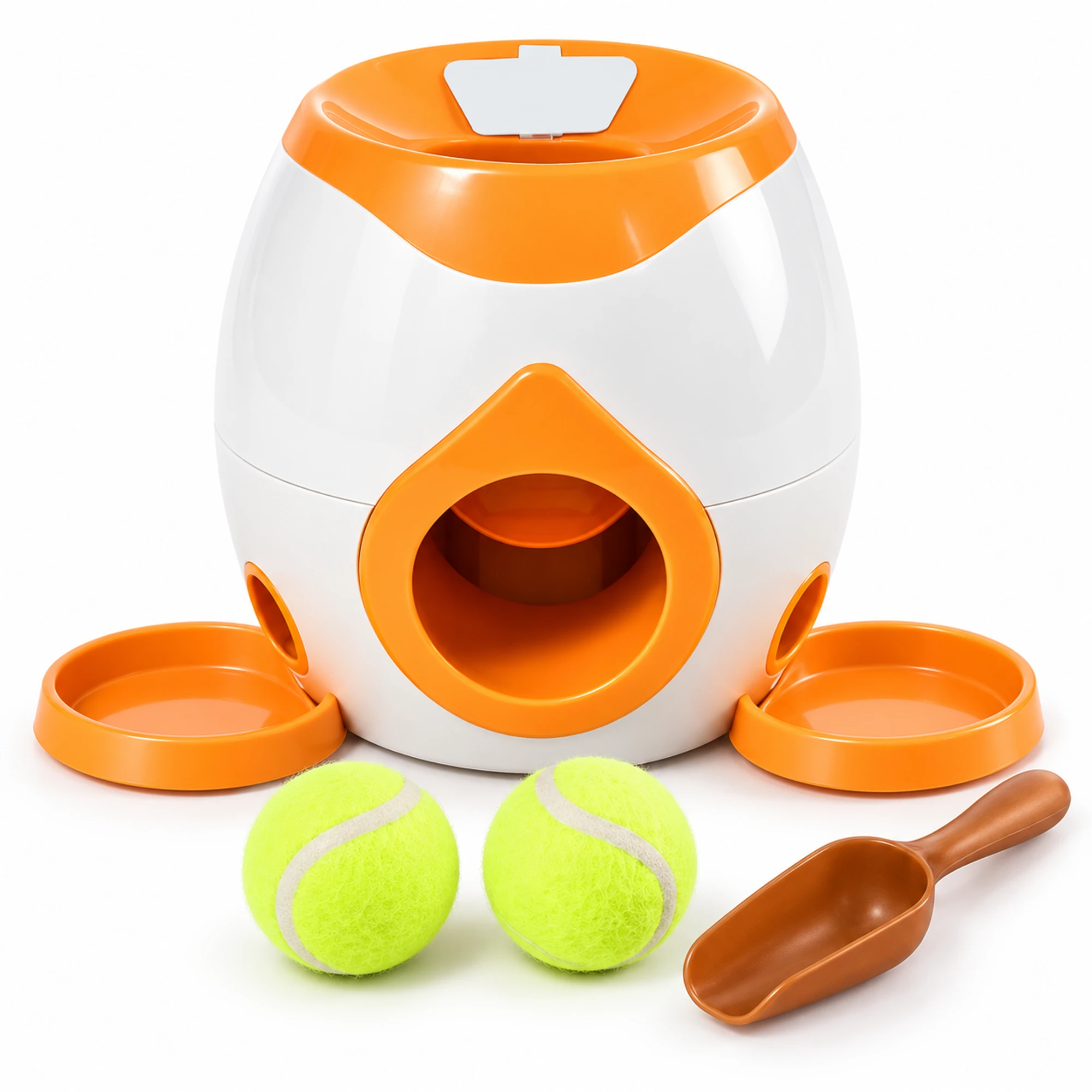
Gravity-Powered Mechanics: The Orange Ball Return and Reward Station
Automated electronic ball throwers have gained popularity in recent years, yet many dogs find high-velocity motorized mechanisms loud, intimidating, or frustrating indoors. Mechanical treat-release stations solve this problem through elegant, gravity-driven design.
The Orange Ball Return and Reward Station operates entirely on your dog mechanical participation without electrical cords, batteries, or noisy motors. Your dog drops a standard tennis ball into the wide top funnel. The falling ball depresses an internal counterbalanced lever, which slides open a concealed lower chamber to dispense crunchy kibble or dehydrated training treats. Simultaneously, the ball rolls out of an angled bottom ramp, setting up the next retrieval cycle.
This simple physical interaction creates an autonomous reward loop. Because the dog controls the operating pace, the game never triggers frantic over-arousal. The mechanical action remains quiet, making it suitable for noise-sensitive dogs who shy away from motorized whirring sounds.
Step-by-Step Training Protocol for Drop Toys
Teaching your dog to use a gravity return station requires three brief training steps:
- Phase One: Funnel Association. Place the station on a non-slip rug. Drop the ball into the top opening yourself while your dog watches, allowing them to eat the dispensed treats immediately. Repeat this five times until your dog anticipates the treat release whenever the ball drops.
- Phase Two: Targeted Delivery. Hand the ball to your dog from two inches above the funnel opening. Use your standard release cue, such as drop it or give, guiding the ball directly into the chute. Praise warmly as treats appear on the floor tray.
- Phase Three: Distance Extension. Gradually step backward by one foot increments. Encourage your dog to pick up the rolled ball from the floor and carry it back to the funnel independently. Most retrievers and herding breeds master the full cycle within three five-minute sessions.
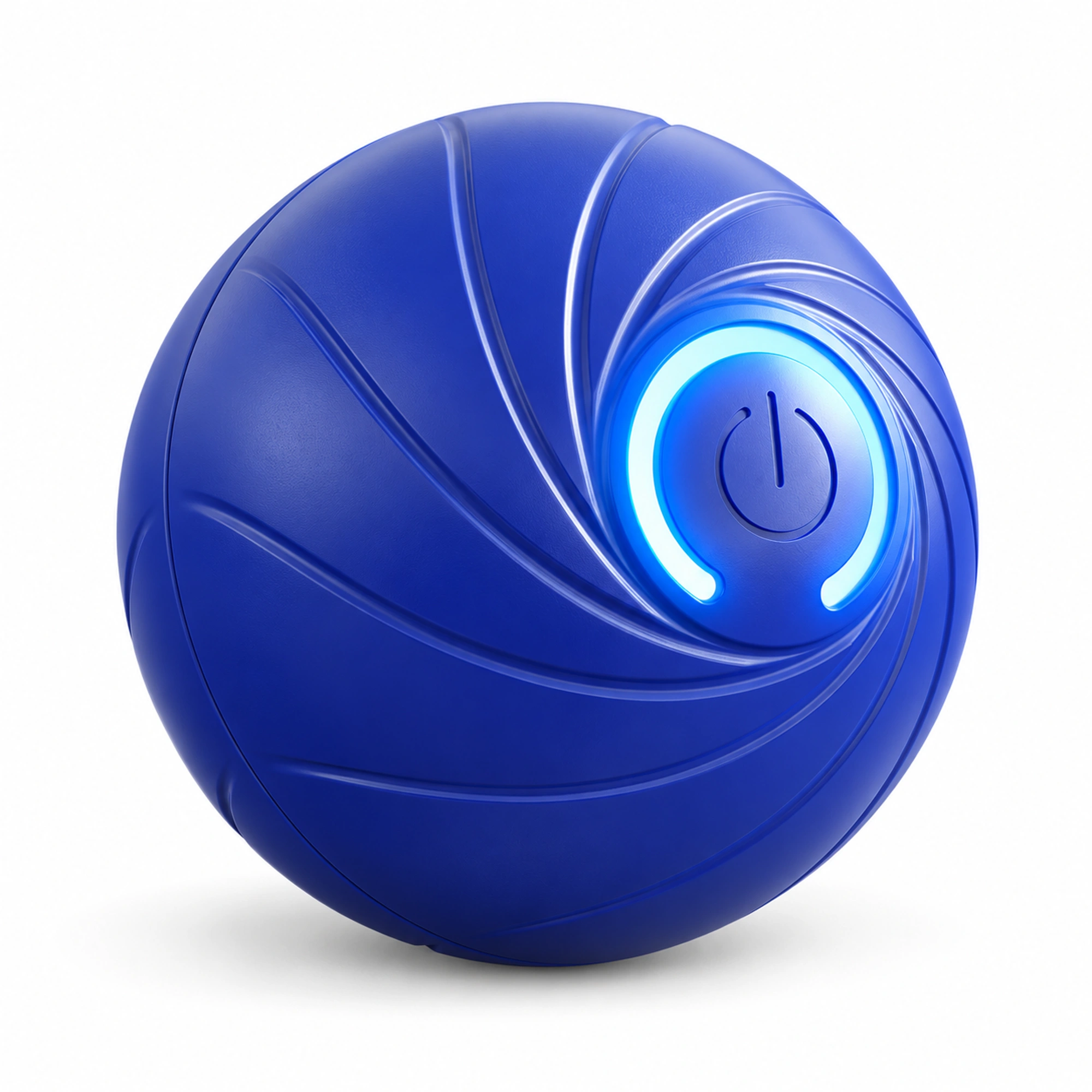
Active Kinetic Movement: The Blue Swirl Rechargeable Rolling Ball
Dogs with pronounced visual tracking instincts thrive on unpredictable motion. When an object rolls across a room in erratic patterns, it triggers the canine visual streak, a specialized band of retinal ganglion cells optimized for detecting horizontal motion.
The Blue Swirl Rechargeable Rolling Ball provides autonomous kinetic movement across hard floors and low-pile carpets. Encased in a soft food-grade silicone shell, this smart sphere contains an internal eccentric motor that switches directional rotation whenever it meets resistance from walls, furniture, or door frames.
Unlike older motorized rolling toys that ran continuously until their batteries died, modern interactive spheres incorporate intelligent motion sensors. After three minutes of active rolling, the ball enters a standby resting mode to prevent canine exhaustion. The moment a curious dog nudges the sphere with a damp nose or exploratory paw, the internal accelerometer instantly re-engages, sparking a fresh burst of evasive movement.
The textured blue swirl pattern provides clear visual contrast, allowing dogs with dichromatic vision to track the rotating sphere easily even in dimly lit hallways.
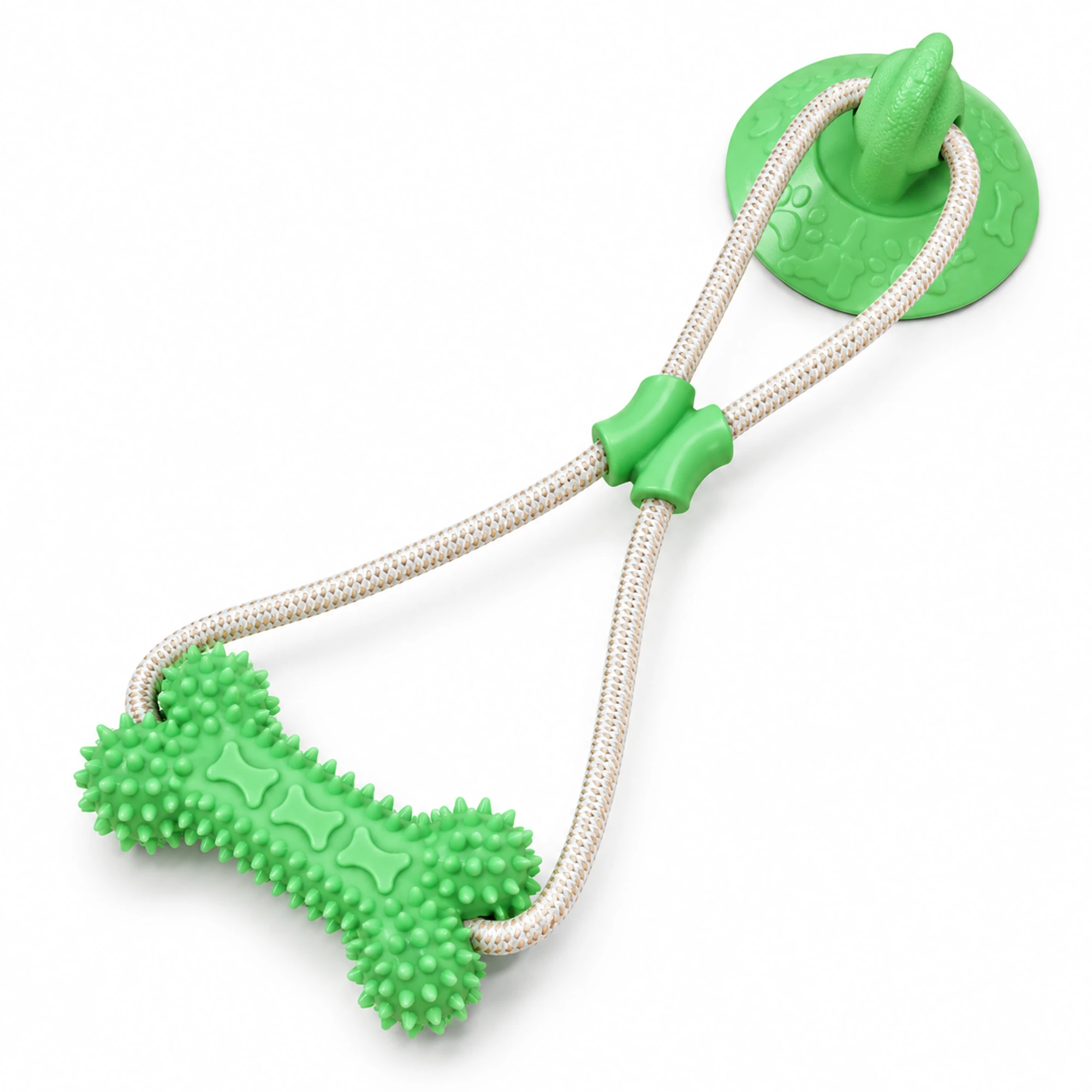
Anchored Resistance Play: The Green Suction and Rope Bone Tug Game
Tugging is among the most natural physical outlets for dogs, helping release muscular tension and satisfying primal gripping instincts. However, solo tugging usually poses a structural dilemma: tying ropes to door knobs risks damaging home fixtures, while free ropes offer zero resistance once dropped.
The Green Suction and Rope Bone Tug Game addresses this challenge through heavy-duty industrial vacuum adhesion. A wide concave silicone suction cup locks firmly onto smooth, non-porous surfaces such as porcelain floor tile, polished hardwood, or glass sliding patio doors. An integrated braided cotton rope connects the suction base to an ultra-tough natural rubber bone handle.
When your dog pulls backward against the bone, the elastic rope absorbs tension and pulls back with gentle resistance. The rubber bone features raised ridges that massage gingival tissue and clean interdental spaces while your dog bites down.
Suction Floor Preparation Tips
To ensure maximum holding power during vigorous tug sessions, follow these surface guidelines:
- Clean the target floor tile thoroughly with isopropyl alcohol to remove dust and pet hair.
- Moisten the underside rim of the suction cup with a damp sponge before locking.
- Press downward firmly on the center dome while pulling the locking latch to exhaust trapped air.
- Inspect the braided rope weekly for frayed fibers or loose knots.
Breed Drive Alignment and Toy Selection Matrix
Different dog breeds exhibit distinct cognitive styles and sensory priorities. Matching the appropriate self play mechanism to your dog natural inclinations ensures high engagement and prevents frustration.
| Breed Category | Dominant Behavioral Drive | Ideal Solo Toy Mechanism | Key JoyPetPlay Selection |
|---|---|---|---|
| Herding Breeds (Border Collie, Aussie, Malinois) | High visual acuity, pattern prediction, sustained work drive | Gravity treat puzzles, multi-step ball return stations | Orange Ball Return and Reward Station |
| Terriers and Sighthounds (Jack Russell, Whippet) | High chase acceleration, visual tracking of rapid motion | Sensor-activated erratic rolling balls with auto-sleep | Blue Swirl Rechargeable Rolling Ball |
| Bully Breeds and Working Mastiffs (Boxer, Staffie) | Intense isometric biting, jaw grip, pulling resistance | Vacuum-anchored suction ropes with resilient rubber bones | Green Suction and Rope Bone Tug Game |
| Scent Hounds (Beagle, Basset Hound, Dachshund) | Olfactory foraging, slow deliberate nose tracking | Hollow treat-dispensing canisters and maze mats | Orange Ball Return and Reward Station |
Home Safety Protocols for Unsupervised Solo Play
While self play dog toys are designed for independent use, establishing clear safety protocols guarantees peace of mind while you are away from home.
First, designate a dedicated enrichment zone. Choose an open area with smooth, unobstructed flooring and remove any dangling electrical cables, delicate potted plants, or small household objects that could become secondary chew targets. A quiet corner of a living room or a dog-proofed laundry area provides an ideal setting.
Second, avoid introducing brand-new toys right before heading out the door. Always supervise your dog through the first three or four sessions. Watch closely to see how your dog interacts with the object. Do they manipulate the mechanisms appropriately, or do they attempt to chew through the outer casing? Confirming that your dog views the toy as an interactive puzzle rather than an edible snack ensures long-term safety.
Third, maintain toy novelty through strict rotation schedules. Leaving six interactive toys scattered across the living room carpet every single day leads to sensory habituation. Dogs view permanent floor clutter as background furniture. Instead, offer one specific solo toy in the morning and put it away in a closed cupboard when you return home in the evening. Rotating between the Orange Ball Return Station on Monday, the Blue Swirl Rolling Ball on Wednesday, and the Green Suction Tug on Friday keeps curiosity keen and enthusiasm high.
Hygiene, Cleaning, and Mechanical Longevity
Independent toys accumulate dried saliva, floor grit, and treat crumbs, making routine hygiene essential for canine health.
Treat-dispensing mechanisms like the Orange Ball Return Station should be emptied and wiped down weekly with warm water and pet-safe unscented soap. Avoid harsh chemical detergents or bleach, which leave lingering residues that deter sensitive canine noses. Inspect the internal treat slide for moisture buildup, which can cause kibble fragments to stick and block the gravity chute.
Rechargeable motorized toys require regular hair clearing. Fine pet fur and carpet lint can wrap around the drive axles of the Blue Swirl Rolling Ball over time. Use a small pair of tweezers to remove accumulated fibers from the seam seals every fortnight. Wipe the silicone outer shell with a damp microfiber cloth and ensure the USB charging port cover is securely sealed before each play session.
For suction rope toys, submerge the cotton braided rope in hot water every two weeks to remove dried enzymes. Allow the rope to air dry completely in sunlight to maintain fiber elasticity.
Frequently Asked Questions
Can self play dog toys replace human interaction and daily outdoor walks?
No. Independent toys provide supplemental cognitive enrichment during solitary hours, but they cannot replace social bonding, structured obedience training, or outdoor exercise. Dogs need daily outdoor walks to experience olfactory variety, socialize with their environment, and strengthen their relationship with their owners. Think of solo enrichment toys as productive mental entertainment that prevents boredom while you are working or running errands.
How do I teach my dog to drop the ball into the return station funnel?
Start by placing high-value treats directly inside the chute so your dog associates the funnel opening with food. Next, hold a tennis ball directly above the opening and ask for your dog drop command. As soon as the ball drops inside and treats dispense, offer energetic verbal praise. Keep initial training sessions under five minutes to prevent cognitive fatigue, and practice across multiple days until the habit becomes automatic.
Will the suction cup on the Green Tug Game damage hardwood flooring?
The industrial silicone suction cup creates adhesion purely through air displacement and vacuum pressure, meaning it uses no chemical adhesives, glues, or sticky pads. It leaves zero residue on sealed hardwood, polished stone, or smooth ceramic tile. To prevent surface scratching from vigorous pulling, place the suction base on flat tile or clean laminate rather than soft, unsealed timber.
What should I do if my dog ignores the interactive toy after a few minutes?
Lack of interest usually stems from two factors: low food motivation or excessive initial difficulty. If your dog ignores a treat-dispensing station, upgrade the reward to intensely aromatic morsels like freeze-dried liver or tiny cheese cubes. If using a motorized rolling ball, sit on the carpet and roll the ball gently between your hands first to build your dog interest through social modeling. Once your dog sees you enjoying the object, their curiosity will quickly take over.