Snuffle mats create an exceptional indoor scent challenge for domestic canines. Tapping into a dog’s keen olfactory drive burns restless energy rapidly, trims baseline cortisol, and fosters calm problem-solving far quicker than a neighborhood leash walk.
A delicate foraging pad engineered for a five-pound Chihuahua quickly collapses under the paws of an eighty-pound shepherd. Placing a short-nosed Pug or French Bulldog before towering fleece folds can also trigger eye chafing, labored breathing, and deep foraging frustration.
Choosing the right enrichment feeder requires understanding your dog’s physical anatomy, jaw power, and natural foraging style. Here is the definitive guide to picking between snuffle mats for small dogs versus large dogs, complete with material standards, stability hacks, and breed-specific mechanics.
Quick Comparison: Small Dog vs. Large Dog Snuffle Mats
| Feature / Factor | Snuffle Mats for Small Dogs & Puppies | Snuffle Mats for Large & Working Breeds |
|---|---|---|
| Typical Dimensions | 10 to 18 inches (compact or bowl-shaped) | 24 to 36+ inches (large flat mats or 3D cubes) |
| Ruffle & Pocket Depth | Shallow (1 to 2 inches) to prevent face burial | Deep (3 to 5 inches) for intense nose burrowing |
| Fabric Density | Lightweight, soft polar fleece or felt | Heavyweight canvas, dense twill, or double-fleece |
| Base Weight & Grip | Lightweight anti-slip silicone dots | Heavy rubber grid backing or suction cup anchors |
| Kibble Compatibility | Micro-bites, training treats, small crunchy morsels | Large breed kibble, freeze-dried patties, whole jerky bits |
| Primary Risk Factor | Mat flipping due to short reach; visual obstruction | Tearing fabric strips, shaking mat violently to dump treats |
Anatomical Drivers: Why Canine Size Dictates Foraging Mechanics
Dogs interact with nose work puzzles through a combination of scent detection, muzzle navigation, and paw manipulation. When sizing a foraging toy, three physical traits matter most:
1. Muzzle Anatomy and Facial Structure
A long-nosed Collie or German Shepherd approaches a puzzle mat differently than a brachycephalic (flat-faced) breed like a French Bulldog, Shih Tzu, or Pug. Flat-faced toy breeds lack muzzle protrusion. When forced to dig their noses into deep fleece canyons, they risk inhaling dust, rubbing their sensitive corneas against rough fabric edges, and experiencing respiratory restriction. Small dogs need open, shallow folds or roll-up cloth strips that allow easy breathing while foraging.
In contrast, large dolichocephalic (long-headed) breeds possess elongated nasal cavities. A shallow mat offers very little mental challenge for a Golden Retriever or Labrador, who can sweep the surface with one pass of their wide snout. Deep pockets and multi-layered fabric slits force them to work each scent trail deliberately.
2. Jaw Force and Chewing Tendencies
A ten-pound Pomeranian exploring a puzzle toy will generally use the tip of their nose and front paws to nudge fabric aside. An adolescent Boxer, Pitbull, or Husky, however, brings formidable jaw pressure to the game. If food is hidden too securely, a large dog may decide that ripping the fabric off the base is easier than carefully sniffing out individual kibble pieces.
3. Eye Level and Field of Vision
Small dogs stand only a few inches off the floor. Deep, high-walled foraging mats can completely block a toy breed’s peripheral vision, inducing stress or startle reactions. Low-profile designs or roll-out strips keep the small dog’s surrounding environment visible while they work.
Small Dog Foraging Challenges: Shallow Ruffles, Short Legs, and Mat Flipping
Pet parents often assume any small snuffle mat will work for a toy dog, only to find their pet struggling within sixty seconds. Here are the most common challenges small dogs face:
The “Mat Flipping” Phenomenon
Because toy breeds and puppies weigh very little, they cannot easily anchor a light mat with their front paws while pulling a stubborn treat out of a tight pocket. When frustrated, many small dogs resort to grabbing the edge of the mat with their teeth and flipping the entire toy over, scattering kibble across the floor.
Solution: Choose a roll-up bowl design with cinch cords or place the mat inside a shallow cardboard box that stops edge lifting.
The Kibble Sinking Trap
If you hide tiny puppy training treats inside dense, three-inch fleece fringes, the treats drop straight down to the rubber mesh base. Small dogs with tiny snouts cannot reach the bottom without pressing their entire face into the fabric. If they cannot retrieve the reward after two minutes, they often lose interest and walk away.
Solution: Use shallow ruffle bowls or roll-out cloth trails where treats sit securely in surface bands rather than deep hidden wells.
Large Dog Foraging Challenges: Destructive Digging, Shaking, and Capacity
Large and giant breeds present the opposite set of challenges. When a big dog tackles an enrichment puzzle, durability and volume become paramount:
Destructive Paw Digging and Shaking
High-energy working breeds (German Shepherds, Belgian Malinois, Australian Shepherds) naturally use their paws like shovels. An unweighted mat will slide across hardwood floors or crumple into a messy ball within thirty seconds. Even worse, clever large dogs quickly learn the “shake and dump” trick: picking the mat up by one corner, whipping their head back and forth, and vacuuming up the treats from the rug.
This frustration is widespread among owners of active breeds. As one owner shared in an open dog training forum:
“Bruce is about a 14 month old neutered male GSD/American Staffordshire/American Bulldog mix. He really loves foraging activities, and has his own “dig zone” in our yard where I bury treats for him to find. I want to try a snuffle mat for him because in bad weather or winter weather he won’t be able to use his dig zone, but he’s a super aggressive chewer and can’t be trusted with plush toys. Is there a good brand or design anyone can recommend? Obviously he would only use the mat under supervision so if he did start to chew it up I could take it away, but if there’s a brand that tends to hold up a little better I’d love to know! Dog tax included.”
To keep large, powerful dogs engaged without destroying equipment:
- Look for heavy base construction: Heavy-gauge natural rubber bases prevent the mat from bunching up under heavy pawing.
- Transition to 3D foraging shapes: Geometric plush cubes or multi-sided puzzle blocks resist the “shake and dump” tactic because treats are buried inside enclosed internal compartments.
- Teach the “Search” cue with strict rules: Interrupt paw pawing immediately by cupping your hand over the toy, waiting for four paws on the floor, and giving a gentle “Find it” restart.
Material and Construction Standards: What to Look For
Whether buying for a five-pound Yorkie or a ninety-pound Rottweiler, inspect these construction details before introducing any snuffle toy:
1. Fabric Type and Edge Finishing
- For Small Dogs: Anti-pill polar fleece or soft jersey cloth. Raw edges should be neatly trimmed without loose hanging threads that could wrap around tiny puppy teeth or tongues.
- For Large Dogs: Reinforced double-layer felt, heavy cotton canvas, or Oxford polyester cloth. Check that pocket seams feature double or triple stitching to resist tearing during enthusiastic nose shoving.
2. Base Construction and Grip
- Suction Cups: Effective on smooth tile or polished hardwood, keeping eager dogs from pushing the mat across the room.
- Non-Slip Dot Backing: Suitable for low-pile carpets and small breeds, but insufficient for large dogs who will slide the mat effortlessly.
- Machine Washability: Dog saliva accumulates rapidly during twenty minutes of nose work. Verify that the entire unit can be tossed into a washing machine inside a laundry bag on a gentle cold cycle.
Product Spotlights: JoyPetPlay Foraging Feeders by Canine Size
JoyPetPlay manufactures purpose-built foraging feeders designed to match specific size categories and feeding behaviors.
| Dog Size Category | Recommended Foraging Toy | Design Characteristics and Benefits |
|---|---|---|
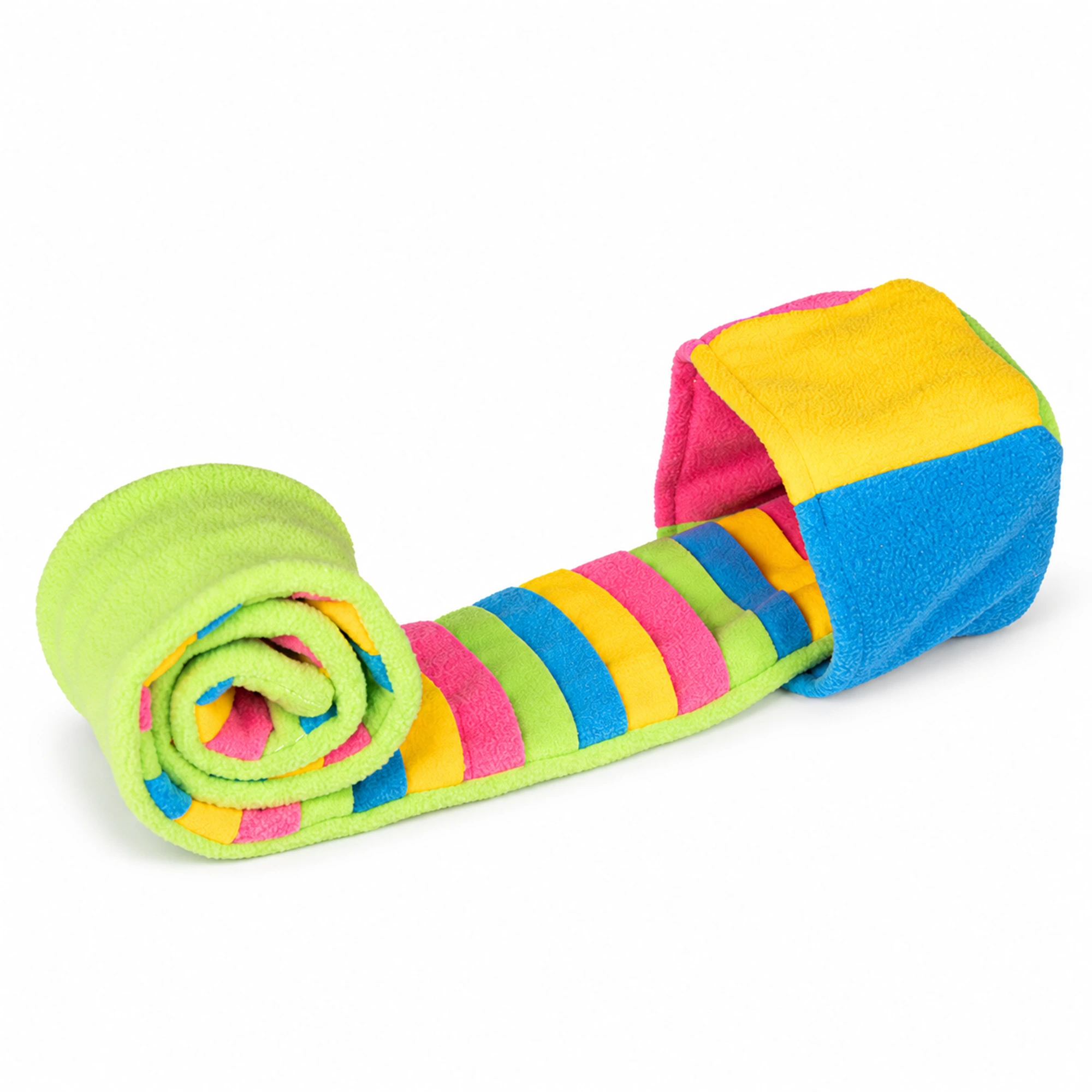
| Small Dogs and Puppies (under 25 lbs) | Small Rainbow Roll-Up Foraging Bowl | Compact fleece bowl with unrollable fabric trail, shallow elastic treat bands to prevent facial suffocation, and adjustable cinch design |
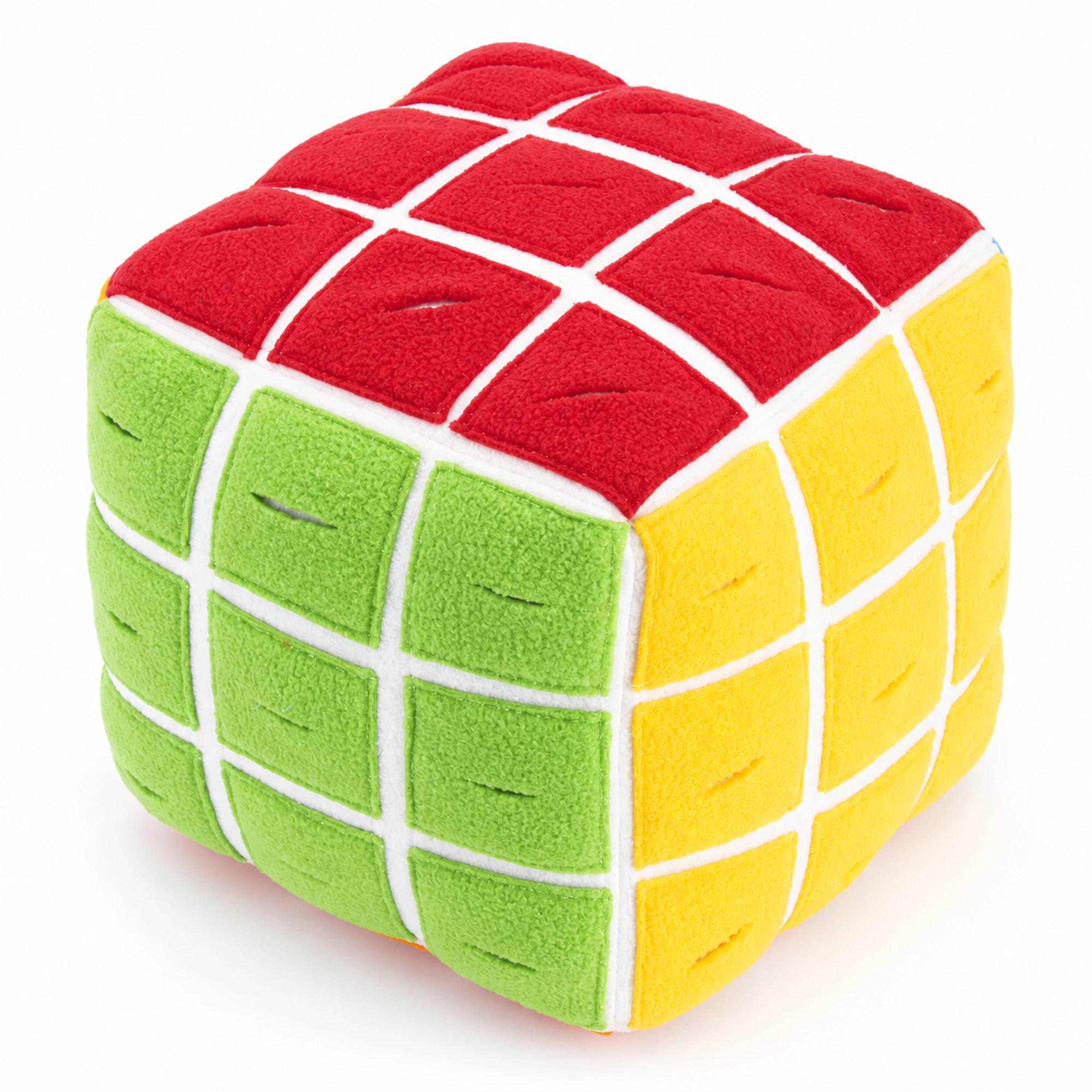
| Medium to Large Breeds (25 to 90+ lbs) | Large Fabric Pocket Foraging Cube | 3D multi-sided geometric cube with deep fabric slits, eliminates shake-and-dump cheating, and accommodates large-breed crunchy kibble |
For Small Dogs & Puppies: The Small Rainbow Roll-Up Foraging Bowl
Unroll the colorful cloth trail, place a few dry treats between the real fabric bands, then roll the connected strip back into its soft fleece bowl. During supervised play your pet can pull the trail out to discover the next treat. The small rainbow version has a lime-green roll and a blue, yellow and pink cloth bowl.
Why it works for small breeds:
- The roll-up mechanism eliminates deep crevices where treats get trapped beyond reach.
- Small dogs use their paws or teeth to pull the lime-green strip forward, turning foraging into an interactive, step-by-step game.
- The soft cloth bowl walls contain loose crumbs without towering over a tiny dog’s eye line.
For Large Dogs & Determined Foragers: The Large Fabric Pocket Foraging Cube
Hide a small treat in a fabric slit and invite your dog to search. Turn the soft cube to reveal another coloured face, then reset the pockets for the next supervised round.
Why it works for large breeds:
- Flat mats are easily flipped over by big paws; the 3D cube rolls naturally when nudged, continually exposing new pocket faces without spilling its contents.
- Deep fabric slits hold larger biscuit bites securely, requiring deliberate snout burrowing rather than rapid surface sweeping.
- The multi-sided structure prolongs the game from five minutes to fifteen or twenty minutes of sustained mental exertion.
Step-by-Step Training: Teaching Dogs to Sniff, Not Shred
A snuffle toy is a cognitive feeder, never a chew toy. Without proper introduction, both small and large dogs may try to bite or shred the fabric. Follow this three-step protocol:
- Step 1: The Easy Scatter (Day 1-2): Place five to eight high-value treats resting visibly on top of the fabric folds. Do not hide them inside. Let your dog learn that the toy produces food through licking and sniffling.
- Step 2: Partial Tucking (Day 3-5): Tuck treats halfway into the fabric slits or roll-up bands, leaving half of each treat exposed. Encourage your dog with a gentle “Find it” cue.
- Step 3: Deep Burrowing (Day 6 onward): Bury treats fully inside the pockets or roll the cloth strip completely inside the bowl.
- The Immediate Pickup Rule: The moment your dog finishes the last treat, calmly pick up the toy, praise them, and put it out of reach. Leaving an empty mat on the floor invites bored chewing and fabric swallowing.
Frequently Asked Questions
Can a large dog use a small snuffle mat?
While a large dog can physically eat treats off a small mat, they will finish the game in under two minutes and may tear the delicate fleece trying to reach crumbs. A small mat does not offer enough mental stimulation for a medium or large dog, and aggressive chewers can easily pick up and destroy a lightweight unit.
Can a small dog or puppy use a large dog snuffle mat?
A small dog can use a large mat only if the fleece ruffles are wide and shallow. If the mat features deep, tightly compressed fabric strips designed for large snouts, small puppies and flat-faced breeds will struggle to reach treats, leading to frustration and disinterest.
How often should you wash a dog snuffle mat?
Wash your dog’s snuffle mat after every three to five uses, or immediately if wet food, oily treats, or excessive drool contacts the fabric. Wash in cold water on a delicate cycle inside a mesh laundry bag, then air dry completely to preserve fabric elasticity.
How do I stop my dog from shaking the snuffle mat?
If your dog lifts and shakes the mat, anchor it down using heavy suction cups, place it inside a heavy-lipped tray, or switch to a 3D puzzle cube like the Large Fabric Pocket Foraging Cube that cannot be dumped with a single shake.
Summary Checklist: Choosing the Best Foraging Toy
- For dogs under 25 pounds, choose shallow ruffles, roll-up cloth bands, or compact foraging bowls that preserve clear vision.
- For dogs over 25 pounds, invest in heavy rubber bases, deep fabric pockets, or 3D multi-sided foraging cubes that resist flipping.
- Match treat dimensions to pocket depth: micro-bites for shallow bowls, large crunchy biscuits for deep fabric slits.
- Always supervise 100% of snuffle sessions and remove the feeder immediately once empty.