Check the food and the dispensing outlet before asking your dog to keep trying. Confirm which food the toy is intended to hold, find the opening it should leave through, and use only the adjustment described for that model. If the instructions do not tell you how to set it up, pause and ask the maker rather than cutting the opening or improvising an insert.
Separate loading from dispensing
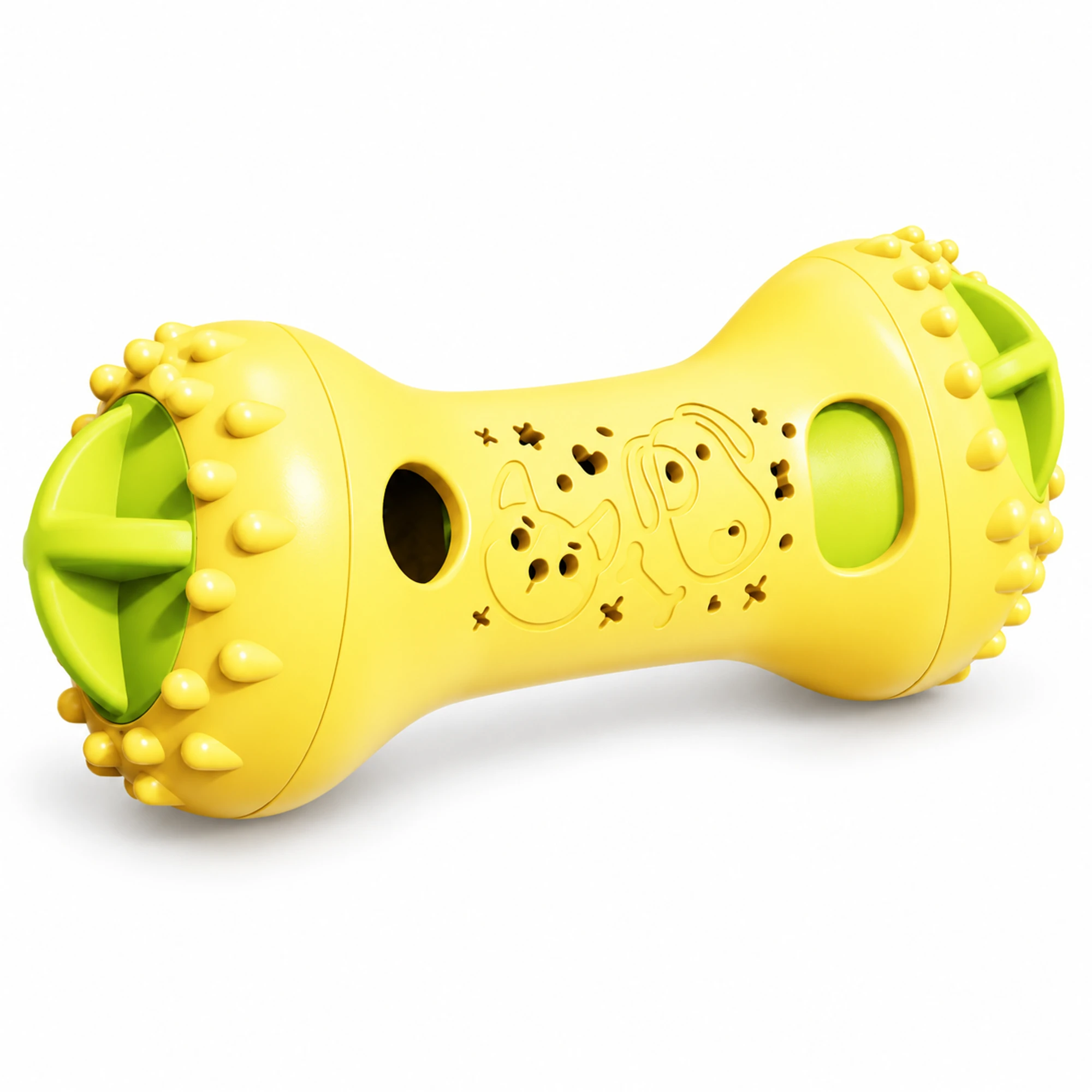
A place to put food in is not necessarily the place it should come out. JoyPetPlay’s Yellow Roll & Adjust Treat Dumbbell makes the distinction explicit: twist an end lid to fill it, then turn the grip to adjust the side outlet. Its description identifies a yellow dumbbell with lime end grips for rolling treat play.
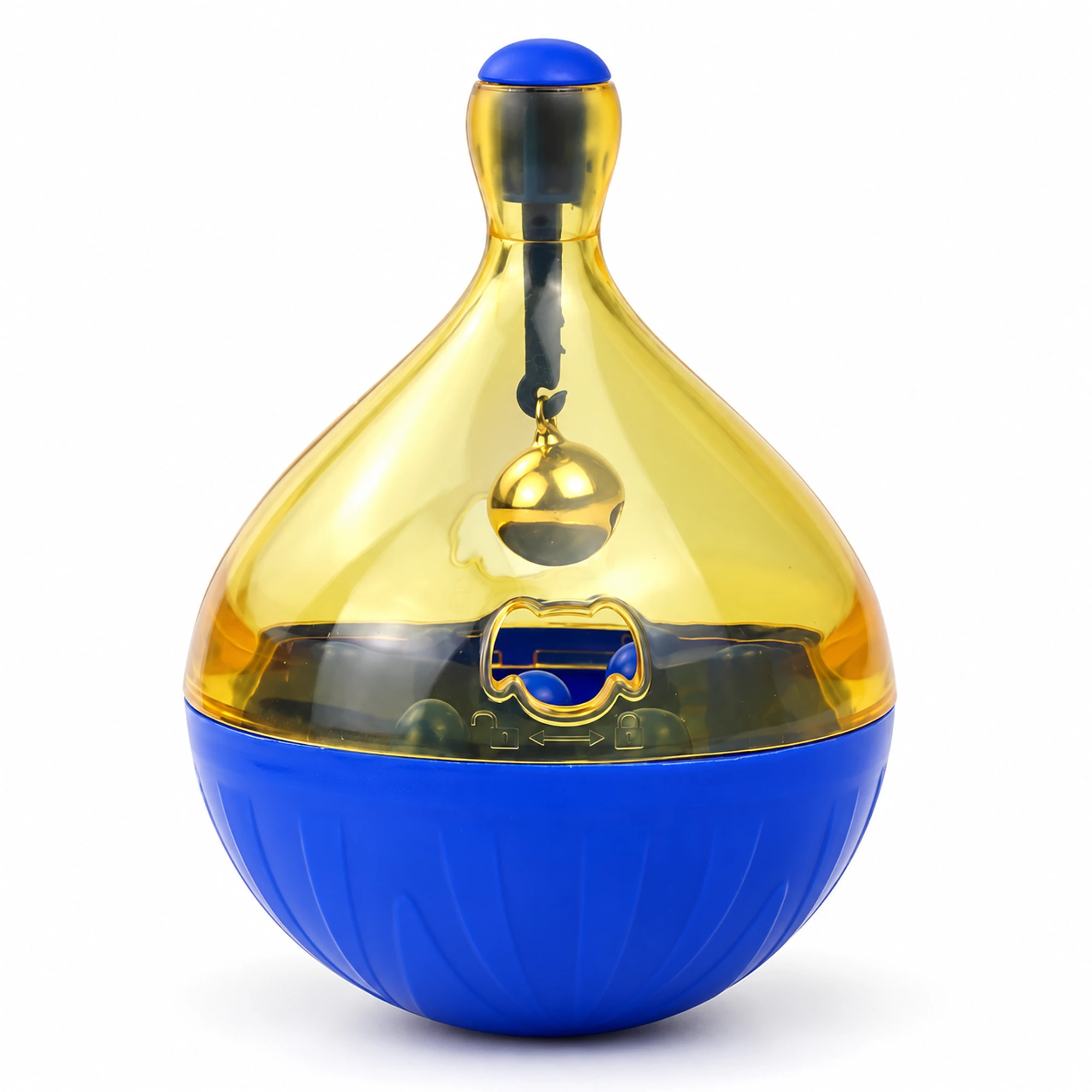
The Blue Bell Wobble & Treat Toy has a different description: nudge the rounded base to rock it, open the top to add food, and close it before supervised play. Small treats are described as leaving through a shaped side opening.
For the blue toy, the description does not identify an outlet adjustment. For the yellow toy, it does not give the outlet’s minimum or maximum dimensions. Keep those unanswered details separate from the operating steps that are actually stated.
Check the food format before its size
PetSafe’s guide to treat-dispensing toys distinguishes toys that release loose treats or kibble from toys that hold treat rings or are filled and frozen. It also describes small Treat Meter prongs on some treat-holding toys that control dispensing.
That is a reason to start with your toy’s instructions. Do not transfer a frozen-filling idea or another model’s prong adjustment to a rolling dispenser merely because both are called food toys.
For the food you intend to use, answer these questions:
- Does the maker allow this type of food in this model?
- Does it specify a piece size or a compatible treat?
- Which opening is the outlet, and is adjustment actually described?
- What movement is supposed to release the food?
If there is no size guidance, send the maker the exact toy option and the food’s name, shape and measured dimensions. Ask what fits rather than substituting a guessed millimeter limit.
Use the built-in adjustment, where one is documented
PetSafe’s UK page for the Busy Buddy Twist ‘n Treat describes twisting the opening wider for easier access to treats and tighter for longer play. That is an example of a designed adjustment. It does not establish a particular release rate for your food, or give permission to modify another toy.
For the yellow dumbbell, the documented control is the grip that adjusts the side outlet. Keep the filling lid and outlet control separate when checking your setup. If the direction, travel limit or correct closed position is unclear, get the model’s fuller instructions before experimenting.
The opposite problem is useful to recognize too. An r/puppy101 owner reported that tiny puppy kibble mostly fell out of their ball in one roll. They asked about making the opening smaller, including a proposed glued insert. That was a question about their own toy, not an approved modification or a result we recommend reproducing.
Make one controlled setup check
Here is a simple way to organize a check once the maker’s food and operating instructions are clear. Set the dog aside from the check and use the documented loading, closure and movement steps. Change one permitted setting at a time, keeping the food the same, and record what you actually observe.
| Observation | Next step |
|---|---|
| No food comes out under the instructed movement | Recheck permitted food, loading, closure and outlet setting. If those are correct, ask the maker to troubleshoot the exact setup. |
| Most food comes out immediately | Look for a documented way to reduce the opening or change the setup. If there is none, ask about compatible food before altering the toy. |
| Food comes out during your setup check, but the dog does not operate the toy | Treat the next task as introducing the movement to the dog, rather than continuing to change the outlet. |
| You cannot identify the control or its allowed range | Stop the adjustment and request the model’s instructions. |
A note can be as plain as “food used / outlet setting / movement tried / what came out.” You do not need a target number of treats per minute. The purpose is to describe a reproducible setup, not to prove a guaranteed difficulty level.
For supervised play, follow the exact toy’s instructions. Keep washing and drying questions with its care instructions too: solving a food-release problem does not establish how to clean the toy.