Finding white synthetic fluff strewn across your living room rug is a familiar sight for many pet owners. Dogs routinely target the vulnerable seams of plush toys, pull the stuffing out by the mouthful, and leave behind an empty fabric carcass. While this dissecting behavior is deeply rooted in natural canine instincts, loose toy stuffing presents genuine physical dangers if your dog decides to eat it.
Knowing how to react the moment your dog opens a toy, recognizing the subtle early symptoms of intestinal obstruction, and swapping vulnerable plush toys for safe stuffing-free alternatives keeps your pet healthy without eliminating everyday play.
Why Dogs Pull Stuffing Out: The Predatory Dissection Instinct
Pet owners frequently wonder why their dogs methodically eviscerate soft toys. Eviscerating a plush toy stems from an innate predatory sequence: searching, stalking, catching, biting, and dissecting.
In the wild, canids dissect prey before eating. Domestic dogs retain varying degrees of this drive. The soft give of a plush toy mimics prey tissue, and the squeaker inside often sounds like an injured animal. Once a dog punctures the fabric, pulling the batting out fulfills their biological urge to deconstruct the object. High prey drive breeds such as terriers, hounds, and herders often exhibit this motor pattern with remarkable focus.
On r/dogs, user khushnand described this exact scenario: their dog would chew up stuffed toys and continuously remove and chew the stuffing, tearing open repeated repair stitches and prompting a search for durable, soft alternatives without loose interior batting.
When dogs lack acceptable mental stimulation, this dissection motor pattern becomes an easy coping mechanism. Dissecting fabric releases dopamine in the canine brain, creating a self-reinforcing loop where tearing fluff provides temporary relief from boredom or nervous energy.
Immediate Action Plan: What to Do When the Stuffing Comes Out
When you catch your dog actively pulling stuffing from a toy, follow these immediate steps:
- Trade, Do Not Chase: Dashing toward your dog or shouting often triggers defensive guarding or prompts an immediate panic swallow. Reach for smelly, high-value treats instead. Toss a treat slightly away from the dog to entice them to release the toy willingly.
- Clear the Mouth: Once the dog steps away, quickly check inside their cheeks and around the tongue. Gently sweep away any loose polyester fibers clinging to their teeth or roof of the mouth.
- Assess the Missing Volume: Pick up the torn toy and gather all scattered fluff from the floor. Form the recovered batting into a loose pile to estimate whether your dog swallowed a significant chunk or simply spat it out during play.
- Inspect the Squeaker: Check whether the plastic squeaker capsule is still inside the toy or accounted for on the carpet. Ingested squeakers pose an immediate rigid obstruction risk.
- Record the Time and Timeline: Note the exact time the incident occurred. Veterinary treatment options change significantly depending on how many hours have elapsed since ingestion.
Gastrointestinal Pathology: Linear Foreign Bodies vs Obstructive Polybezoars
Standard dog toy stuffing consists of polyester fiberfill, commonly known as polyfill. Unlike natural food items, synthetic polyester fibers cannot be broken down by gastric acid or pancreatic enzymes.
Obstructive Polybezoars
When swallowed in clumps, polyester fibers accumulate with digestive mucous, shed hair, and partially digested kibble. This mixture forms a dense, non-digestible mass termed a trichobezoar or polybezoar. As the stomach attempts to propel this mass through the pyloric sphincter into the duodenum, the clump can wedge tightly, preventing the passage of fluids and solids.
Linear Foreign Body Plication in the Jejunum
The most dangerous medical complication occurs when a dog ingests long unraveling strands of fabric, structural thread, or bonded batting sheets. This creates a classic linear foreign body.
In a linear obstruction, one portion of the material anchors proximal to the stomach or duodenum, frequently catching at the pyloric outflow tract or upper duodenal flexure. Meanwhile, normal intestinal peristalsis attempts to sweep the free trailing end downward through the jejunum and ileum.
Because the proximal end remains anchored, the intestine crawls along the taut synthetic thread like fabric gathering along a drawstring. This condition is called intestinal plication. As peristaltic contractions continue against the fixed synthetic line, the thread acts like a cheese wire, sawing through the delicate mesenteric border of the intestinal wall. Perforation spills intestinal contents into the peritoneal cavity, resulting in severe septic peritonitis, systemic shock, and high mortality rates if surgical intervention is delayed.
Foreign Body Type and Veterinary Risk Matrix
| Foreign Body Classification | Primary Gastrointestinal Risk | Typical Onset Window | Standard Clinical Treatment |
|---|---|---|---|
| Dispersed Polyester Fluff (Small Pinch) | Mild transient constipation, safe passage in stool | 24 to 48 hours | High-fiber diet, hydration, close home monitoring |
| Dense Fiberfill Wad (Large Ingestion) | Mechanical luminal blockage, pyloric or ileocecal impaction | 12 to 36 hours | Endoscopic extraction or exploratory laparotomy with enterotomy |
| Bound Internal Seam Threads (Linear Body) | Jejunum plication, mesenteric sawing, bowel perforation | 18 to 48 hours | Emergency exploratory surgery with bowel resection (enterectomy) |
| Hard Plastic Squeaker Capsule | Acute esophageal choking, mechanical gastric outflow blockage | 2 to 12 hours | Immediate fluoroscopic endoscopy or gastrotomy |
Clinical Warning Signs and When to Seek Emergency Care
Humane World for Animals advises that many factors contribute to toy safety depending on dog size, activity level, and preferences, and warns to buy toys of appropriate size because small toys or fragments can be swallowed or lodge in a dog’s throat.
Monitor your dog closely for 24 to 72 hours following suspected stuffing ingestion. Contact your emergency veterinarian immediately if you observe any of the following clinical signs:
- Repeated unproductive retching or persistent vomiting, particularly after drinking water
- Complete refusal of meals or sudden onset anorexia
- Marked lethargy, depression, or reluctance to rise from their bed
- Abdominal pain demonstrated by the prayer position with front paws down and rear end elevated
- Tense, rigid, or vocalizing abdomen during gentle palpation
- Absence of normal bowel movements for more than 24 hours
- Dark, tarry stools (melena) indicating upper gastrointestinal hemorrhage
The Clinical Decision Window: Endoscopy vs Conservative Monitoring vs Surgery
When you bring a dog to the veterinary clinic after toy ingestion, timing dictates the available medical options.
The 2-Hour Gastric Window
If you arrive within two hours of ingestion and the stuffing does not contain sharp objects, your veterinarian may induce emesis using intravenous apomorphine hydrochloride in dogs. Emetic induction carries risks if large foreign bodies might become lodged in the esophagus on the way up, but for soft fluff, early vomiting often evacuates the stomach completely. Never attempt home remedies like salt or hydrogen peroxide without explicit veterinary direction, as hydrogen peroxide causes severe hemorrhagic gastritis.
Diagnostic Imaging
When foreign material passes beyond the pylorus into the small intestine, vomiting is no longer effective or safe. Your veterinarian will perform abdominal radiographs. While polyester batting is radiolucent and does not show up as a bright white object like bone or metal, veterinarians look for indirect signs: bunched gas patterns, abnormal bowel diameter ratios (small intestinal diameter exceeding 1.6 times the height of the second lumbar vertebra), and plicated ribbon-like gas bubbles. Abdominal ultrasonography provides detailed real-time visualization, highlighting hyperechoic luminal interfaces with acoustic shadowing and hypermotile or aperistaltic loops.
Enterotomy vs Enterectomy
If conservative medical management fails or imaging confirms an obstruction, an exploratory laparotomy is required. If the intestinal tissue remains pink, viable, and well vascularized, the surgeon performs an enterotomy, making a longitudinal incision along the anti-mesenteric border to extract the synthetic mass. If linear sawing has caused necrosis, discoloration, or perforation, the surgeon must perform an enterectomy, removing the compromised segment of bowel and anastomosing the healthy margins.
Safe Stuffing-Free Alternatives for Dogs That Love to Dissect
Removing vulnerable plush toys never means cutting off play. Channeling that natural urge to nose, unravel, and tug into designs without loose polyester fiberfill delivers the same satisfaction safely.
Small Rainbow Roll-Up Foraging Bowl
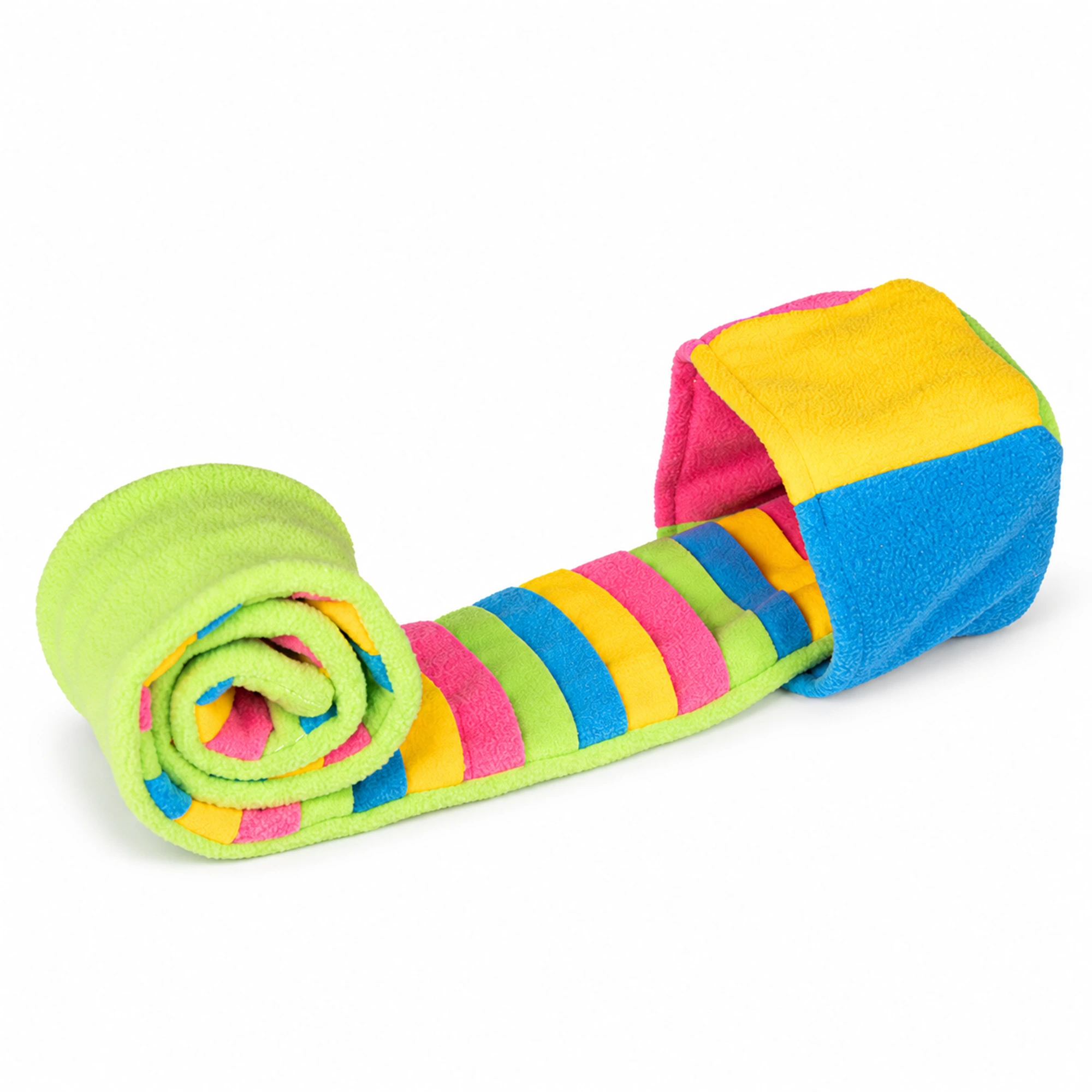
For dogs that crave the soft tactile sensation of fabric and love digging for rewards, the Small Rainbow Roll-Up Foraging Bowl ($16.00) offers an ideal enrichment solution. The design features a colorful cloth trail where dry treats can be placed between fabric bands, then rolled into its soft fleece bowl for supervised nosework play. The small rainbow version has 10 cm rolled width and height.
Dogs use their paws and snout to unroll the fabric bands layer by layer, satisfying their foraging and unraveling instincts without any loose polyfill stuffing to ingest. Because each band is firmly stitched and contains no loose batting, dogs receive the rewarding sensation of deconstructing layers while working for their food.
Green Suction & Rope Bone Tug Game
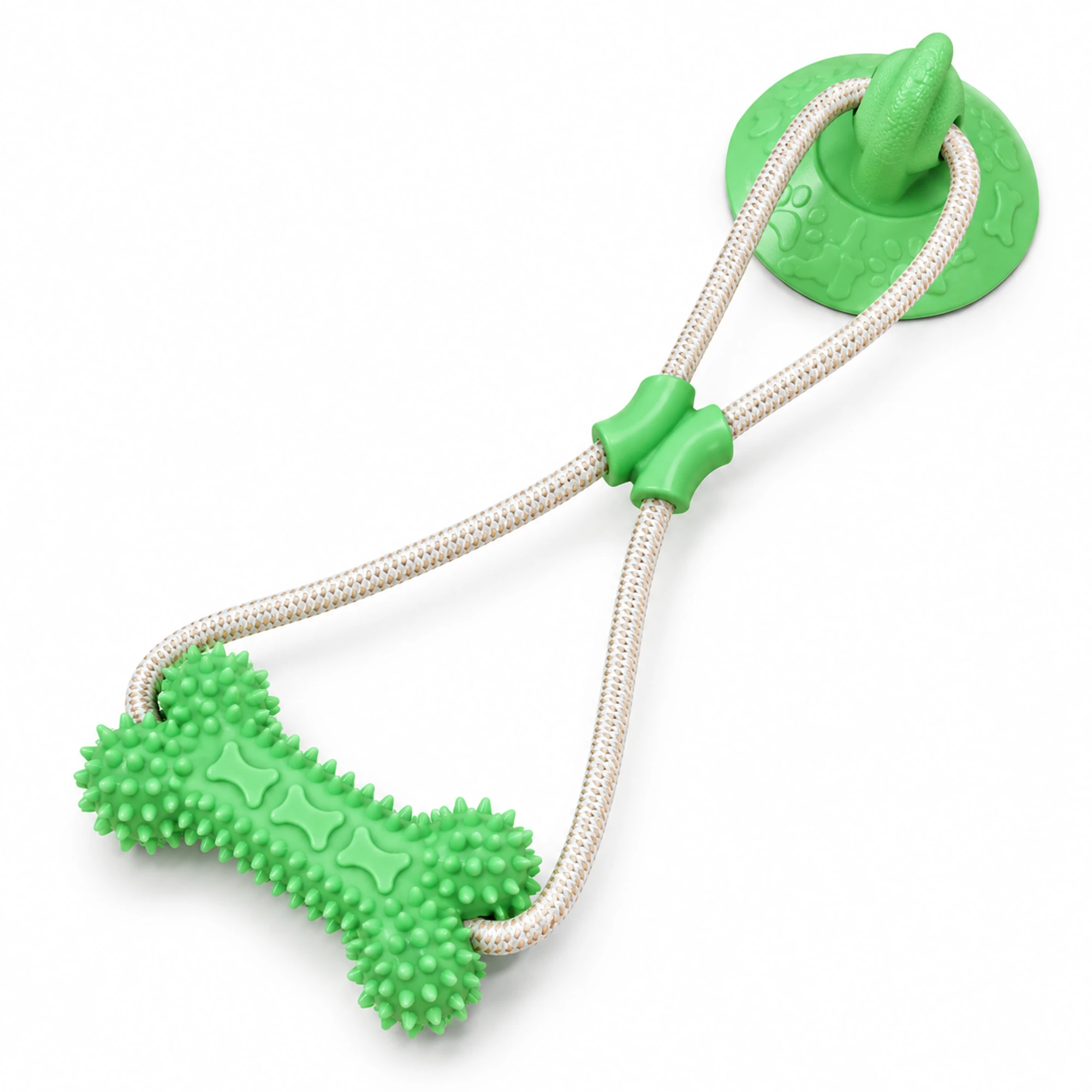
For dogs that channel frustration or high energy into vigorous pulling and ripping, mechanical floor-anchored toys provide a durable physical outlet. The Green Suction & Rope Bone Tug Game ($8.50) features a green suction base designed to press onto a clean smooth floor for solo pulling games with a textured bone and adjustable rope loop.
By anchoring to tile, hardwood, or laminate surfaces, the toy allows dogs to pull and shake with full body engagement without shredding seams or exposing interior fluff. The dense rubber chew bone massages gums while the durable rope fibers resist unraveling under sustained isometric tension.
Practical Supervision and Environmental Management Rules
Safe play habits prevent emergency veterinary clinic visits. Adopt these simple management routines:
- Supervise All Fabric Play: Treat any toy containing fabric or seams as an interactive, supervised activity rather than a toy left in an empty crate. When you leave the room, put soft toys out of reach.
- Retire Damaged Toys Promptly: The moment seams begin separating or interior layers become visible, remove the toy from circulation. Attempting to stitch torn seams rarely holds against determined jaws.
- Establish a Systematic Two-Toy Rotation: Keep only two or three durable toys accessible at a time. Rotating toys every few days maintains novelty and reduces boredom-driven destruction.
- Provide Daily Mental Fatigue Outlets: A mentally tired dog is far less likely to dissect soft household objects. Using snuffle bowls, rolling treat dispensers, and scent games channels excess energy productively.
Frequently Asked Questions
Can a dog pass plush toy stuffing naturally without medical treatment?
Small amounts of loosely swallowed polyester fluff can pass through the digestive tract if the dog is large, well hydrated, and fed high-fiber foods that bulk up the stool. However, large wads or synthetic threads pose significant obstruction risks. If your dog exhibits vomiting, lethargy, or loss of appetite, immediate veterinary evaluation is essential.
Why do dogs swallow the stuffing instead of spitting it out?
While many dogs spit out fluff after ripping it apart, some accidentally swallow strands because the synthetic fibers stick to the saliva on their tongues. Other dogs swallow stuffing during high-arousal resource guarding, gulping the material rapidly if they believe an owner is running over to take it away.
Is crinkle paper safer than polyfill stuffing inside dog toys?
Crinkle paper and cellophane linings still pose intestinal foreign body risks if swallowed in volume, but they do not form the same dense, fibrous polybezoars as polyester batting. However, unlined rubber toys and structured fleece snuffle rolls remain much safer alternatives for persistent chewers.
How do veterinarians diagnose swallowed polyester batting on X-rays?
Polyester batting is radiolucent, meaning it appears gray and translucent on standard radiographs. Veterinarians look for secondary obstructive signs, such as asymmetric bowel distention, stacked fluid-filled loops, and characteristic pleating patterns caused by linear foreign bodies. In uncertain cases, barium contrast studies or abdominal ultrasound confirm the diagnosis.