Unlike commercial kibble or topical medications, canine play items do not arrive stamped with an exact expiration calendar. A resilient natural rubber bone might endure half a year inside a gentle retriever’s toy basket, whereas a soft plush squeaker may disintegrate within twenty minutes under an eager young terrier’s determined jaws. Because chewing dynamics and jaw forces diverge significantly across canine breeds, knowing when to decommission a toy relies on routine physical inspection rather than arbitrary time intervals.
Recognizing the moment an everyday comfort companion deteriorates into an urgent choking hazard represents a critical protective responsibility for every dedicated pet guardian. In this comprehensive guide, we examine fundamental safety thresholds for retiring canine play items, assess typical service lifespans across diverse materials, navigate the emotional attachment dilemma surrounding worn comfort items, and outline how structured rotation schedules preserve durability across your entire toy assortment.
The Core Safety Rule: When to Toss Immediately
When determining whether a toy is safe to keep in active circulation, systematic visual inspection serves as your frontline safeguard. Veterinary health standards established by The Humane Society of the United States recommend that guardians promptly discard play items as soon as tearing begins or structural pieces break off.
This rigorous baseline directly protects against gastrointestinal obstruction, among the most prevalent and urgent surgical emergencies encountered in veterinary facilities. As dogs gnaw on weakened toys, loose synthetic threads, polymer fragments, and textile shards easily slide down the esophagus. Polyfill batting, foam fillings, internal squeaker chambers, and jagged plastic edges resist canine gastric acid breakdown. Once swallowed, these foreign masses cause dangerous blockages within the intestines, presenting as acute vomiting, profound lethargy, abdominal tenderness, and severe tissue necrosis.
If you encounter any of the following critical warning indicators, retire and discard the play item immediately:
- Missing components or exposed internal elements: Any item missing limbs, plastic eyes, or squeaker capsules must be removed from your pet’s reach before loose fragments are swallowed.
- Torn exterior seams and leaking fill material: The moment an outer fabric seam gives way, loose synthetic batting becomes an immediate obstruction danger.
- Structural fractures across rubber, ropes, or plastics: Deep rubber fissures, peeling chunks, unraveled linear rope threads, or jagged puzzle edges can slice soft oral tissues or cause internal obstructions.
Lifespan and Wear Patterns by Toy Category
Because different toy styles serve distinct physical and cognitive purposes, their rates of degradation look very different. Understanding the intended function of each category helps you monitor wear accurately.
1. Plush and Squeaker Fabric Toys
Average Lifespan: A few hours to several months (depending on chewing style)
Plush toys are designed primarily for gentle carrying, comforting companionship, and soft squeaking stimulation. They are not engineered to withstand sustained grinding or tearing. The earliest signs of failure appear along the reinforced seams, usually where the limbs or ears join the torso. Once a seam splits, dogs naturally target the squeaker bladder and polyfill batting. If your dog is a designated dissector who methodically shreds fabric, plush toys should only be offered under close supervision and removed as soon as the outer skin gives way.
2. Rope and Braided Tug Toys
Average Lifespan: 1 to 4 months
Rope toys are built for interactive tug-of-war games and gentle flossing action between teeth. Over weeks of enthusiastic tugging, the tight cotton braid loosens and develops hairy fraying. While minor surface fuzz is harmless, long tangled strands that pull free easily are dangerous. Once the central knots loosen or significant thread strands unravel, trim the frayed ends or discard the rope entirely to keep your dog from swallowing loose threads.
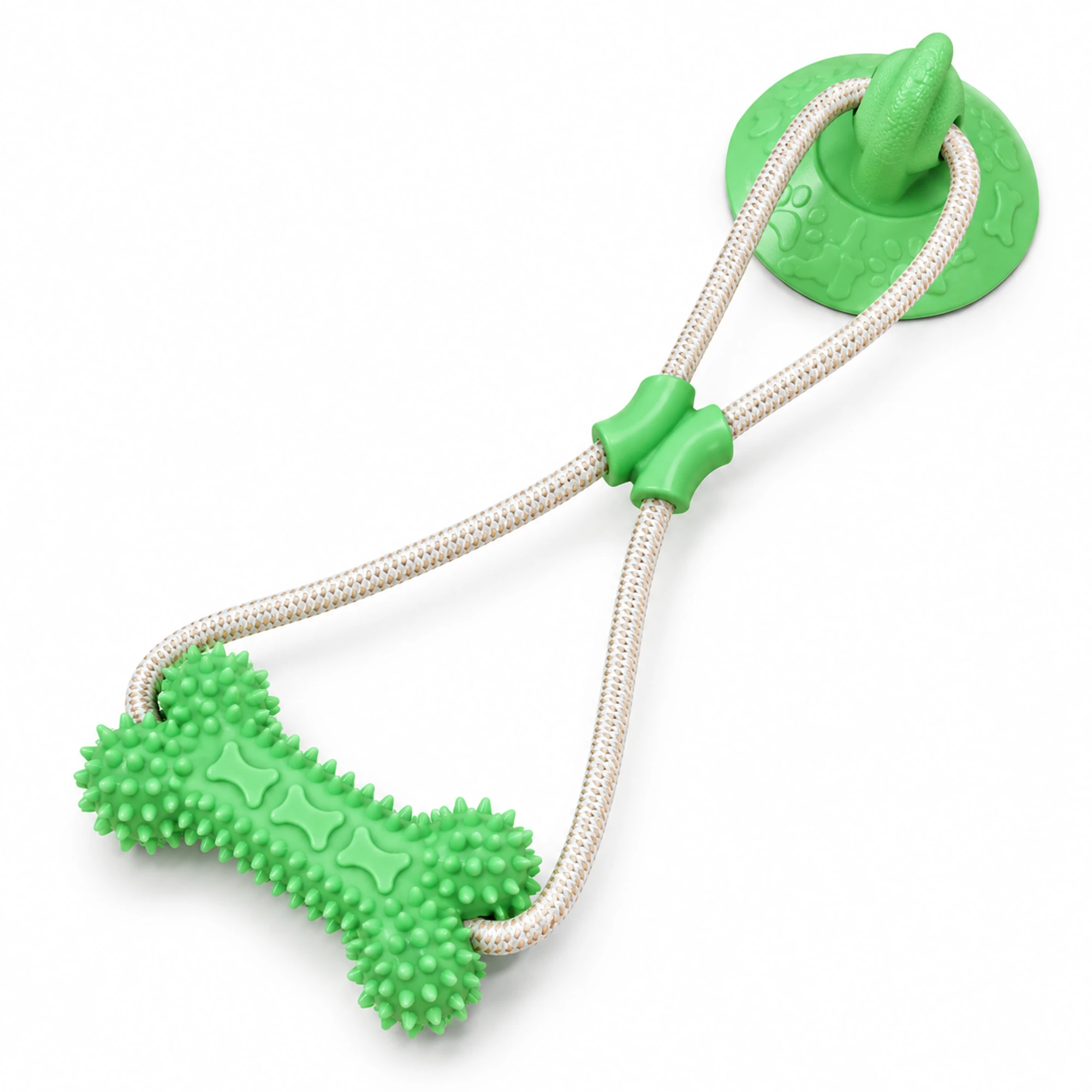
For pet parents looking for a safer, more controlled pulling dynamic, interactive tethered designs like the Green Suction & Rope Bone Tug Game offer a resilient combination. You press the green suction base onto a clean, smooth floor and invite your dog to pull the textured bone. The integrated braided rope is kept taut against the floor rather than left lying loose in a basket, making wear inspection simple after every play session.
3. Rubber and TPR Chew Toys
Average Lifespan: 3 to 12 months
Natural rubber and thermoplastic rubber (TPR) toys are the gold standard for independent chewing. High-grade rubber flexes under jaw pressure, distributing biting forces evenly across the toy surface. However, rubber eventually suffers from fatigue. Inspect rubber toys under bright light by bending them in your hands. Look for hairline surface cracks, brittle discoloration, or areas where your dog has gnawed off small chunks. If the toy has become gummy, overly soft, or shed its outer texture, it is time for a replacement.
4. Interactive Mental Enrichment Puzzles
Average Lifespan: 6 to 18+ months
Interactive treat puzzles are designed for cognitive enrichment rather than jaw resistance. Because their primary goal is problem solving, puzzles should always be used as supervised enrichment activities rather than chew toys.
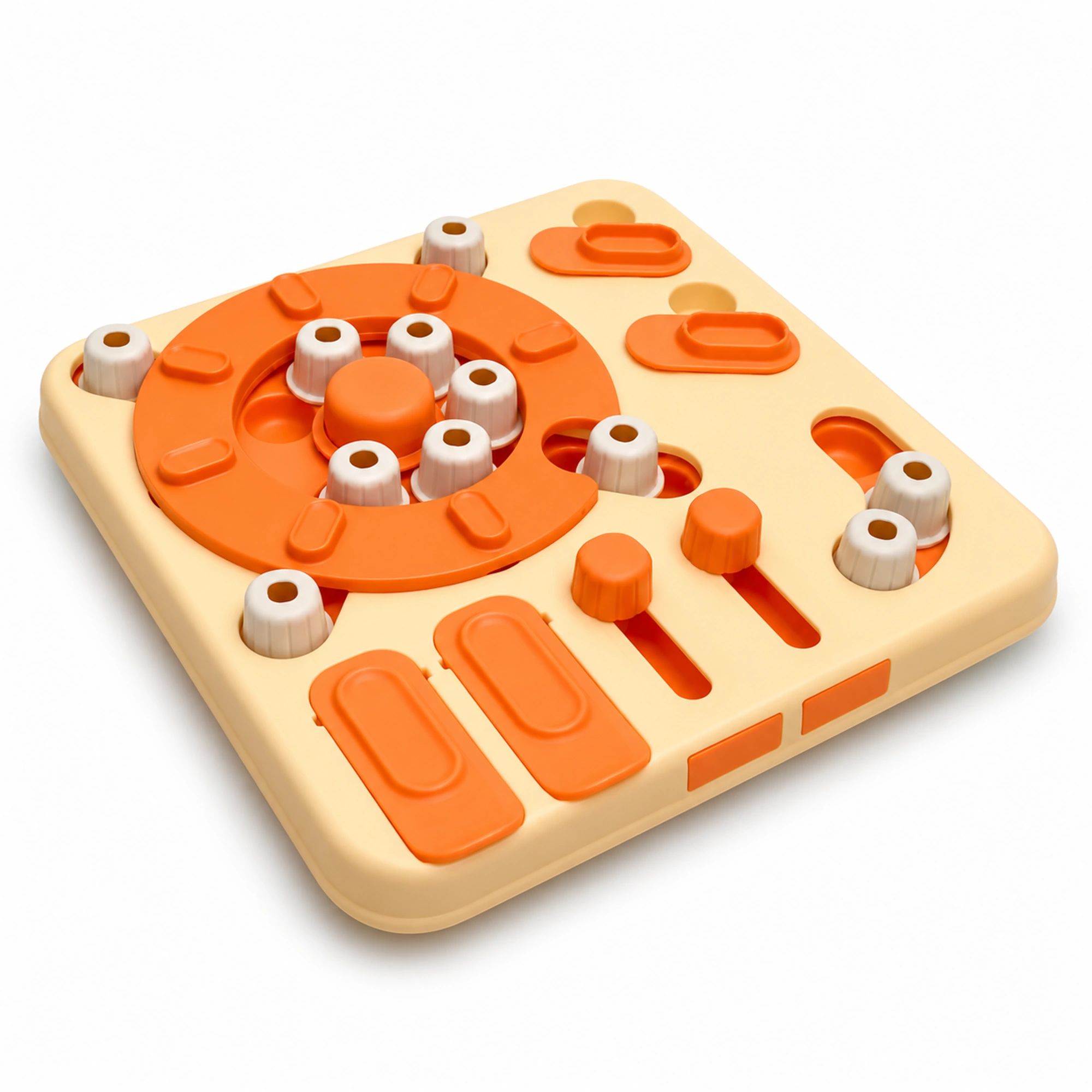
A well-crafted design like the Orange Turn, Slide & Lift Treat Puzzle incorporates multiple mental challenges: dogs explore a rotating ring, sliding drawer handles, hinged lift-up covers and swivelling oval covers on one square treat puzzle. Because dogs manipulate these compartments using their nose and paws, physical degradation is minimal when sessions are supervised. However, if a pet is left alone with an empty puzzle and starts gnawing on sliding handles or pry-up lids, plastic edges can become rough or splintered. Inspect all moving hinges and slide tracks after each mental puzzle workout to verify that every drawer and cover operates smoothly without sharp plastic burrs.
The Emotional Attachment Dilemma: Why Dogs Keep Torn Toys
Many dog owners experience a familiar hesitation when tidying up their living room: your dog’s favorite stuffed companion is missing both ears, half its stuffing, and its squeaker, yet your dog still gently carries the ragged shell from room to room.
In pet care discussions on community forums like Reddit, dog owners frequently face dilemmas deciding when to toss depleted or torn toys because dogs remain attached even after stuffing is gone. Pet parents wonder whether taking away a dog’s comfort rag will cause emotional distress.
Dogs form strong attachments to specific toys for reasons that extend beyond simple chewing pleasure:
- Familiar Scent Anchors: An older toy absorbs the combined scent of your home, your hands, and your dog’s saliva. To a dog’s sensitive olfactory system, that weathered toy smells intensely comforting and safe.
- Predictable Texture: A softened, broken-in toy feels familiar in a dog’s mouth, requiring minimal jaw exertion to carry around during relaxing moments.
- Maternal or Companion Instincts: Some dogs, especially those with gentle temperaments or phantom maternal instincts, treat specific toys like puppies or sleep companions rather than prey to be dismantled.
How to Safely Handle Attached Toys
If your dog merely carries, cuddles, or rests their head on a de-stuffed fabric shell without chewing or tearing loose threads, you can often keep it in supervised circulation after carefully removing all residual stuffing, plastic squeakers, and ragged hanging threads.
However, if your dog still bites, rips, or shreds the remaining fabric, the safety risk outweighs sentimental comfort. In that situation, implement a gentle transition: introduce a new, sturdy replacement with an appealing texture, rub it with your hands to transfer your familiar scent, and pair it with high-value treats before quietly retiring the hazardous relic while your dog is distracted on a walk.
How Structured Toy Rotation Multiplies Lifespan
Leaving your dog’s entire toy collection scattered across the living room carpet is a guaranteed recipe for premature toy destruction and pet boredom. When dogs have continuous, unmonitored access to twelve different toys simultaneously, two things happen: they habituate to the toys and lose interest, or they hyper-focus on one item until it is ground to dust.
A structured toy rotation system solves both problems, keeping excitement high while dramatically reducing physical wear:
1. The Rule of Three Active Set
Keep only three or four distinct toy types accessible on any given day:
- One active physical toy: A dynamic pulling or retrieving game, such as the Green Suction & Rope Bone Tug Game, which engages large muscle groups during controlled sessions.
- One cognitive puzzle feeder: A mental stimulation tool like the Orange Turn, Slide & Lift Treat Puzzle for mealtime or quiet afternoons.
- One durable solo chew: A dense rubber bone for evening decompression.
- One soft comfort item: A plush companion for resting (if safe for your dog).
2. Store the Reserve Out of Sight
Store all other toys in an airtight bin in a high closet or pantry. When toys are hidden away, they retain their novelty value. When you swap in a toy that has been locked in the closet for seven days, your dog greets it with the same exuberance as a brand-new store purchase.
3. Rotate Every 3 to 5 Days
Switch out the active toys twice a week. Frequent rotation cuts daily chewing hours per toy by 60% to 75%, allowing materials to rest and preventing localized fatigue along seams and joints.
Weekly Inspection Checklist for Dog Toys
Set aside five minutes each weekend during your routine cleaning to audit your dog’s current toy bin. Use this quick four-point checklist:
- Seam and Fabric Integrity: Pull along all plush seams to identify emerging holes or loose threading before stuffing escapes.
- Surface Texture and Elasticity: Rub your thumb along rubber edges and puzzle sliders, checking for sharp burrs, peeling chunks, or brittle cracks.
- Internal Part Security and Sanitation: Verify squeaker valves cannot dislodge into hollow cavities, and thoroughly sanitize surfaces in warm, soapy water.
- Size Appropriateness: Re-evaluate dimensions as puppies grow, retiring any items small enough to slip past the base of the tongue into the airway.
Frequently Asked Questions
How often should you inspect and replace dog toys?
Dog toys should be inspected visually every week and replaced whenever structural breakdown occurs. For aggressive chewers, toys may need replacement every few weeks; for gentle dogs, durable rubber chews and well-maintained puzzle toys can last 6 to 12 months or longer.
Is it safe to let my dog play with an unstuffed plush toy?
It can be safe only if your dog treats the unstuffed fabric as a gentle companion or cuddle item. If your dog chews, tears, or ingests fabric fragments, the toy remains an intestinal obstruction risk and should be discarded immediately.
Can structured toy rotation really make toys last longer?
Yes. Rotating toys on a 3-to-5-day schedule drastically reduces the daily cumulative wear on any single toy. Because novelty is preserved, dogs play with greater curiosity and focus rather than resorting to destructive chewing born out of boredom.