Watch any dog sink its teeth into a squeaking plush toy, and you immediately see that intense, laser-focused expression. The high-pitched squeak sounds piercing to human ears, but to a canine, that sound unlocks an ancient behavioral sequence. Dogs do not just enjoy squeaky toys as casual pastimes. They respond to them on a deep neurobiological and evolutionary level.
Understanding why dogs love squeaky toys and why do dogs like squeaky toys with such intense focus helps owners provide healthy enrichment. Choosing the right squeaky dog toys allows energetic pets to satisfy natural canine drives without the risk of accidental ingestion. Here is the behavioral science behind the squeak, the neurological feedback loop that reinforces it, breed variations in prey play, and practical guidelines for safe home play.
Evolutionary Origins of Canine Auditory Predatory Responses
All domestic dogs descend from ancestral canids whose survival depended on hunting small game such as rodents, rabbits, and birds. Hunting behavior in wild canids follows a hardwired predatory motor pattern consisting of six distinct phases: orient, eye, stalk, chase, grab-bite, and kill-bite.
Centuries of domestic breeding have modified these sequences in different working breeds, yet the foundational motor patterns remain intact. When a toy emits a sharp, high-frequency sound between two and eight kilohertz, it closely mimics the distress cry of an injured rodent or nestling bird. For a dog’s acute auditory system, this acoustic trigger bypasses deliberate calculation and activates the grab-bite reflex immediately.
Herding breeds may fixate on chasing the rolling squeak, while terriers and retrievers instinctively compress their jaws to deliver the decisive grab-bite. The squeak serves as instant acoustic confirmation that the simulated prey is caught.
Frequency Dynamics: How Two to Eight Kilohertz Stimulates the Inner Ear
Canine hearing operates across a frequency bandwidth far wider than human hearing. While people detect sound between twenty hertz and twenty kilohertz, dogs hear frequencies up to forty-five kilohertz. Within this wide auditory envelope, frequencies between two kilohertz and eight kilohertz occupy a specialized biological niche.
In nature, small mammals communicate alarm through high-frequency shrieks within this specific acoustic range. When a toy squeaker compresses, air rushes past an internal vibrating plastic reed, generating an abrupt pitch spike. This sharp spike registers strongly in the canine cochlea and triggers heightened alertness. The sound informs the dog that the object in its mouth is responsive, resisting, and worth pursuing.
Because synthetic squeakers reproduce this frequency profile with high repeatability, dogs remain engaged far longer than they would with an inert rubber ball. For pet owners sensitive to piercing noises, ultrasonic squeaker toys produce vibrations at twenty-eight kilohertz, keeping the auditory reward accessible to the dog while maintaining quiet in the home.
Neurochemical Reinforcement: Dopamine Surges Behind Continuous Chewing
Beyond ancestral instincts, squeaky toys act as powerful sensory feedback engines. When a dog bites a standard tennis ball or inert rubber chew, the physical resistance feels satisfying, but the toy remains silent. With a squeaky toy, mechanical jaw pressure produces an instantaneous, high-volume auditory consequence.
This direct cause-and-effect loop triggers an immediate surge of dopamine, the neurotransmitter responsible for motivation, pleasure, and goal-directed behavior. Each successful bite validates the effort and encourages another bite. In animal learning theory, this mechanism represents continuous reinforcement. Because every compression yields a distinct reward, the dog enters a self-sustaining play state often described as play obsession.
High-drive dogs can escalate from joyful play into frenzied arousal under this cycle. Recognizing this neurochemical cycle allows owners to structure playtime constructively rather than letting dogs spiral into frantic overstimulation.
Working Breed Profiles: Contrasting Terriers, Retrievers, and Herders
Different dog breeds direct their predatory instincts toward squeaky toys in remarkably varied patterns based on their historical working roles:
Terriers and Earthdogs: Breeds such as Jack Russell Terriers, Cairn Terriers, and Miniature Schnauzers were selected to locate and dispatch vermin in tight burrows. They exhibit intense dissection urges, systematically chewing through outer seams to find and destroy the plastic squeaker capsule within minutes.
Retrievers and Gundogs: Golden Retrievers, Labradors, and Cocker Spaniels possess soft-mouth instincts engineered to carry fallen waterfowl without tearing flesh. These dogs frequently carry squeaky toys around the house like treasures, gently squeezing them with rhythmic jaw compressions while resting their chins on an owner’s knee.
Herding Breeds: Border Collies, Australian Shepherds, and Belgian Malinois focus on motion and chasing. They often prefer fetch games where a squeaky toy bounces erratically across the grass, using the sound to track flight trajectory during high-speed sprints.
Understanding your dog’s breed heritage helps you pick appropriate toy structures that match their play style while protecting them from unintended destruction.
Managing Ragging Behaviors with Knotted Rope Combos
Once a dog catches simulated prey, the next natural instinct is lateral head thrashing, often termed the kill-bite or ragging phase. In the wild, rapid side-to-side head shaking serves to immobilize small prey quickly. During domestic play, dogs replicate this exact motion by gripping a toy firmly and whipping their necks back and forth.
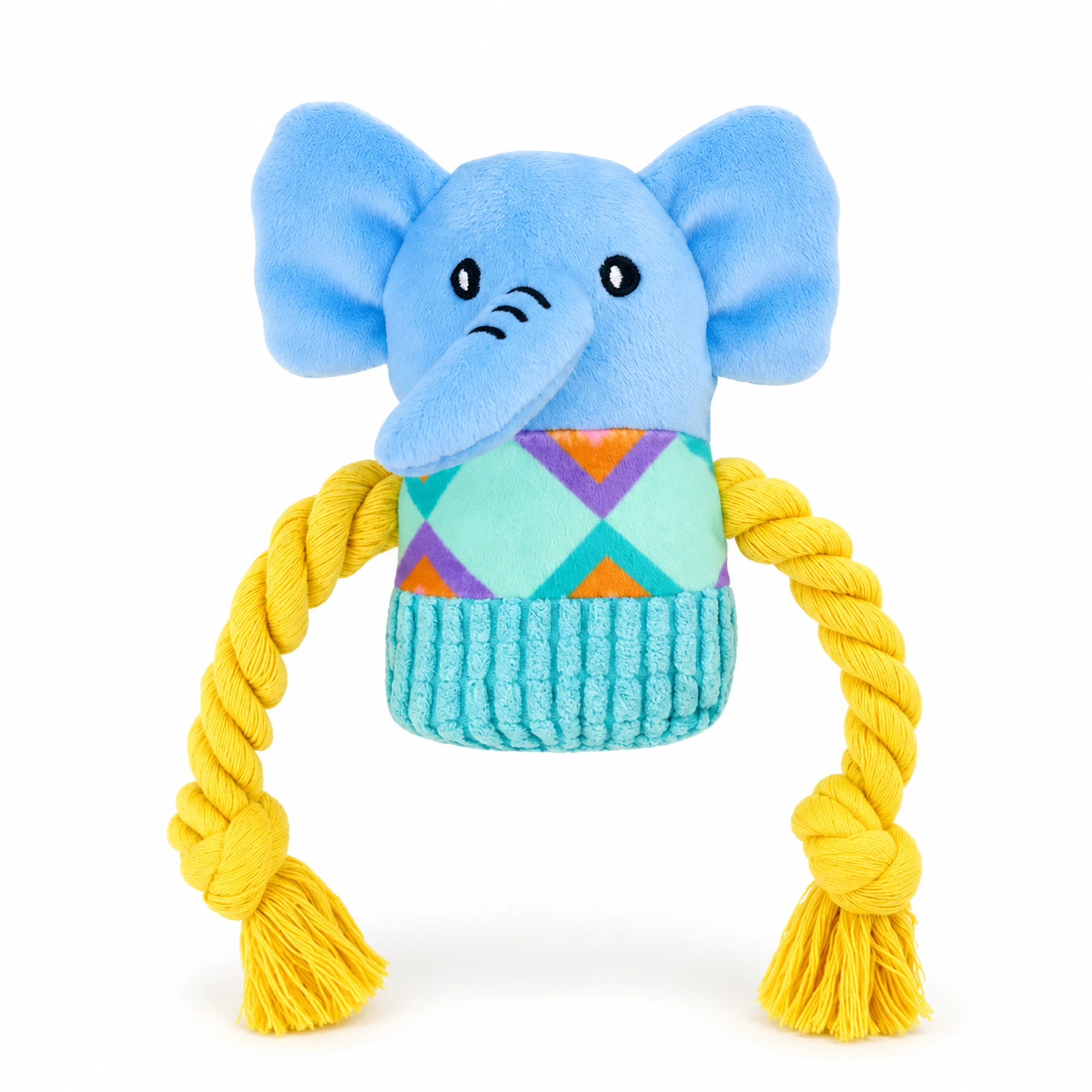
Toys that combine a compressible squeaker body with sturdy rope handles channel this ragging reflex safely. The JoyPetPlay Blue Elephant Rope Tug & Shake Toy ($4.88) provides an ideal structure for this instinct. This design integrates a soft plush head with durable cotton rope limbs. The plush section offers gentle bite feedback, while the knotted rope legs give the dog secure grip points for lateral thrashing without slamming hard plastic against teeth or living room baseboards.
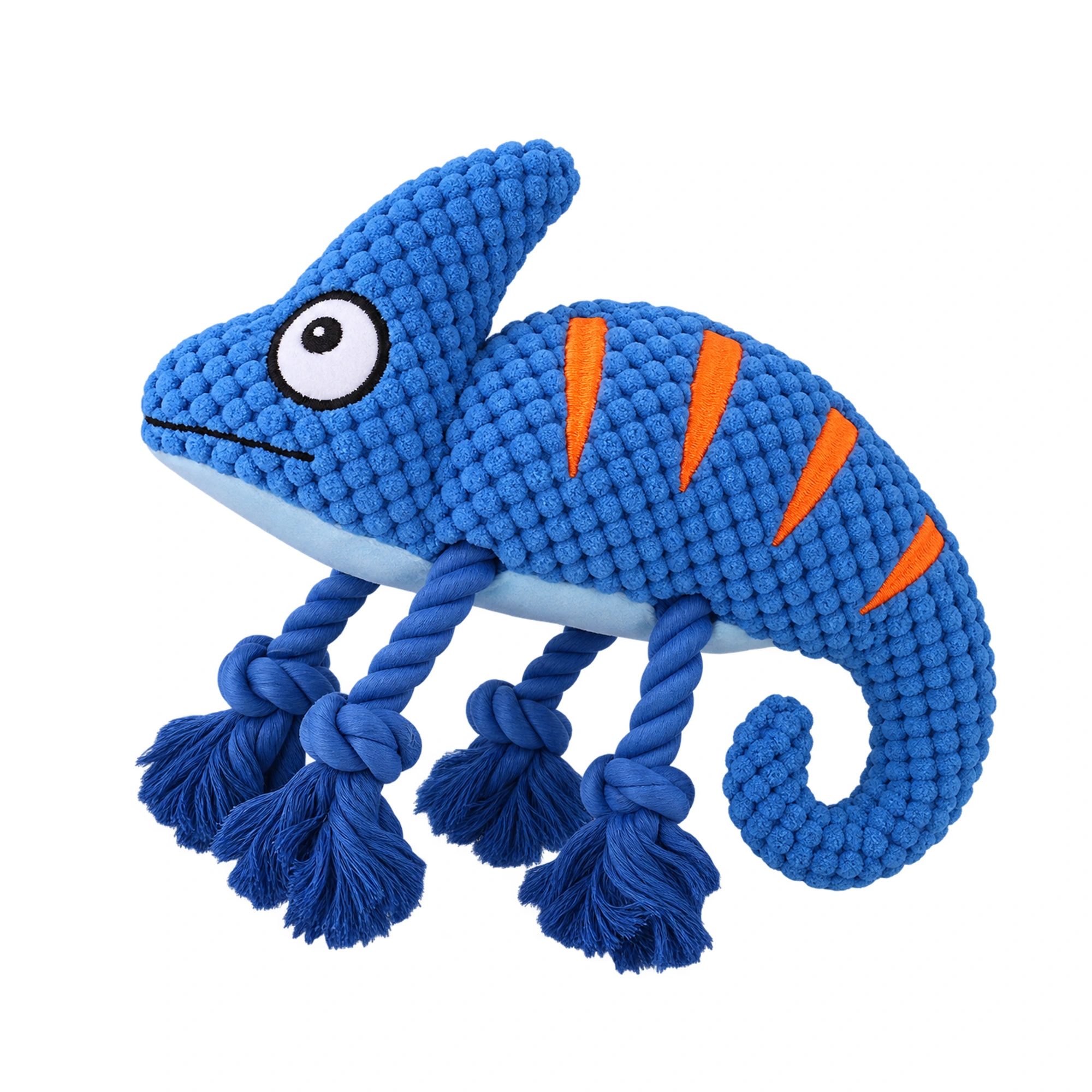
Another excellent alternative is the JoyPetPlay Blue Pull-Through Chameleon Tug Toy ($14.00). Built with a pull-through body and textured accents, it allows pet parents to participate directly in cooperative tugging. Engaging in collaborative games redirects solitary squeaker obsession into cooperative play that builds human-canine bonding and prevents resource possessiveness.
Layered Sensory Enrichment: Combining Squeaks, Crinkles, and Scent Mats
Canine sensory satisfaction increases when toys provide varied tactile and acoustic textures. While squeakers provide sudden high-frequency bursts, crinkle paper layers mimic the rustling of dry leaves, grass, or small animal nesting materials underfoot.
Combining squeakers with crinkle elements and tactile fabrics creates multi-layered auditory enrichment. Squeaker mats and multi-texture soft toys feature varied compartments where each quadrant sounds different upon impact. Dogs enjoy investigating each texture, pressing with forepaws to activate soft crinkles before applying jaw pressure to find the central squeaker.
Adding olfactory puzzles alongside auditory elements provides balanced enrichment. When high-drive dogs alternate between auditory chase games and slow scent-work on snuffle mats, their overall arousal levels stabilize, promoting restful sleep rather than frantic pacing.
Veterinary Safety Protocols: Preventing Choking and Squeaker Ingestion
While squeaky toys offer outstanding physical exercise and mental engagement, maintaining dog toy safety requires proactive management:
Supervise Every Play Session: Never leave an unattended dog with plush squeaker toys. Many dogs deliberately dissect toys to extract the internal plastic squeaker capsule, creating a severe gastrointestinal foreign body hazard. The small plastic reed or polyethylene body can lodge in the intestine, requiring emergency abdominal surgery.
Audit Seams and Fabric Walls: Regularly examine toy seams and stitching. Before buying or reusing toys, check for loosened threads or thin fabric patches. For comprehensive guidance on retirement criteria, consult our safety checklist on when to throw away dog toys.
Remove Compromised Toys Promptly: If fabric thins, seams split, or the internal squeaker shifts toward an open tear, take the toy away immediately. Replace worn plush items with durable alternatives before parts detach.
Enforce Rest Periods: If your dog begins panting heavily, guarding the squeaky toy, or exhibiting frantic dilated eyes, gently swap the toy for a calming treat and initiate a mandatory five-minute settling break.
Common Questions About Squeaky Toy Obsession
Why do dogs get so obsessed with squeaky toys?
Dogs become intensely focused on squeaky toys because the sound simulates the high-pitched distress vocalizations of small prey animals. Each bite produces immediate acoustic feedback that triggers a release of dopamine in the canine brain, creating a self-reinforcing sensory loop that rewards repeated biting and chasing.
Why do dogs try to destroy squeakers inside toys?
Many dogs view the internal squeaker as the heart of their prey. In wild hunting sequences, an animal falls silent once captured. Because an artificial squeaker continues making noise every time it is touched, the dog feels compelled to dissect the plush fabric and extract the plastic capsule to permanently silence the noise.
Can squeaky toys cause aggressive behavior in dogs?
Squeaky toys do not cause clinical aggression, but their high-frequency sound can raise canine excitement to intense levels. In multi-dog households or dogs prone to resource guarding, high arousal can trigger possessive behavior. Providing structured playtime with clear start and stop cues prevents excitement from spilling over into conflict.