Playing fetch gives dogs physical conditioning and outlets for their natural prey tracking drive. Yet emergency veterinary clinics treat severe airway obstructions every week caused by fetch balls that were simply too small for the dog’s mouth. These incidents happen fast. A running dog pants heavily with an open mouth, snatches a ball out of the air, and suddenly the ball slips behind the tongue.
Choosing the right ball diameter based on your dog’s jaw width and body weight keeps outdoor retrieve games safe.
The Biomechanics of Canine Airway Obstruction During High-Velocity Fetch
Dogs sprint with their jaws wide open when chasing a toy. Heavy panting shifts oral structures into an emergency ventilation posture. The tongue drops flat, the pharynx widens, and the soft palate lifts to maximize air intake. Under high physical exertion, the canine gag reflex that normally guards the throat relaxes.
Three mechanical factors create rapid suffocation during a fetch retrieve:
Saliva coats rubber toys in seconds. Canine saliva contains high concentrations of mucins that turn slick upon contact with smooth rubber, vinyl, or compressed felt. Once wet, teeth lose their friction grip on the surface of the ball.
Inhalation creates strong inward suction. A sprinting dog inhales deeply right as its teeth contact the toy. If the sphere fits between the premolars, atmospheric suction draws the slick toy directly into the posterior oral cavity.
Material flexibility worsens the hazard. Hollow rubber balls compress under canine bite pressure, which routinely exceeds two hundred pounds per square inch in medium breeds. A compressed ball easily slips through the dental arches into the hypopharynx. When jaw pressure releases, the rubber expands back to its full shape. Once expanded behind the base of the tongue, the ball lodges against the larynx. The wet sphere acts like a cork inside a wine bottle, creating an airtight seal over the trachea.
A fetch ball must be wide enough that it cannot slip past a dog’s front teeth and lodge in the trachea, making balls under 2.5 inches severe choking hazards for medium and large dogs. Complete tracheal occlusion cuts off alveolar ventilation, causing loss of consciousness within ninety seconds.
Dog Ball Sizing Chart: Recommended Diameters by Weight and Cranial Anatomy
Ball selection depends on jaw width, oral depth, and canine bite volume. The toy should always extend visibly beyond both sides of the mouth when gripped between the canine teeth.
Safe ball diameters vary directly with skull width and jaw depth across common companion breeds:
| Canine Weight Class | Typical Weight Range | Recommended Minimum Ball Diameter | Safe Toy Diameter Range | Typical Representative Breeds |
|---|---|---|---|---|
| Toy Breeds | Under 10 pounds (under 4.5 kg) | 1.75 inches (4.5 cm) | 1.75 to 2.0 inches (4.5 to 5.0 cm) | Chihuahua, Pomeranian, Yorkshire Terrier, Papillon |
| Small Breeds | 10 to 25 pounds (4.5 to 11.3 kg) | 2.25 inches (5.7 cm) | 2.25 to 2.5 inches (5.7 to 6.4 cm) | French Bulldog, Boston Terrier, Beagle, Jack Russell |
| Medium Breeds | 25 to 55 pounds (11.3 to 24.9 kg) | 2.75 inches (7.0 cm) | 2.75 to 3.0 inches (7.0 to 7.6 cm) | Border Collie, Australian Shepherd, English Springer Spaniel |
| Large Breeds | 55 to 85 pounds (24.9 to 38.6 kg) | 3.25 inches (8.3 cm) | 3.25 to 3.5 inches (8.3 to 8.9 cm) | Golden Retriever, Labrador Retriever, Boxer, German Shepherd |
| Giant Breeds | Over 85 pounds (over 38.6 kg) | 3.50 inches (8.9 cm) | 3.50 to 4.0 inches (8.9 to 10.2 cm) | Great Dane, Mastiff, Newfoundland, Cane Corso, Rottweiler |
Standard tennis balls measure 2.5 to 2.7 inches across. While tennis balls work for small terriers and beagles, they present major hazards for dogs over fifty-five pounds. Adult Golden Retrievers and German Shepherds possess broad oropharyngeal openings that allow standard tennis balls to slip backward during fast aerial catches. Owners evaluating toy options should always check whether are tennis balls safe for dogs before bringing them to the dog park. When choosing between two sizes on the chart, buy the larger diameter.
Cranial Variations and Sizing Nuances
Weight alone does not tell the whole story. Head anatomy changes how toys seat inside the mouth. Dogs fall into three primary cranial classifications:
Dolichocephalic dogs have long, narrow skulls. Breeds like Greyhounds, Whippets, and Collies have relatively narrow oral cavities. Their high sprint speeds generate strong negative airway suction. They need toys with textured exteriors that prevent sliding along the palate.
Mesocephalic dogs feature balanced skull dimensions. Retrievers, Pointers, and German Shepherds fall into this category. They possess wide mouths and powerful jaw muscles. These breeds need balls measuring at least 3.25 inches to prevent the sphere from clearing the front dental line.
Brachycephalic dogs have shortened facial bones. Breeds such as French Bulldogs, Pugs, and Boxers have compressed upper airways. Their elongated soft palates reduce available breathing space inside the pharynx. Any object that blocks oral airflow causes rapid hypoxia. Choose wide balls with internal pass-through breathing tunnels or irregular exterior shapes.
Two Physical Safety Tests Before Throwing
Owners can perform two fast physical checks at home before introducing any fetch ball:
The Lip Line Check: Watch your dog hold the ball between its side premolars. At least half of the ball must remain visible outside the lips. If your dog can close its lips fully around the toy, the ball is dangerously small.
The Caliper Check: Measure the distance between the tips of your dog’s upper canine teeth. The ball diameter should exceed that measurement by at least twenty-five percent. This size difference ensures the canine teeth form a solid mechanical stop during hard catches.
Safe Motion Play with the Blue Geometric Tap-Wake Ball
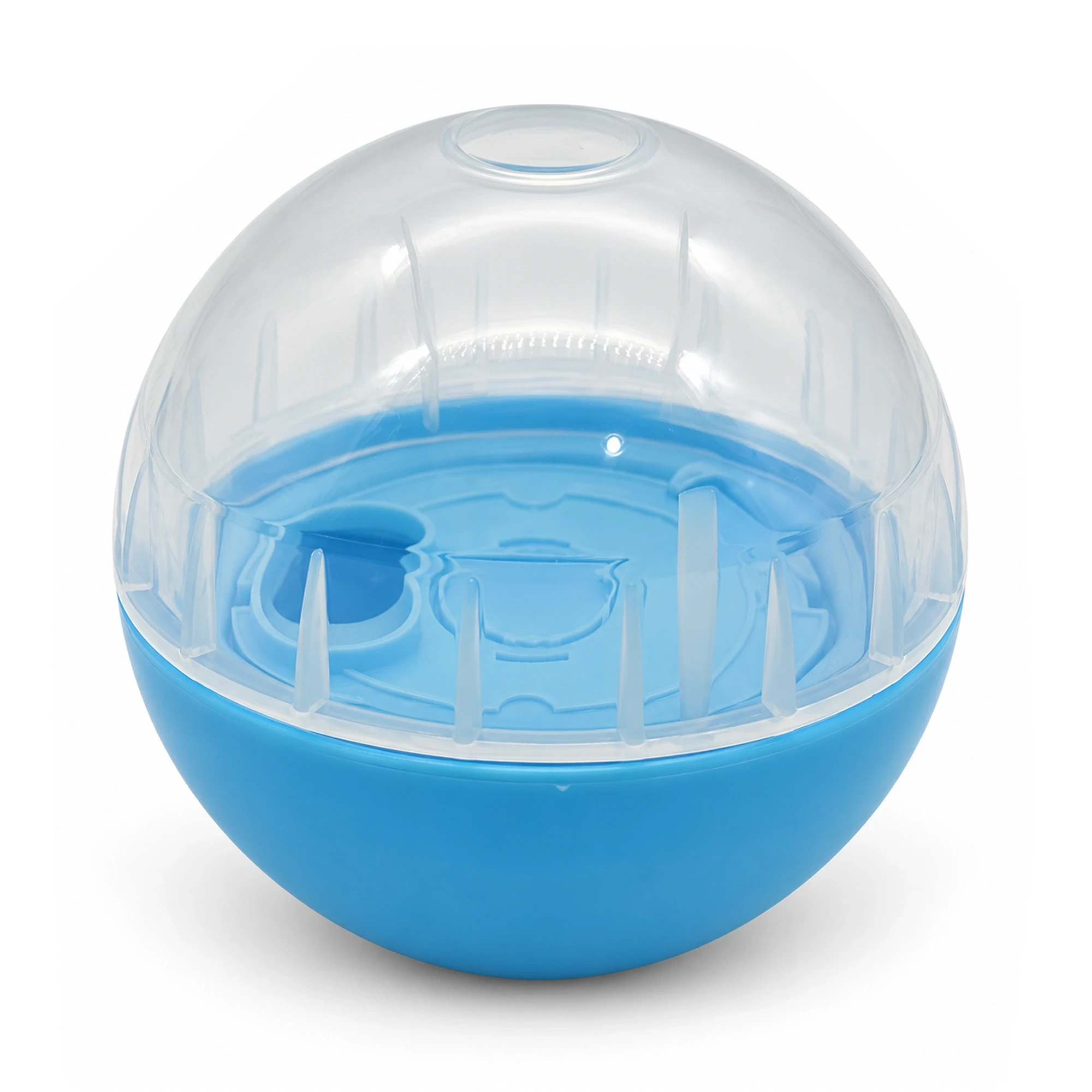
Small breeds and puppies need indoor exercise without the risks of thrown projectile toys. Motorized floor toys keep dogs active while removing high-speed aerial collisions. A small blue motor-driven ball with curved shell grooves and a light around its central button. The supplier shows small dogs chasing it on a floor and waking it with a tap.
This electronic toy provides several distinct structural safety advantages:
Ground rolling eliminates mid-air throat trauma. Choking emergencies usually occur when dogs leap into the air with open mouths, catching balls at terminal velocity. Autonomous ground rolling allows the dog to track, pounce, and grip at self-regulated ground speeds.
Geometric traction channels prevent slips. The hard outer shell features curved grooves that give small incisors purchase without requiring the dog to bite deep into its jaw pockets.
The responsive sensor encourages paw interaction. Instead of gnawing on the core, dogs tap the shell with their front paws to activate movement. This keeps play focused on tracking rather than swallowing.
Controlled Rolling Enrichment with the Mint Roll Reward Toy
Switching from spherical balls to cylindrical puzzle toys eliminates the physical possibility of a round airway seal. Cylinders cannot form vacuum locks inside the canine throat.
Roll, nudge and discover small dry treats through the side openings. The smoky see-through body has mint end caps with concentric grooves.
This rolling dispenser offers three key practical benefits:
The elongated shape prevents pharyngeal entry. The toy’s total length exceeds the width of the dog’s oral opening. Even when a dog grabs the cylinder, the wide mint end caps remain outside the mouth.
Controlled foraging replaces frenzied chasing. Traditional fetch elevates adrenaline, which interferes with calm swallowing reflexes. Nudging the cylinder across living room rugs to shake loose training treats slows the dog down and stimulates independent problem-solving.
Textured rubber end caps support dental health. The concentric ridges on the mint caps clean plaque along the gumline while resisting sharp puppy teeth.
Emergency Rescue Protocol: Responding to Airway Obstruction
Every dog owner should know how to clear an obstructed airway. If a ball lodges in your dog’s throat, act without delay:
Recognize the warning signs early. A choking dog cannot bark or whine. The dog will paw desperately at its mouth, extend its neck forward, and show wide eyes. Gums will turn from pink to grey or blue within sixty seconds.
Do not perform blind finger sweeps. Thrusting fingers blindly down a dog’s throat pushes smooth, wet balls deeper into the larynx, locking the seal. Only grasp the ball if you can see it clearly and hook your finger around its rear edge.
Use the external submandibular push. Place both thumbs on the outside of the dog’s throat, directly below the lodged ball. Press firmly upward and forward toward the jaw hinge to force the toy forward through the teeth.
Apply the canine Heimlich maneuver. For medium and large dogs: Stand behind the dog while it stands. Wrap your arms around its belly. Make a fist with one hand and place it directly behind the last rib. Grasp your fist with your other hand and pull upward and forward in five sharp thrusts. If the dog collapses on its side, place one hand on the spine and use your other palm to thrust forward against the lower abdomen. For small dogs: Hold the dog upright with its spine against your chest. Use your fingertips to deliver gentle upward thrusts into the soft area behind the rib cage.
Seek veterinary care immediately after clearing the toy. Even after successful removal, dogs can suffer from pharyngeal swelling or secondary fluid in the lungs.
Best Practices for Fetch and Safe Ball Storage
Good play routines protect dogs throughout their lives:
Inspect toys before each session. Check rubber balls for micro-cracks, punctures, and softness. Damaged rubber collapses easily during catches, increasing choking hazards.
Put fetch balls away after outdoor exercise. Fetch balls are interactive retrieve tools, not all-day chew items. Leaving balls on the floor allows dogs to gnaw on them until seams weaken. Store them in closed cabinets.
Pick high-contrast colors. Blue and orange toys contrast well against green grass. When dogs see the ball clearly, they calculate their retrieve angle accurately and avoid frantic throat-first lunges.
Size up in multi-dog homes. If you own dogs of different sizes, every ball in the house must fit the largest dog. A ball sized safely for an eighteen-pound beagle is a fatal choking hazard for a seventy-pound retriever.