Shopping online for canine companions that rapidly dismantle toys within minutes frequently becomes an exercise in sheer exasperation. Nearly every digital listing promises impenetrable resilience or extreme heavy-duty reinforcement, yet package after package inevitably ends up in shredded scraps across the living room rug. Commercial copywriters recognize that durability promises drive conversion, which results in descriptions overwhelmed by superlatives rather than verifiable technical specifications.
To safeguard your household budget while shielding your dog’s gastrointestinal tract, pet owners must evaluate retail listings with rigorous scrutiny. Genuine durability stems from material density, structural geometry, and targeted play mechanics rather than bold advertising claims. Learning how to translate manufacturer descriptions into realistic performance expectations helps you select toys that withstand determined jaws.
Why ‘Indestructible’ Is a Marketing Myth, Not a Material Spec
The word “indestructible” appears in thousands of pet toy listings, but no commercial dog toy is completely immune to destruction. A full-grown German Shepherd, Pit Bull, or Mastiff can generate bite forces exceeding several hundred pounds per square inch. When concentrated through sharp canine teeth or premolars onto a single focal point, repeated pressure will eventually degrade any synthetic or organic polymer.
Dog owners frequently share stories of so-called bulletproof toys failing on the first afternoon. On pet discussion forums like Reddit’s r/dogs, community members frequently lament living in a “graveyard of dog toys” where soft items and cheap novelties are quickly disassembled into hazardous debris. When a brand labels an item indestructible, they are using promotional hyperbole, not an engineering rating.
Legitimate safety authorities emphasize regular replacement over eternal durability. The Humane Society of the United States recommends discarding pet toys as soon as they begin to break into pieces or are torn. Ingesting detached toy fragments, squeakers, or loose cords poses serious risks of intestinal obstruction that often require surgical intervention. Viewing toys as consumable tools that require ongoing supervision keeps dogs far safer than trusting absolute marketing claims.
Material Deep Dive: Decoding Natural Rubber, TPR, and Nylon in Listings
A useful product description identifies the exact composition of the toy rather than relying on vague descriptors like “tough composite.” Different chewing styles require distinct physical material properties.
| Material Listed | Texture and Elasticity | Best Use Case | Red Flags to Watch For |
|---|---|---|---|
| Natural Vulcanized Rubber | High rebound, firm give, pliable under compression | Heavy daily chewing, erratic bouncing | Thin hollow walls, strong chemical solvent smell |
| Thermoplastic Rubber (TPR) | Flexible, textured traction, tear-resistant | Interactive tugging, teething, gentle fetch | Chalky surface finish, brittle thin ridges |
| Hard Molded Nylon | Extremely rigid, zero dental give | Scraping and gnawing by power chewers | Sharp micro-burrs, risk of dental enamel fractures |
| Multi-layer Ballistic Fabric | Woven synthetic textile, stitched edges | Light tugging, interactive retrieve | Exposed seams, squeakers sewn near outer edges |
Understanding how materials deform under load explains why certain toys survive. Natural vulcanized rubber and dense thermoplastic rubber absorb impact by flexing, distributing the force across the entire structure. Hard nylon, by contrast, resists puncture through sheer surface hardness, but it carries a higher risk of slab fractures on upper carnassial teeth if the material has zero flex. A reliable rule of thumb among veterinary dentists is the thumbnail test: if you cannot press a slight indentation into a chew toy with your thumbnail, the material may be too hard for unsupervised play.
Structural Design Clues That Predict Early Toy Failure
Material choice accounts for only half the durability equation. Poor engineering creates mechanical stress lines. When reviewing product imagery and schematics, pay close attention to geometric continuity.
Flat planes, thin protruding limbs, decorative ears, and glued cosmetic accents provide natural leverage points. Dogs do not chew uniformly across an entire object. They use their front incisors to isolate small tabs or edges, working back and forth until the corner tears away. Once an initial tear forms, material tensile strength drops dramatically, allowing rapid structural failure.
Monolithic, rounded shapes with gentle transitions resist targeted shearing forces much better than complex decorative forms. Seam placement is equally telling. Molded rubber toys produced in two-part clamshell molds display a visible parting line where the halves fuse together. In lower-tier manufacturing, this seam remains a structural weak point. Look for product images displaying uniform wall thickness, smooth continuous perimeters, and absence of external flash or glued appendages.
Matching the Mechanism to the Chewer: Suction Anchors and Treat Dispensers
Destructive chewing often signals boredom or excess energy rather than pure aggression. Dogs with intense jaw drive benefit when physical force is channeled into productive movement or cognitive problem solving. Product descriptions that explain the functional mechanic of the toy help you choose the right play mode.
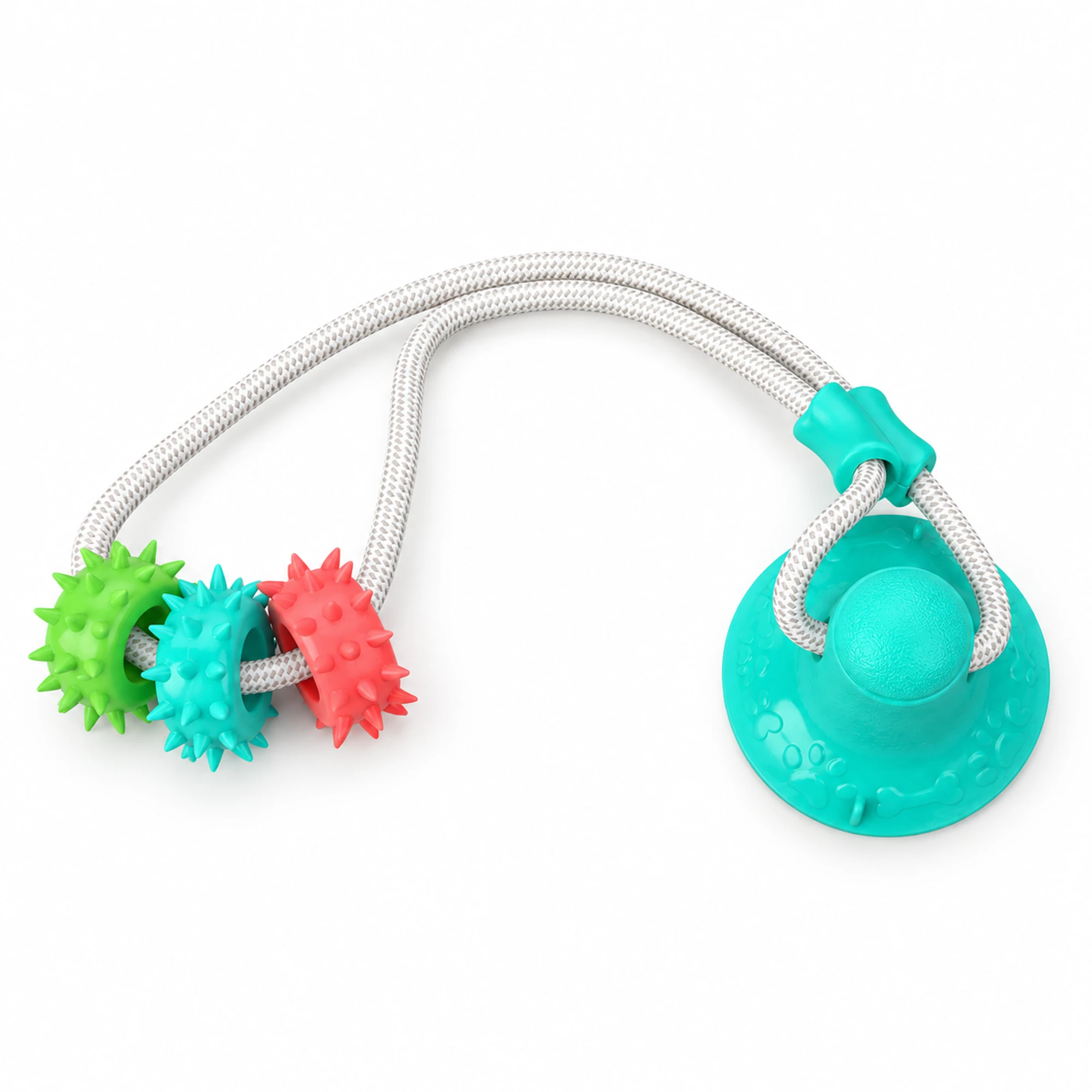
For dogs that enjoy vigorous pulling and resistance, a floor-anchored system changes the physical dynamic. The Cyan Three-Ring Suction Tug Toy connects a heavy-duty floor suction base and an adjustable rope slider to three textured spiked chew rings. Rather than lying stationary and grinding teeth into a single rubber flank, the dog works against the suction anchor during active play sessions. The textured spiked rings provide tactile sensory feedback, while the adjustable slider allows owners to vary the rope length. The cup is pressed onto a clean, flat surface during play and peeled off at the edge when the game concludes.
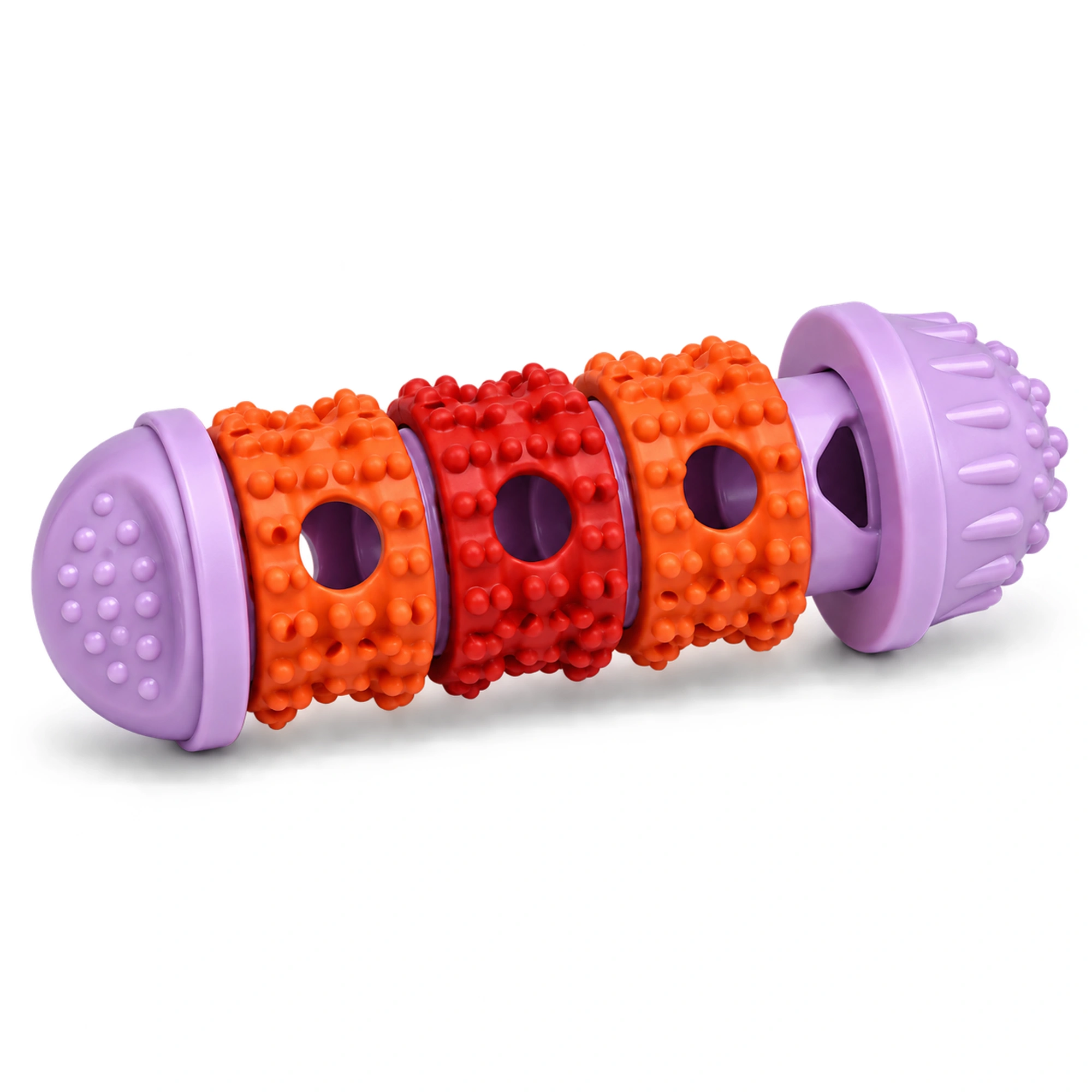
For dogs motivated by food, mental stimulation reduces the urge to dismantle objects simply to pass the time. The Lavender Twist & Treat Ring Toy features three textured rings positioned around a central core with calibrated openings for small dry treats. An adjustable twist mechanism at the end can hold a chew stick securely during supervised enrichment sessions. By turning chew time into a foraging challenge, the toy keeps the dog focused on extracting rewards rather than biting through the primary casing.
The Power Chewer Product Description Inspection Checklist
Before committing to a prospective purchase, evaluate online product listings through these key criteria:
- Material and Structural Geometry: The listing identifies vulcanized natural rubber or dense thermoplastic elastomers, featuring monolithic shapes free of glued decorative appendages.
- Dimension and Safety Disclosures: Clear length, diameter, and weight metrics are stated, accompanied by transparent warnings emphasizing supervised play sessions.
- Hygiene and Internal Core Security: Easy washing procedures are outlined, and squeakers are absent or safely embedded deep inside thick shock-absorbing walls.
Frequently Asked Questions
Can any dog toy truly withstand aggressive chewers without damage?
No commercial toy is completely immune to destruction. High-drive dogs can eventually damage any toy material if given enough uninterrupted time. Durable toys delay breakdown and resist wear, but all items require regular inspection and timely disposal when tearing occurs.
What materials are safest for heavy chewers’ teeth?
High-density natural rubber and resilient thermoplastic elastomers offer the best combination of puncture resistance and dental safety. They flex slightly under bite pressure without cracking tooth enamel, unlike excessively hard nylon bones or unyielding stones.
Why do some durable toys feature treat openings or suction cups?
Physical resistance and foraging mechanics channel chewing energy into active play and mental problem solving. Suction bases and treat-dispensing cavities engage dogs mentally, reducing repetitive biting habits that accelerate toy destruction.