Most dog owners who venture to a lake, river, or backyard pool have experienced the sudden disappointment of launching a brand new fetch toy across the water, only to watch it vanish beneath the ripples while their dog paddles in confused circles. Commercial pet packaging routinely promises water fun, yet countless popular fetch balls sink like lead weights immediately or gradually take on water until they submerge completely out of reach.
Understanding what dog toys actually float reliably requires examining the underlying principles of fluid displacement, polymer material density, and canine aquatic retrieval biomechanics. By understanding how buoyancy physics intersect with chew durability, handlers can select gear that bobs high on the surface, stays visible to swimming dogs, and survives rigorous jaw pressure.
The Physics of Buoyancy: Why Typical Fetch Toys Sink
Whether an object floats or sinks is governed by Archimedes principle of displacement and the specific gravity of its constituent materials relative to water. Pure freshwater has a specific gravity of 1.00. Any solid material with a density exceeding 1.00 naturally sinks unless it encloses a sufficient volume of trapped air to reduce its overall average density below that threshold. In seawater, where salt concentration increases density to roughly 1.025, toys gain a slight buoyancy boost, but heavy solid plastics still submerge quickly.
Pet parents frequently ask: do rubber dog balls float naturally? Standard heavy vulcanized rubber, widely praised for terrestrial durability against power chewers, has an inherent specific gravity between 1.15 and 1.50. A solid natural rubber ball will sink to the muddy bottom of a pond within two seconds. To make rubber float, manufacturers frequently mold hollow spheres with thin walls. However, hollow rubber designs introduce two fatal failure points in open water: sharp puncture leaks from canine incisors and open squeaker or vent holes. The moment water penetrates the internal cavity, trapped air escapes, overall density climbs past 1.00, and the toy drops permanently to the bottom.
Tennis balls present a different set of aquatic failures. Although the pressurized gas core creates initial surface buoyancy, the outer wool and nylon felt acts like a dense physical sponge. As the felt absorbs lake water and pond sediment, the ball becomes waterlogged and rides lower in the water. Furthermore, chewing on wet, grit-soaked felt grinds down canine tooth enamel like industrial sandpaper. Selecting dependable floating fetch toys requires eliminating absorbent fabrics and fragile hollow air bladders entirely.
Material Breakdown: Solid Rubber vs Closed-Cell Foam vs Hollow Cores
Matching your dog chew drive with the correct aquatic polymer determines whether a toy lasts for years or sinks on its maiden voyage. The following material analysis outlines how common compounds perform in water:
Closed-Cell Expanded Polymers (EVA and ETPU)
Closed-cell foams contain millions of microscopic, individual gas bubbles completely sealed within their polymer walls. Unlike open-cell household sponges that drink in liquid, closed-cell structures cannot absorb moisture even when punctured.
Expanded Thermoplastic Polyurethane (ETPU) represents the gold standard in modern canine aquatic engineering. ETPU features exceptional elasticity, high tensile strength, and permanent positive buoyancy. When sharp teeth puncture the surface, the surrounding microscopic closed cells stay intact, preventing water ingress and keeping the ball riding high across choppy surface waves.
Solid Vulcanized Natural Rubber
Solid natural rubber provides unbeatable resistance against aggressive chewers on dry grass or living room carpets. However, because its solid density exceeds water, it possesses negative buoyancy. Unless shaped with large open displacement channels or massive air chambers, solid rubber toys must remain on dry ground.
Hollow Thermoplastic Rubber (TPR) with Open Geometries
Thermoplastic Rubber (TPR) combines the processability of plastics with the flexible resilience of rubber. When molded into open-grid or honeycomb patterns rather than sealed hollow balls, TPR allows water to flow through freely rather than trapping it. This open drainage keeps the toy lightweight and prevents waterlogging.
Buoyancy and Durability Matrix
To help owners compare common materials, the following table summarizes how key compounds compare across buoyancy and dental durability:
| Toy Material | Specific Gravity | Buoyancy Mechanism | Waterlogging Risk | Tooth Enamel Safety |
|---|---|---|---|---|
| Closed-Cell ETPU Foam | 0.20 to 0.35 | Microcellular sealed air matrix | Zero (impervious to punctures) | Excellent (smooth non-abrasive surface) |
| Standard Tennis Ball Felt | 0.85 to 1.20 | Pressurized hollow core | High (felt absorbs water and silt) | Poor (traps silica sand that wears teeth) |
| Hollow Vulcanized Rubber | 0.70 to 1.10 | Single sealed air cavity | High (punctures flood interior) | Good (flexible natural rubber) |
| Open-Grid Molded TPR | 0.90 to 0.98 | Geometric displacement voids | Low (water drains instantly) | Excellent (gentle compliant texture) |
| Solid Heavy Rubber | 1.15 to 1.50 | Negative buoyancy (sinks) | Non-absorbent but sinks immediately | Good for ground chewing only |
Catalog Showcase: High-Displacement Engineering
Examining purpose-built toys from the JoyPetPlay collection illustrates how structural engineering overcomes the natural tendency of rubber to sink.
Microcellular Buoyancy: The Yellow Flecked ETPU Ball
When testing floating dog toys in lakes and deep pools, the Yellow Flecked ETPU Dog Play Ball demonstrates advanced buoyancy engineering. Featuring a yellow body with contrasting blue and gray flecks, this sphere measures 7 cm in diameter.
The 7 cm diameter is precisely scaled to provide medium and large sporting breeds with a confident mouth grip while preventing accidental pharyngeal swallowing. Because it is molded from fused microcellular ETPU beads rather than a hollow rubber skin, it cannot pop, deflate, or sink. It bounces off the water surface upon landing, rides high on choppy waves, and sheds moisture immediately upon pickup.
Open Honeycomb Drainage: The Blue Honeycomb TPR Ball
For dogs that prefer a softer, pliable bite feel or dogs that tend to swallow water during deep retrieves, open-matrix designs provide substantial physical advantages.
The Blue Honeycomb TPR Dog Play Ball features a raised geometric honeycomb exterior across a 65 mm diameter. Molded from supple Thermoplastic Rubber, this ball incorporates hexagonal drainage channels that allow water to cascade through as soon as the dog lifts the ball from the lake. The raised hexagonal ribs offer superior wet traction, allowing tired dogs to grasp the toy securely without applying crushing jaw force.
Oblong Erratic Wobble: The Red and Yellow Rubber Egg
While spherical balls encourage linear retrieving sprints, non-spherical shapes add unpredictable surface drift to calm swimming sessions. The Red and Yellow Rubber Egg Dog Toy measures 80 by 62 by 62 mm, featuring a red outer shell, bright yellow core, and deep cutout openings.
When dropped into a swimming pool, this egg-shaped toy bobs and pivots erratically across ripples rather than rolling away in a straight trajectory. The cutout openings create balanced water displacement that stabilizes the toy right at the surface line, while its oblong contours allow dogs to hook the narrow end effortlessly without submerging their nostrils.
Shallow Wading and Shoreline Rewards
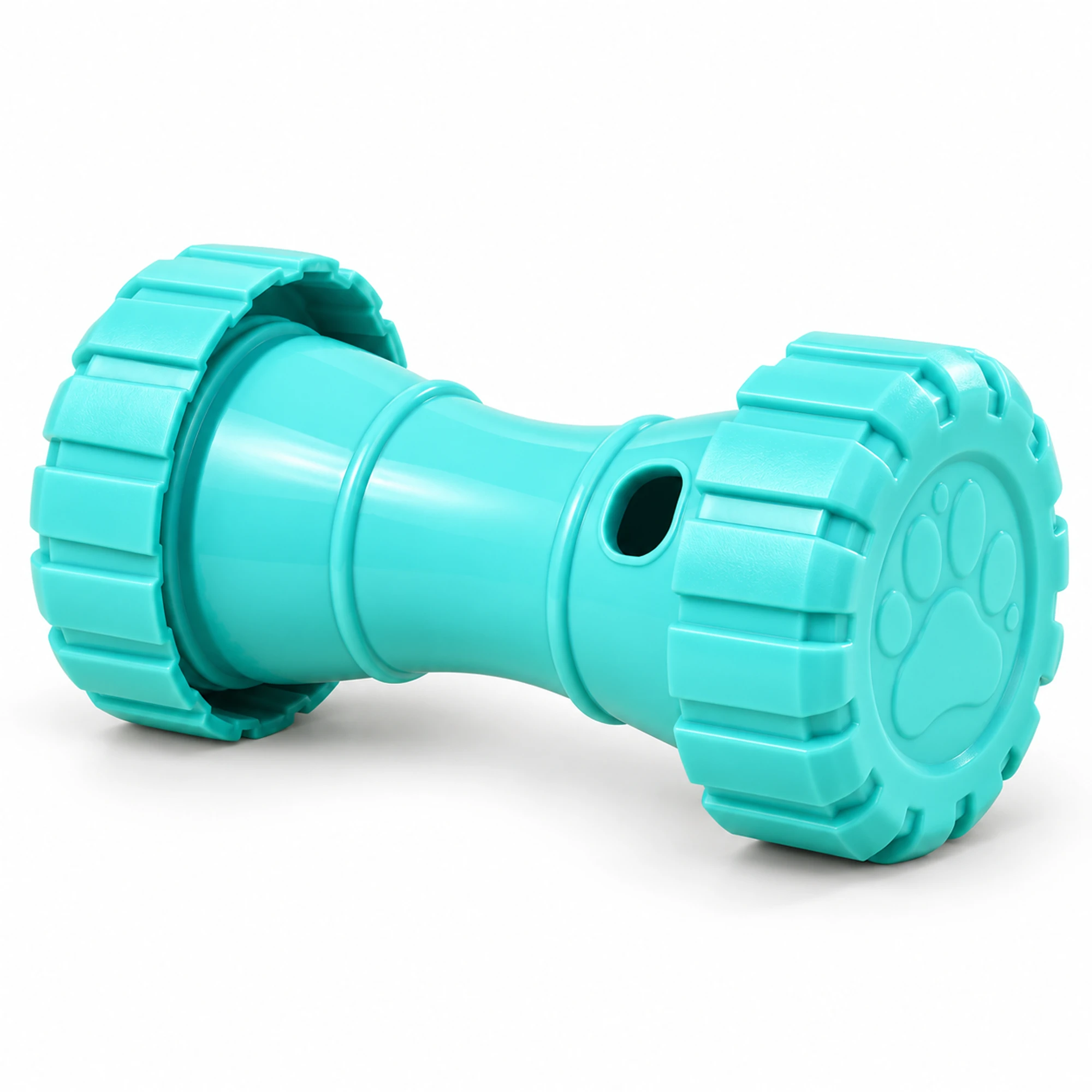
For shallow shoreline play or post-swim relaxation on the grass, the Mint Tyre End Treat Dumbbell ($4.90) features textured rubber tire ends that provide tactile chewing satisfaction while owners dry off wet coats.
Canine Vision on Water: Why Color Contrast Matters
Launching a toy across sunlit water presents a severe visual challenge for canines. Direct solar glare, rippling surface waves, and dark muddy lake bottoms make tracking floating objects difficult from a swimming dog low water perspective.
Canine eyes contain only two functional classes of cone photoreceptors, granting dogs dichromatic color perception comparable to red-green color blindness in humans. Dogs distinguish the visual world primarily in shades of blue, yellow, gray, and white. Red and green objects appear to dogs as muted shades of brown and gray.
A bright red or blaze-orange ball that looks glaringly obvious to a human standing on a sunny shore blends into the dark greenish-brown reflection of lake water from a swimming dog eye level. In contrast, yellow bodies with blue flecks deliver maximum chromatic contrast against both blue chlorinated pools and natural lake ripples. High-contrast coloration allows dogs to spot their retrieve target immediately, eliminating aimless paddling and preventing swim fatigue.
Practical Field Test: Five-Minute Buoyancy Check
Before launching any unfamiliar toy into deep open water, perform this simple home verification test to guarantee safe buoyancy:
- Static Surface Check: Place the toy in a clean bucket, sink, or bathtub filled with tap water. Verify that at least one-third of the toy body rides clearly above the waterline without tilting or submerging.
- Submersion Compression Test: Hold the toy completely under water for thirty seconds while squeezing it firmly. Watch closely for continuous streams of escaping air bubbles. If air bubbles vent out and water enters, the toy will become waterlogged during play and will eventually sink.
- Weight Retention Check: Remove the toy from the water and immediately shake it once. Verify that it does not feel significantly heavier than its dry baseline weight. If liquid sloshes around inside, discard it from your aquatic kit.
- Surface Grip Evaluation: Wet the toy thoroughly with soapy water and test its grip with your bare fingers. It should offer distinct ridges, ribs, or pebbled textures rather than a slick, frictionless surface.
- Post-Play Structural Audit: After every outdoor session, inspect seams and rope attachments for micro-tears. Discard toys that have lost their structural resilience to prevent small piece ingestion.
Frequently Asked Questions
What makes a dog toy float permanently?
A dog toy floats permanently when its total specific gravity remains lower than water, even after being chewed. Closed-cell polymers like ETPU and EVA contain sealed microcellular air pockets that cannot absorb moisture, ensuring the toy never sinks even if punctured by sharp canine teeth.
Why do solid rubber balls sink in freshwater?
Solid natural vulcanized rubber has a specific gravity between 1.15 and 1.50, which is significantly denser than freshwater (specific gravity 1.00). Because solid rubber weighs more than the volume of water it displaces, it possesses negative buoyancy and sinks immediately.
Are tennis balls safe for dogs to retrieve in water?
Tennis balls are not recommended for water retrieval. The outer felt absorbs water rapidly, causing the ball to sink or sit too low in the water. Furthermore, wet felt traps abrasive sand and grit that acts like sandpaper against canine tooth enamel, grinding it down over time.
How do I prevent my dog from swallowing water while retrieving toys?
Choose toys with open-grid honeycomb geometries or toys with attached rope loops. These designs allow water to drain away instantly and let dogs grasp the toy with incisors alone, keeping the head elevated and the airway clear above the splash line.
Which toy colors are most visible to dogs in water?
Bright yellow and deep cyan or blue colors offer the highest visual contrast for canines on water surfaces. Because dogs possess dichromatic vision, red and green toys appear as dull brownish-gray shades that blend into dark lake reflections.
Understanding buoyancy physics, choosing closed-cell polymers, and verifying high surface float height ensures every water retrieve remains healthy, exciting, and completely safe.