Setting a brand-new puzzle feeder down on the carpet often leads to frustration when an unsure dog gives it a quick sniff, paws a locked slider once, and retreats. Successfully introducing puzzle toys to an easily discouraged dog begins by understanding that early surrender stems from learned helplessness, unexpected plastic clatter, and a reward barrier that feels insurmountable.
Guiding a hesitant companion toward food games calls for an encouraging, guaranteed-win scaffolding strategy. Beginning with a quiet fabric foraging feeder lets sensitive dogs succeed through natural sniffing without confusing mechanical latches. As your pet develops scent confidence, you can introduce sliding puzzle trays with covers propped mostly open, adding difficulty only after enthusiastic nose work becomes second nature.
Why Dogs Give Up: Understanding Canine Frustration and Learned Helplessness
When a dog loses interest in a puzzle feeder filled with smelly treats, owners often assume the dog lacks food drive or dislikes mental work. In practice, early abandonment almost always stems from how the barrier was introduced during the first three minutes of exposure.
On Reddit r/PetAdvice, user u/mosesbabu0101 shared that after buying crinkle toys, puzzle feeders, and squeaky balls, their pet plays with them for just a few minutes and then completely ignores them forever. This five-minute drop-off happens when a dog encounters three compounding obstacles at the same time:
- High initial friction blocks early success. If a dog has never moved a plastic cover with its snout, a fully closed sliding drawer blocks both visual access and direct scent plumes. After two or three unsuccessful nose bumps produce zero food, the dog concludes that the object is sealed.
- Unexpected plastic noise startles timid dogs. Hard plastic puzzle boards can click, scrape, or slide across hardwood floors when nudged. For sound-sensitive or rescue dogs, an unexpected plastic clatter acts as a mild punisher, causing them to retreat from the feeder.
- Sealed compartments trigger learned helplessness. Dogs accustomed to eating from open bowls expect immediate access to visible kibble. Facing multiple locked barriers simultaneously overwhelms their problem-solving persistence, prompting them to sit back and wait for human intervention.
Understanding where your dog sits on the mechanical learning curve prevents this shutdown. You can review our breakdown of dog puzzle toy difficulty levels explained to see why starting a novice dog on multi-step locks triggers rapid fatigue.
The Silent Nose-Work Stage: Soft Fabric Bowls for Timid Dogs
For a dog that quits quickly or startles when plastic pieces snap shut, the first introduction to enrichment should remove rigid barriers altogether. Soft cloth foraging systems replace mechanical latches with gentle fabric folds, allowing the dog to succeed using natural scent tracking.
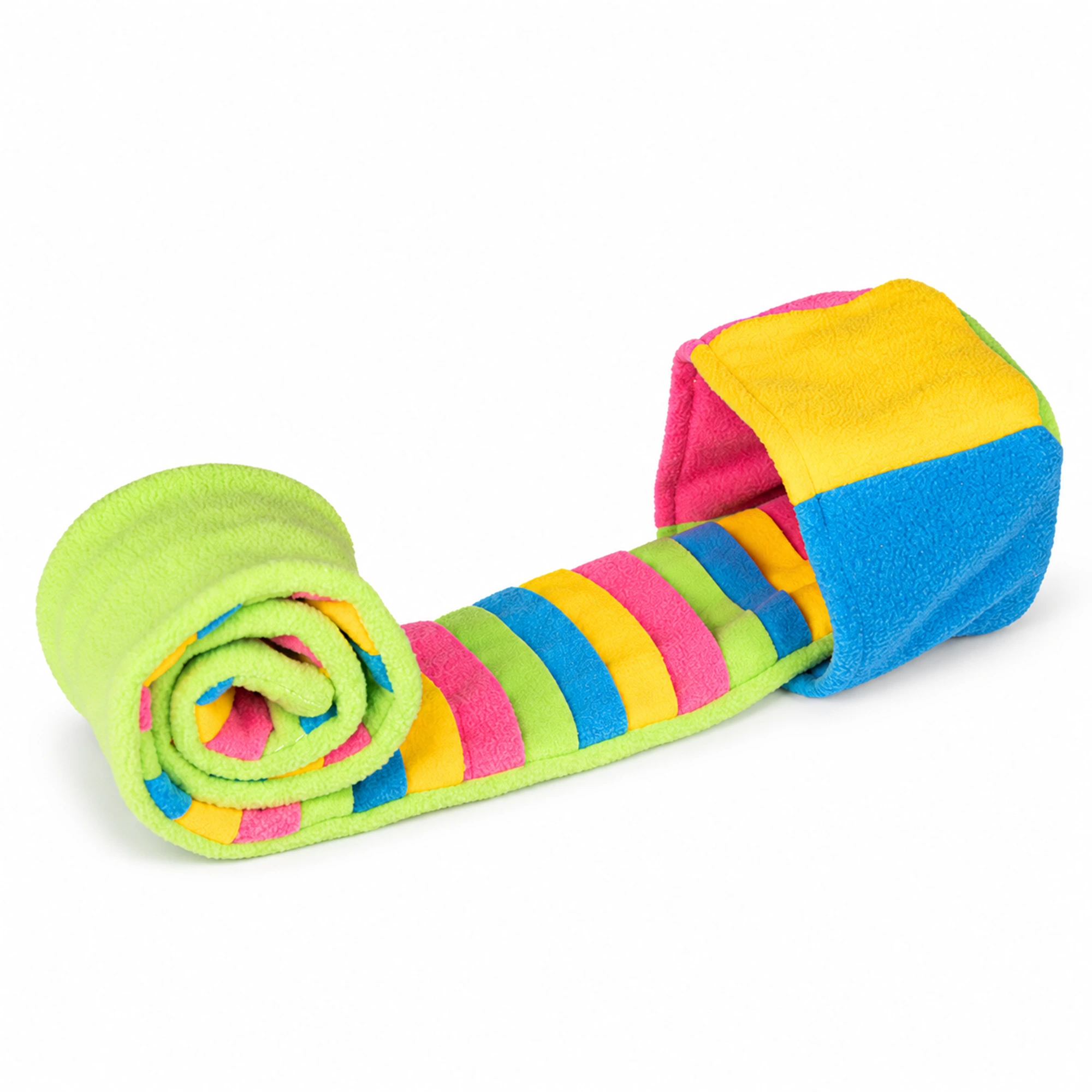
With the Small Rainbow Roll-Up Foraging Bowl, you unroll the colorful cloth trail, place a few dry treats between the real fabric bands, and roll the connected strip back into its soft fleece bowl. Because the entire structure is made of soft cloth and fleece, it produces zero clicking or scraping noise on the floor.
To introduce a fabric foraging bowl to a dog that gives up easily, use a three-stage unrolled setup during supervised play:
- Session 1 starts with a flat open trail. Lay the colorful cloth trail completely unrolled outside the soft fleece bowl, and place high-value dry treats on top of the fabric bands where your dog can see and eat them without moving any cloth.
- Session 2 uses loosely tucked bands. Keep the cloth trail unrolled on the floor, and tuck small dry treats halfway under the sewn fabric bands so your dog only needs to brush its nose against the soft band to dislodge the food.
- Session 3 moves to a half-rolled bowl. Roll the connected strip halfway back into the soft fleece bowl, leaving the top loop loose and pre-baited with two visible treats on the rim. As your dog eats the top treats, its muzzle naturally pushes the lime-green cloth roll outward, unspooling the trail and exposing the next hidden morsel.
The Guaranteed-Win Scaffolding Protocol for Slider Puzzles
Once your dog actively searches through soft fabric folds for five continuous minutes without walking away, they are ready to learn how to train a dog to use a puzzle toy with moving plastic parts. Mechanical scaffolding makes a composite board approachable by opening most of the barriers so the toy works like an open tray on day one.
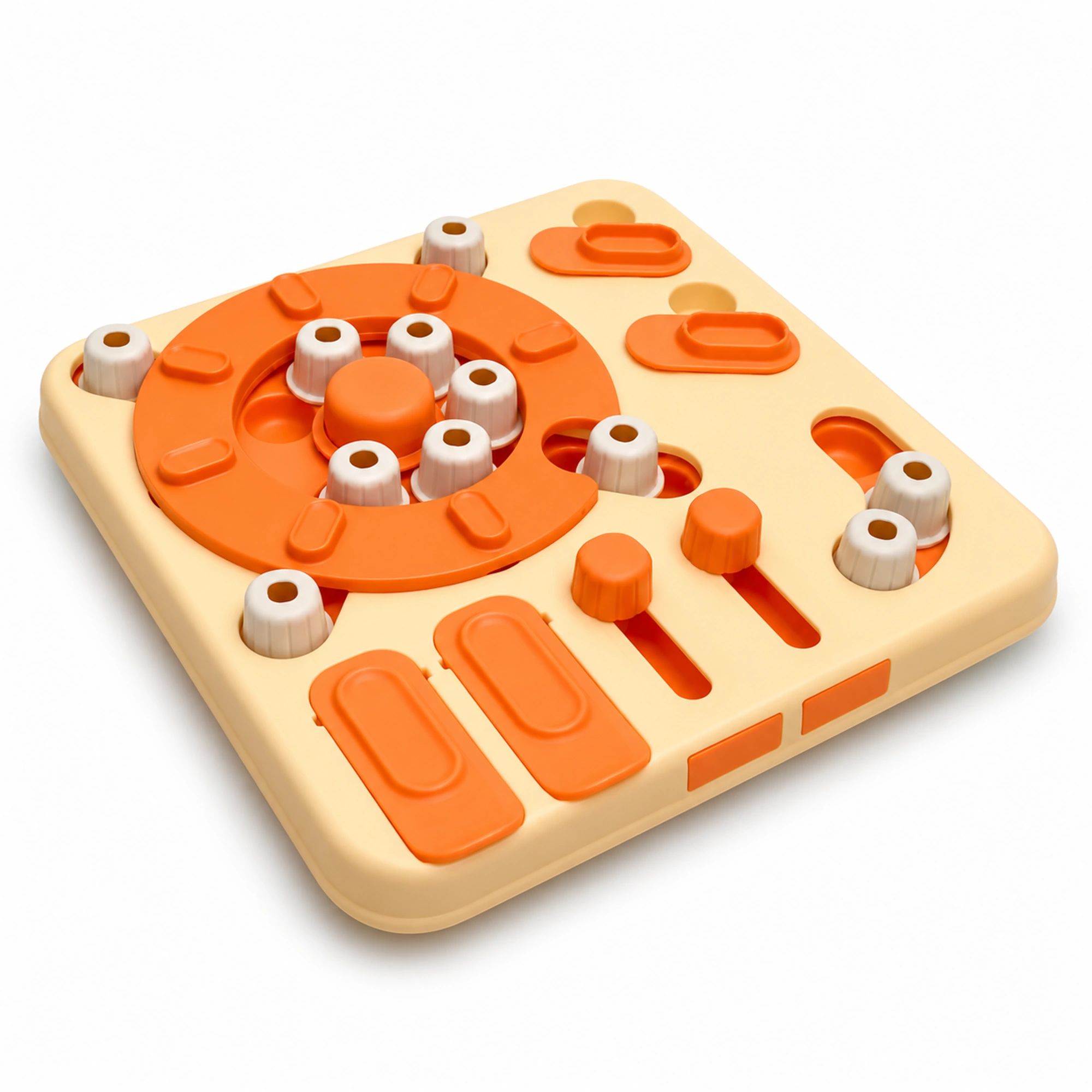
The Orange Turn, Slide & Lift Treat Puzzle features a rotating ring, sliding drawer handles, hinged lift-up covers and swivelling oval covers on one square treat puzzle. While those four distinct mechanisms provide rich mental work for an experienced dog, presenting all four closed at once will stall a hesitant beginner.
Use this guaranteed-win scaffolding sequence to introduce the board without frustration:
| Training Phase | Compartment Setup | Treat Placement | Target Canine Action |
|---|---|---|---|
| Phase 1: Surface Association | All sliding drawer handles pulled 100% open; hinged lift-up covers flipped open | Treats placed inside open wells AND scattered on flat board surface | Eating calmly off the plastic surface without startle |
| Phase 2: The 80% Open Slider | Sliding drawer handles pushed 20% over the well (leaving 80% of the treat visible) | High-aroma dry treats wedged right against the inner rim of the slider | Accidental nose nudge moves the handle slightly while eating |
| Phase 3: Single Swivel Cover | Swivelling oval covers rotated halfway over the recess | One treat on top of the oval cover, two treats underneath | Nose push pivots the loose oval cover horizontally |
| Phase 4: Hinged Lift & Ring | Hinged lift-up covers resting loosely over larger treats that prop the lid slightly ajar | Crunchy treat sticking out from under the hinged lip | Muzzle scoop flips the hinged cover upward |
Always place a hard puzzle board on a non-slip rug or rubber mat before calling your dog over. Preventing the square board from skidding across tile floors gives timid dogs stable footing and predictable leverage when they push a slider handle.
Prompting Traps: When Owner Help Accidentally Causes Disengagement
Many compassionate dog owners accidentally train their dogs to quit puzzles by stepping in too quickly. When a dog pauses for four seconds and looks up at its owner, the human instinct is to point at a compartment, tap the plastic slider with a fingernail, or pull the drawer open for the dog.
Opening the compartment keeps the dog eating in that moment, yet repeated human rescues teach the dog that staring at a person unlocks food faster than nosing the toy. Within three sessions, the dog stops investigating the puzzle board altogether, barks or whines at the owner after eating the easy surface treats, and walks away if the owner stops pointing.
To help a stuck dog without creating owner dependency, follow three silent adjustment habits:
- Wait ten seconds in silence when your dog looks up at you. Keep your hands calm and look directly at the puzzle board without making eye contact or talking, as dogs often return to sniffing once they realize no verbal instruction is coming.
- Reset compartments between rounds while your dog is looking away. If your dog genuinely cannot open a compartment and turns aside, quietly slide two covers 80 percent open to lower the difficulty and let them rediscover the easy win independently.
- Rub a piece of freeze-dried liver or dry sausage along the edge of a swivelling oval cover or fabric band before the session starts. Scent trails direct your dog’s nose to the exact contact point without human hand gestures.
If your dog has the opposite problem and gulps food frantically or slams paws onto the board, our guide on dog food puzzles for fast eaters covers how to pace high-drive eaters safely.
The 7-Day Confidence Progression Plan
Building lasting persistence takes short, daily repetitions that end while your dog still wants more. Follow this seven-day schedule to transition a hesitant dog from immediate quitting to independent foraging:
- Days 1 and 2 focus on zero-barrier scent success. Conduct two 3-minute supervised sessions per day using the Small Rainbow Roll-Up Foraging Bowl with the cloth trail completely unrolled on the floor so every sniff yields an immediate dry treat.
- Days 3 and 4 introduce gentle unrolling motion. Roll the cloth trail loosely into the soft fleece bowl so your dog learns to nudge fabric folds apart with its snout. End each session the moment the last treat is eaten and pick the bowl up immediately.
- Days 5 and 6 bring in the open composite board. Introduce the Orange Turn, Slide & Lift Treat Puzzle on a non-slip surface with all sliding drawer handles, hinged lift-up covers, and swivelling oval covers propped 80 percent open, leaving the central rotating ring open so every well is accessible.
- Day 7 tests the first closed swivel and slider compartments. Close two swivelling oval covers and two sliding drawer handles completely while leaving the remaining compartments half open. Mixing instant rewards with mild barriers keeps motivation high while encouraging persistent nose work.
Remember that puzzle toys should always be introduced under human supervision to prevent chewing on fabric bands or plastic handles. Never withhold your dog’s regular daily nutrition to force them into solving a difficult puzzle; use a small portion of their daily kibble mixed with aromatic dry treats so enrichment stays a low-pressure game.
Frequently Asked Questions
Why does my dog stare at me and whine instead of solving the puzzle toy?
Staring and whining happen when the initial barrier is too difficult or when an owner has previously opened compartments in response to the dog’s frustration. As seen in community reports on Reddit r/PetAdvice from u/mosesbabu0101, pets easily abandon puzzle feeders after a few minutes when barriers feel overwhelming. Lower the mechanical difficulty immediately by propping sliders mostly open so your dog earns rewards through independent sniffing.
How do silent fabric snuffle bowls help dogs that get scared of plastic toys?
Soft fabric feeders eliminate the sharp clicking, scraping, and skidding noises that hard plastic toys make on bare floors. With the Small Rainbow Roll-Up Foraging Bowl, you unroll the colorful cloth trail, place dry treats between the real fabric bands, and roll the strip into its soft fleece bowl, allowing sound-sensitive dogs to forage silently at their own pace.
How can I make a multi-piece composite slider puzzle easier for a beginner dog?
You can simplify the Orange Turn, Slide & Lift Treat Puzzle by pulling its sliding drawer handles 80 percent open, propping the hinged lift-up covers ajar with larger dry treats, and leaving the swivelling oval covers and rotating ring unlocked during the first week of supervised sessions.
How long should an initial puzzle training session last to avoid frustration?
Keep initial puzzle sessions between three and five minutes, stopping while your dog is still actively engaged and succeeding. Picking up the foraging bowl or puzzle board immediately after the final treat is eaten prevents boredom-induced pawing or chewing and preserves high enthusiasm for the next session.